
The Mishima Incident: A Balcony Appeal for Constitutional Change and the Trial of Three Tatenokai Members
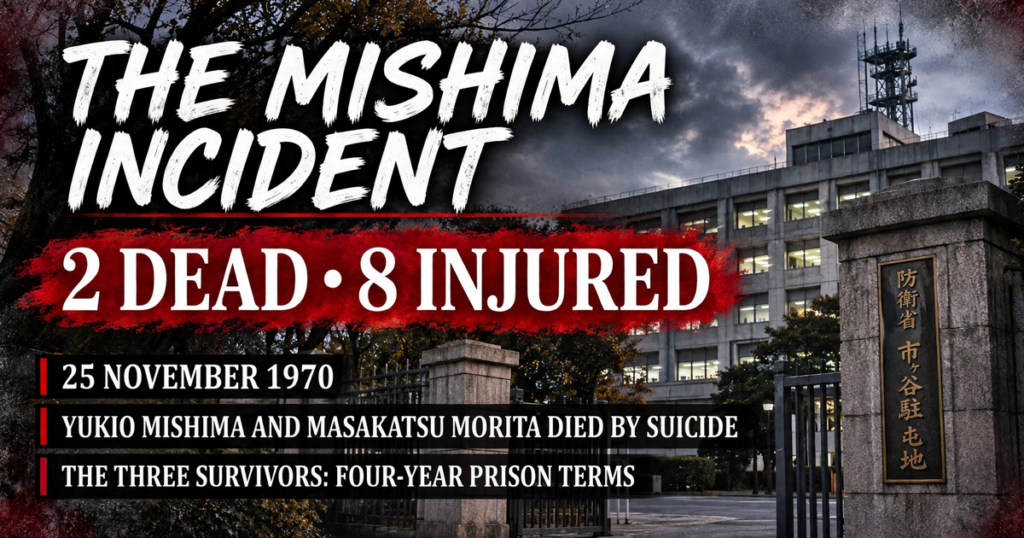
On 25 November 1970, Yukio Mishima and four Tatenokai members seized the office of the Japan Ground Self-Defense Force's Eastern Army commander at Camp Ichigaya. Mishima called for constitutional change from a balcony; he and Masakatsu Morita later died by suicide. Eight personnel were injured, and the three surviving members received four-year prison sentences in 1972.
Introduction: The Incident at Camp Ichigaya
On 25 November 1970, novelist Yukio Mishima entered the Japan Ground Self-Defense Force's Camp Ichigaya in Tokyo with four members of the Tatenokai, a nationalist association he had founded. The group restrained the commander of the Eastern Army and demanded that troops assemble to hear Mishima speak. From a balcony outside the commander's office, he called for constitutional change and action by the Self-Defense Forces. Mishima and fellow member Masakatsu Morita later died by suicide inside the office. Eight Self-Defense Force personnel were injured, and the three surviving members were arrested.
The incident is also known as the Tatenokai Incident. It did not change Japan's constitution or bring about the uprising Mishima sought.
Mishima's military training and political objective
Mishima had developed close ties with the Self-Defense Forces before 1970. From 12 April to 27 May 1967, he completed 46 days of experience-based training with the Ground Self-Defense Force, using his birth name, Kimitake Hiraoka. He later encouraged students to take part in similar training.
His political objective was to revise Japan's post-war constitutional framework, particularly Article 9, and establish the Self-Defense Forces as a formal national military. In October 1968, he formally established the Tatenokai, often translated as the Shield Society, bringing together students who had taken part in Self-Defense Force training. Mishima served as its leader. On the day of the incident, the four members with him were Masakatsu Morita (25), Masayoshi Koga (22), Masahiro Ogawa (22) and Hiroyasu Koga (23).
A prearranged meeting and the seizure of the commander's office
The group arrived at Camp Ichigaya at about 11 a.m. The meeting had been booked on 21 November, and guards had been told to expect the visitors. They were escorted to the office of Lieutenant General Kanetoshi Masuda, the 57-year-old commander of the Eastern Army. Mishima gave the appraisal of a famous sword, Seki Magoroku, as the stated reason for the meeting.
At about 11:05 a.m., following a signal from Mishima, Masayoshi Koga moved behind Masuda and covered his mouth. Ogawa and Hiroyasu Koga tied the commander to a chair with rope, while Morita barricaded three entrances with desks and chairs. Staff officers entered after noticing the disturbance, and a struggle followed. Swords, wooden swords and special batons were used; eight Self-Defense Force personnel were injured. One officer required treatment expected to last 12 weeks and was left with reduced grip strength in his left hand. The source article does not establish that Masuda suffered a serious injury.
The demands and the balcony speech
The group presented a written demand calling for all personnel at Camp Ichigaya to assemble by 11:30 a.m. and listen to Mishima. It also asked that other Tatenokai members be brought from the Ichigaya Hall. The document demanded that no attack or interference occur until 1:10 p.m. and promised Masuda's safe release after two hours if the conditions were met. It also threatened that Mishima would kill the commander and die himself if the demands were rejected.
Senior officers agreed to assemble the troops. At about 11:34 a.m., Colonel Hidenobu Yoshimatsu told Mishima that personnel would be gathered. However, around 30 Tatenokai members elsewhere at the base were kept inside the hall and did not join the gathering.
At around noon, Mishima appeared on the balcony wearing a headband bearing the words “Shichō Hōkoku.” An estimated 800 to 1,000 personnel were below. For about ten minutes, he called for constitutional revision, the removal of Article 9 and action by the Self-Defense Forces. Copies of his manifesto, the “Geki,” were distributed. He spoke without a microphone or loudspeaker. Helicopters and heckling made most of his words difficult to hear. The troops had assembled, but they did not listen in silence, and no uprising followed.
The commander was released and three men were arrested
Mishima and Morita returned to the office at about 12:10 p.m. Mishima told Masuda that the action was not motivated by a personal grudge against him. Mishima and Morita then died by suicide in the room. The method is not described here in graphic detail.
Shortly after 12:20 p.m., Koga and Hiroyasu Koga escorted Masuda out and handed him to Yoshimatsu. The commander was freed. The three surviving participants—Masayoshi Koga, Masahiro Ogawa and Hiroyasu Koga—were arrested at the scene. Mishima and Morita had died and were not prosecuted.
That morning, Mishima had also delivered the final chapter of “The Decay of the Angel,” the last volume of his novel sequence “The Sea of Fertility,” to his editor at Shinchosha. The date printed at the end of the book was 25 November 1970. The Tatenokai formally dissolved on 28 February 1971. The Eastern Army headquarters later moved to Camp Asaka in 1994; the Ichigaya site is now part of the Ministry of Defense complex.
The trial of the three surviving members
The three arrested members were indicted on charges including unlawful confinement resulting in injury, offences under the Act on Punishment of Physical Violence and Other Acts, causing bodily injury, coercion in the performance of official duties and homicide upon request. The charge relating to the deaths of Mishima and Morita was homicide upon request: the offence of killing a person at that person's request or with that person's consent. It was not a charge of assisting suicide, and the indictment did not include the separate offence of murder.
The first hearing was held at the Tokyo District Court on 23 March 1971, and the three defendants were released on bail on 7 July. At the final hearing, the eighteenth session, on 27 April 1972, the court sentenced each man to four years' imprisonment. They did not appeal, so the sentences became final. They were released in October 1974 before the full terms had expired.
The outcome applied to the three surviving defendants. Neither Mishima nor Morita was tried, because both had died during the incident.
Government reaction and the later remembrance
Defense Agency Director-General Yasuhiro Nakasone publicly called the action deeply regrettable, and Prime Minister Eisaku Sato also condemned it. On 24 January 1971, a funeral and memorial service for Mishima and Morita were held at Tsukiji Honganji in Tokyo; more than 8,200 members of the public were reported to have attended. The Tatenokai held its dissolution ceremony on 28 February 1971, about three months after its formal action at Ichigaya. A shrine dedicated to Mishima and Morita was later established at Tsurumi Shrine in Yokohama in November 2010. These later commemorations did not alter the legal outcome of the case.
At a glance
Incident: Mishima Incident, also called the Tatenokai Incident. Date: 25 November 1970. Location: Camp Ichigaya, Eastern Army headquarters, Shinjuku, Tokyo. Participants: Yukio Mishima and four Tatenokai members. Commander restrained: Lieutenant General Kanetoshi Masuda. Casualties: Mishima and Morita died; eight Self-Defense Force personnel were injured. Three surviving members were arrested. On 27 April 1972, each received a four-year prison sentence; none appealed, and the sentences became final.
Original Japanese record: 三島事件|憲法改正を訴えたバルコニー演説と楯の会3人への実刑判決
Last updated:
Related articles
Case record
The Yodo-go Hijacking: Red Army Faction Seizes Japan Airlines Flight 351 and Diverts It to North Korea
Case record
The Mitsubishi Heavy Industries Bombing and the East Asia Anti-Japan Armed Front's Corporate Bombing Campaign
Case record
The Assassination of Inejiro Asanuma: Political Violence at a Public Election Meeting
Case record