
The Okawara Koki Case: An Export-Control Prosecution Withdrawn After an Unlawful Investigation
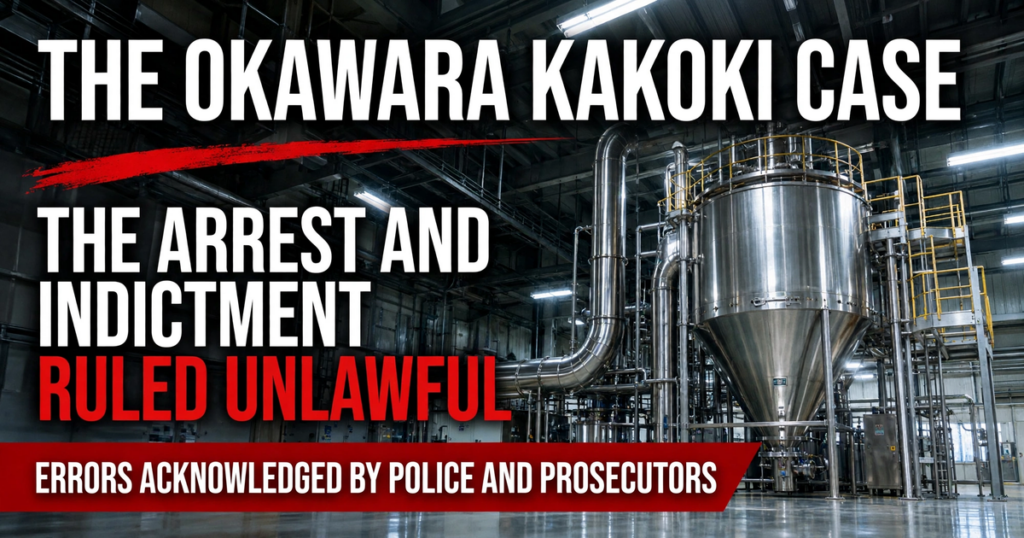
Executives of Okawara Koki, a machinery manufacturer, were arrested in 2020 over alleged unlawful exports of equipment said to be capable of military use. The prosecution was later withdrawn after the death of a detained former adviser and a reassessment of the technical evidence. In 2025, the Tokyo High Court upheld findings that key parts of the police investigation and prosecution were unlawful and ordered the state and Tokyo Metropolitan Government to pay damages. The civil judgment became final; it was not a criminal acquittal after trial.
A machinery company became the subject of an export-control investigation
Okawara Koki, a machinery manufacturer based in Yokohama, became the focus of a criminal investigation over equipment that police and prosecutors believed could be used for military purposes. The case concerned whether spray-drying machinery exported by the company fell within technical controls under Japan's Foreign Exchange and Foreign Trade Act. That law regulates exports of certain goods and technologies when they could contribute to weapons development or other security-sensitive uses. The central issue was not simply whether the company had exported machinery, but whether the equipment met the legal and technical criteria for a controlled item.
Company executives were arrested in March 2020
On March 11, 2020, police arrested the company president, a former director and a former adviser on suspicion of violating export-control rules. The investigation concerned shipments to China and South Korea. The authorities alleged that the equipment was subject to restrictions and had been exported without the required permission. The company denied that the machinery met the relevant technical definition. The arrests and detention placed the executives and the company under intense pressure while the technical question was still contested.
The dispute centred on how the machinery worked
The equipment at issue was a spray dryer. The prosecution theory depended on whether the machine could sterilize or disinfect material inside it while the equipment was stationary, a technical capability relevant to the applicable export-control classification. The company argued that the machinery did not meet that criterion. This was not a minor detail: if the machine fell outside the controlled category, the alleged export violation would lack its essential legal foundation. The case therefore required investigators to understand the actual operation of the equipment rather than rely only on a broad description of its potential use.
A detained former adviser died before the prosecution was withdrawn
The former adviser, Aijima, died on February 7, 2021, while in detention. He was 72 and had been suffering from stomach cancer. His death brought the human consequences of prolonged detention into sharp focus. The remaining defendants continued to contest the allegations. Prosecutors later reassessed the case after doubts emerged about the technical interpretation and the handling of evidence. The death of a detained suspect is distinct from a conviction or acquittal, and the case must not be described as though Aijima had received a judicial determination of guilt.
The prosecution was withdrawn in 2021
On July 30, 2021, prosecutors withdrew the indictment against the remaining defendants. The Tokyo District Court dismissed the prosecution on August 2, 2021. The withdrawal meant that the criminal case ended without a trial judgment deciding guilt or innocence on the merits. It is therefore inaccurate to say that the defendants were acquitted after a full criminal trial. The decision nevertheless ended the prosecution and followed a serious reassessment of whether the machinery was legally controlled and whether the evidence supported the original accusation.
The company and its executives brought a state-compensation action
The company and the affected individuals sought compensation from the state and Tokyo Metropolitan Government, arguing that the police investigation and prosecution had been unlawful. In December 2023, the Tokyo District Court ordered the defendants in the civil action to pay approximately 162 million yen. The plaintiffs and the government side appealed. The civil case examined the conduct of the police and prosecutors, including how they interpreted the export-control criteria, handled technical information and prepared statements. It was separate from the withdrawn criminal prosecution.
The Tokyo High Court found major parts of the investigation unlawful
On May 28, 2025, the Tokyo High Court upheld the finding that significant parts of the investigation and prosecution were unlawful and increased the compensation to approximately 166 million yen. The court criticised the authorities for proceeding without adequately reconsidering whether the machinery met the legal definition of a controlled item. It also examined statements that had been prepared in a form that did not accurately reflect the speaker's meaning. The court found fault in the police investigation and in prosecutorial decisions, while assessing each challenged act on its own legal basis. The ruling was carefully limited: the police arrests and specified interrogation acts were unlawful; the first case's prosecution was also unlawful; and the second case's detention request and prosecution were unlawful. The prosecutors' detention request in the first case, however, was not itself found unlawful. The judgment did not declare every stage of both cases illegal.
The civil judgment became final in 2025
The state and Tokyo Metropolitan Government did not pursue a further appeal from the May 28, 2025 High Court judgment. The civil judgment therefore became final. This is the final legal status of the damages action. It is important to keep three events separate: the 2021 withdrawal of the criminal indictment, the 2023 and 2025 civil judgments finding unlawful conduct, and the later institutional reviews. The damages judgment did not itself create a criminal acquittal, but it did establish civil liability for unlawful conduct by public authorities.
The Supreme Public Prosecutors Office and police reviewed the case
On August 7, 2025, the Supreme Public Prosecutors Office published a review of the prosecution's handling of the case, and the Metropolitan Police Department also released a review of the investigation. The reviews addressed failures in the interpretation of the technical requirements and the treatment of evidence that could have undermined the suspicion. The term negative evidence is important here: evidence that points away from guilt must be assessed alongside evidence that supports an allegation. A fair investigation cannot focus only on material that appears to confirm the initial theory. In February 2026, three former senior Metropolitan Police Department officials paid a total of 5.28 million yen to Tokyo as an internal reimbursement of part of the compensation the government had paid. This was a recourse claim by the metropolitan government, not additional damages paid to the company.
The case raised broader questions about expert evidence and detention
The case shows why export-control investigations require independent technical expertise and careful testing of both incriminating and exculpatory evidence. The civil judgment identified specific unlawful acts and failures to assess evidence; it did not establish improper motives on the part of every official.
The final record must distinguish legal outcomes
The criminal indictment was withdrawn before trial. A separate civil judgment later found specified unlawful conduct and ordered compensation, followed by institutional reviews in August 2025. These outcomes must not be described as an acquittal after a full criminal trial or as proof that every official acted maliciously.
A separate lawsuit over judicial detention decisions began in 2026
On April 6, 2026, The former adviser's wife and children filed a separate damages action against the state, alleging that judges had acted unlawfully by approving detention and repeatedly rejecting bail requests. The claim sought approximately 168 million yen and named 37 judges whose decisions were said to be involved. The state contested the claim at the first hearing on June 29, 2026. As of August 27, 2026, the lawsuit remained pending and no final finding had been made. It must be kept separate from the final civil judgment concerning police and prosecutorial conduct.
Original Japanese record: 大川原化工機事件|逮捕・起訴の違法確定と、警察・検察の検証が認めた「消極証拠」の見落とし
Last updated:
Related articles
Case record
The Yokkaichi Jusco Wrongful Arrest Death: A False Theft Suspicion, Police Restraint and a Civil Judgment
Case record
The PC Remote-Access Case: Four Wrongful Arrests, a Malware Investigation and an Eight-Year Sentence
Case record
The Himi Case: A Wrongful Conviction, a Prosecutor's Retrial Request and an Acquittal
Case record