
The PC Remote-Access Case: Four Wrongful Arrests, a Malware Investigation and an Eight-Year Sentence
Between June and September 2012, threatening messages were sent from computers that had been remotely controlled by malware. Four men were wrongly arrested after police traced the communications to their devices. The actual operator was Yusuke Katayama, who initially denied the charges but admitted them after a new email sent while he was on bail exposed his actions. On February 4, 2015, the Tokyo District Court sentenced him to eight years in prison.
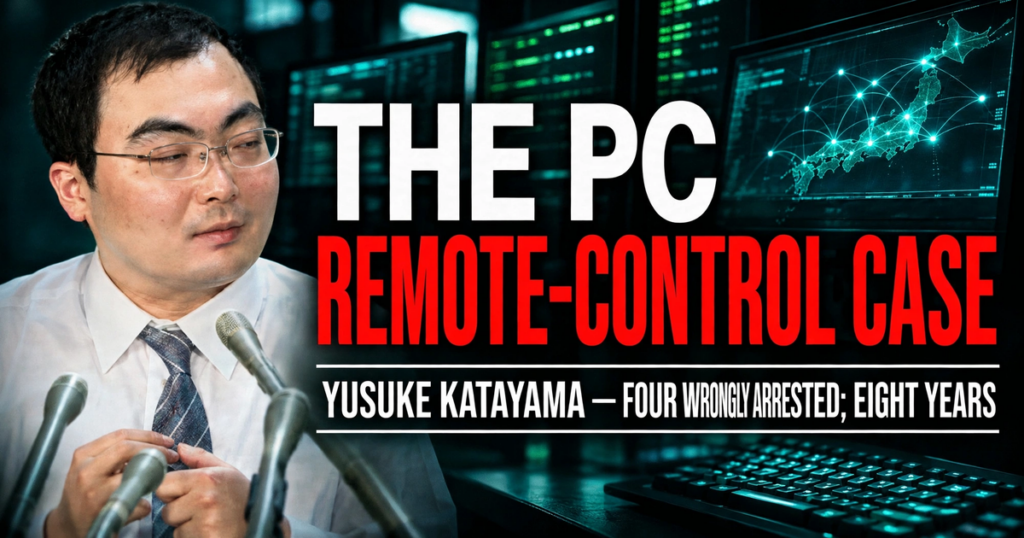
Threatening messages were sent from computers controlled by someone else
Between June and September 2012, a series of threatening messages and crime warnings appeared on the internet. The posts included threats involving a kindergarten and other public targets. The communications appeared to have come from particular computers, but the people who owned those devices had not necessarily written or sent the messages. The computers had been infected with malicious software that allowed a third party to operate them remotely. The distinction between the device that transmitted a message and the person who controlled it became the central issue in the investigation.
Four men were arrested in different prefectures
Police in Kanagawa, Osaka, Tokyo and Mie arrested four men on suspicion of involvement in the threats and related offences, including obstruction of business. The arrests were based in significant part on the communication information associated with the computers used to send the messages. The four men were not responsible for the postings. Subsequent investigation established that their computers had been remotely controlled by a third party. The arrests therefore became a major example of how digital evidence can point investigators toward a device without identifying the person who actually operated it.
The mistaken arrests affected people beyond the moment of detention
Being wrongly arrested did not simply mean spending time in custody and then being released. Each man was treated as a suspect in a serious public threat, questioned by investigators and placed under suspicion in circumstances that could affect family life, work and social reputation. The police later acknowledged that the four men had not been involved and apologised. The incident raised questions about how investigators assessed statements made during questioning and whether they had given sufficient weight to the possibility that a computer could be controlled remotely without its owner's knowledge.
The investigation had to separate the computer from the person using it
The case exposed a basic limitation in interpreting internet communication records. An IP address or a record showing that a particular computer sent data can identify a route through which a message travelled. It does not, by itself, establish who was sitting at the keyboard or who controlled the machine. Malware can allow a remote operator to use another person's computer without the owner's awareness. Investigators therefore need to combine network records with device analysis, evidence about access and control, and the suspect's actual conduct. The remote-access case showed the danger of treating the location of a device as proof of the identity of its operator.
Yusuke Katayama was identified as the person behind the programme
The investigation eventually focused on Yusuke Katayama. Police concluded that he had used a malicious programme to control other people's computers and send the threatening messages. The programme allowed the postings to appear as though they originated from the devices of unrelated users. Katayama was arrested in February 2013 and prosecuted for offences including forcible obstruction of business. The case involved multiple incidents and a number of threatening messages, rather than a single isolated post. The prosecution had to establish his role in the programme and connect him to the individual acts charged.
Katayama initially denied the charges at trial
At his first court hearing in February 2014, Katayama pleaded not guilty and denied being responsible for the offences. The trial examined the malicious programme, the communication records and the evidence linking him to the computers and messages. A denial by a defendant is not proof of innocence, just as an accusation is not proof of guilt. The court had to assess the evidence as a whole. At that stage, the case remained contested, and the prosecution's task was to establish who had operated the remote-control system and sent the threats.
An email sent while Katayama was on bail changed the case
In May 2014, while Katayama was on bail, a new email claiming to come from the real perpetrator was sent to people connected with the case. Investigators traced the sending process and identified evidence linking it to Katayama. The smartphone used in connection with the message became an important part of the investigation. Faced with this evidence, Katayama changed his position and admitted the charges at a court hearing on May 22, 2014. He apologised to the people who had been wrongly arrested and to others affected by the case. The attempt to create another false trail instead provided evidence that undermined his denial.
The Tokyo District Court imposed eight years in prison
On February 4, 2015, the Tokyo District Court sentenced Katayama to eight years in prison. The prosecution had sought ten years. The court considered the scale of the threats, the disruption caused to public institutions and the fact that four unrelated people had been arrested as a result of the conduct. It also considered the attempt to create a false account while Katayama was on bail. The judgment treated the case as more than a series of online messages: the use of remote access had caused real consequences for people whose computers were misused and for the police investigation.
The police review was a separate part of the case
The conviction of Katayama did not automatically repair the harm suffered by the four wrongly arrested men. The National Police Agency reviewed the investigation and instructed police organisations to improve their knowledge of cybercrime and to evaluate digital evidence in combination with other information. The agency's 2013 White Paper described how the four men had been arrested before investigators established that their computers were remotely controlled. The review highlighted the need to consider alternative explanations for a device's activity rather than assuming that the owner was the person who sent a message.
The case remains a warning about digital attribution and wrongful arrest
The established sequence is that threats were sent between June and September 2012 from computers controlled by malicious software; four unrelated men were arrested; investigators later identified Katayama as the operator; and the Tokyo District Court imposed eight years in prison on February 4, 2015. The case also exposed failures in the way the initial investigation interpreted digital evidence. A computer's connection to a message is not the same as proof of the owner's involvement. Reliable cybercrime investigations must establish both the technical path and the identity of the person who actually controlled it.
Original Japanese record: パソコン遠隔操作事件|無関係の4人が逮捕された捜査と片山祐輔の懲役8年
Last updated:
Related articles

Case record
The Okawara Koki Case: An Export-Control Prosecution Withdrawn After an Unlawful Investigation

Case record
The Kabutoyama Case: A Nursery Teacher's 21-Year Trial and Three Acquittals

Case record
The Shiori Ito Civil Sexual-Assault Litigation

Case record