
The Yokkaichi Jusco Wrongful Arrest Death: A False Theft Suspicion, Police Restraint and a Civil Judgment
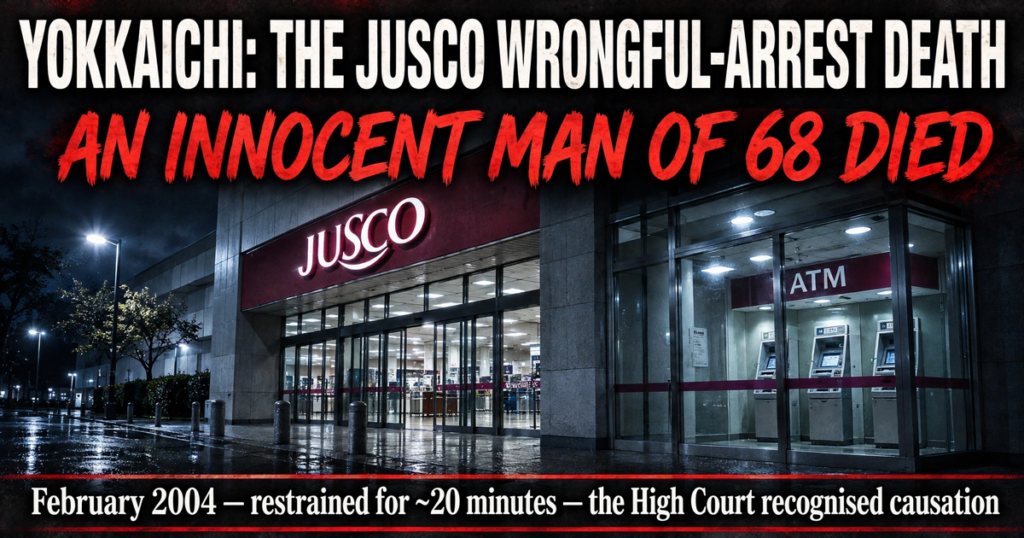
On February 17, 2004, a 68-year-old man was accused of stealing a wallet at the ATM area of the Jusco Yokkaichi Obira store in Mie Prefecture. A woman shouted that he was a thief, and shoppers restrained him before handing him to officers from Yokkaichi-Minami Police Station. During the ensuing police restraint, an officer held him down for about twenty minutes. The man vomited, lost consciousness and died in hospital early the next day. Prosecutors later established that the wallet involved belonged to the man and that the theft suspicion had no basis. In a separate civil action, the Tsu District Court found the restraint unlawful but initially rejected causation; the Nagoya High Court later recognised a causal link and ordered Mie Prefecture to pay approximately 36.44 million yen. This was a civil judgment against the prefecture, not a criminal conviction of an individual officer.
A theft accusation began at an ATM corner
On February 17, 2004, a 68-year-old man from Yokkaichi was at an ATM corner inside the Jusco Yokkaichi Obira store in Obira-cho, Mie Prefecture. A woman holding a child called him a thief. The man and the woman became involved in a dispute, and nearby shoppers restrained him before handing him to police officers from Yokkaichi-Minami Police Station. At the point when the man was first restrained, there had been no confirmation that he had stolen anything. The accusation was the starting point of the incident, not a fact established by a criminal court.
The police restraint lasted about twenty minutes
After police officers arrived, the man was held down on the floor. The later Nagoya High Court judgment, as reported at the time, found that a police officer's restraint continued for about twenty minutes and that strong pressure was applied to the man's chest and abdomen. The officer was described as weighing approximately 94 kilograms. The man vomited while being restrained and then lost consciousness. He was taken to hospital and died the following day. The incident took place during the initial police restraint at the store; it was not a death after a lengthy stay in a police detention cell.
The woman left the scene and was never identified
The woman who called the man a thief left while he was being restrained by police. In February 2005, Mie Prefectural Police released security-camera images of the woman and sought information from the public. Her identity was not established. The later Japanese case article stresses that the man's lack of involvement in theft and the woman's intent are separate questions. The fact that the man was innocent does not by itself prove that the woman knowingly made a false accusation. No criminal judgment established her motive or guilt, and the reason for the initial accusation remains unresolved.
Prosecutors later recognised that the man had not attempted theft
The man had been treated as a suspect in attempted theft, but the Tsu District Public Prosecutors Office later determined that he had not been involved in the suspected offence. The family received suspect compensation of 12,500 yen, reported as the maximum daily amount for one day. This payment related to the fact that the man had been treated as a suspect despite not having committed the alleged theft. It was separate from the family's civil damages claim over the restraint and his death. There was no ordinary criminal trial in which the deceased man could receive a court acquittal.
His wife sued Mie Prefecture in February 2007
On February 1, 2007, the man's wife filed a civil damages action against Mie Prefecture in the Tsu District Court. She sought more than 57.17 million yen, arguing that the wrongful suspicion and unlawful police restraint had caused her husband's death. The case did not simply ask whether the original theft accusation was mistaken. It required the court to examine the officers' conduct after they took control of the man: whether the degree and duration of force were necessary, whether the restraint exceeded lawful limits and whether that conduct had a legally sufficient connection to the death.
The Tsu District Court found the restraint unlawful but rejected causation
On November 18, 2010, the Tsu District Court ordered Mie Prefecture to pay 8.8 million yen. It found that the police restraint had exceeded the necessary and reasonable limits and was therefore unlawful. However, it did not find that the restraint had been proved to cause the man's death. The first-instance court considered the stress of the earlier struggle with the woman and shoppers and the later stress of police restraint, and concluded that the causal contribution to the death could not be sufficiently separated. The 8.8-million-yen award was not the final result, because both sides challenged aspects of the judgment.
The Nagoya High Court recognised a causal link on 9 September 2011
On September 9, 2011, the Nagoya High Court changed the district court's conclusion on causation. It treated the shoppers' restraint as lasting about five minutes and the police restraint as continuing for about twenty minutes. The court considered the pressure applied by an officer weighing approximately 94 kilograms to the man's chest and abdomen, and concluded that the stress caused by the police restraint was substantially greater than that of the earlier restraint by shoppers. It found a causal connection between the police restraint and the man's death and increased the damages award to approximately 36.4 million yen.
Mie Prefecture's assembly recorded the payment and the need for an apology
The Mie Prefectural Assembly's September 27, 2011 committee minutes recorded that the prefecture's supplementary budget included 50,349,000 yen for the damages and delay interest arising from the High Court judgment. That total was not the same as the approximately 36.4-million-yen damages award itself; it included delay interest. The committee also called on the prefecture to make its apology to the victim and his family clear and to take responsibility for preventing a recurrence. The official minutes provide a primary record of the prefecture's post-judgment response.
The civil judgment did not convict an individual officer or the unidentified woman
The legal issues in this case must be kept separate. The prosecutors' determination that the man had not committed attempted theft concerned the original suspicion. The civil courts examined whether the police restraint was unlawful and whether it caused the death. The Tsu District Court found unlawful restraint but rejected causation; the Nagoya High Court recognised causation and increased the damages award. These were civil findings against Mie Prefecture. They were not a criminal conviction of the officer who applied the restraint. Nor did the civil judgment establish criminal guilt on the part of the unidentified woman who called the man a thief. The record supports a wrongful suspicion, unlawful police restraint and a civil finding of causation, but not those additional criminal conclusions.
Original Japanese record: 四日市ジャスコ誤認逮捕死亡事件|無実認定と20分の制圧、高裁が死亡との因果関係を認定
Last updated:
Related articles
Case record
The Okawara Koki Case: An Export-Control Prosecution Withdrawn After an Unlawful Investigation

Case record
The Shibushi Case: A Failed Vote-Buying Allegation, Twelve Acquittals and an Unlawful Investigation
Case record
The Nabari Poisoned Wine Case: Five Deaths, a Reversed Acquittal and the Eleventh Posthumous Retrial Request
Case record