
The Ookayama–Senju Serial Murders: A Confession-Led Indictment, Then Two Other Men
Three people were found murdered in Ookayama in September 1925. Tamiya confessed and was indicted, but he died during the pretrial examination in January 1928 before a public trial could test the confession. After three more people were killed in Senju in 1928, Gomi and Tanaka were linked to both cases, convicted and sentenced to death. Tamiya was never acquitted by a court, but neither was he tried.
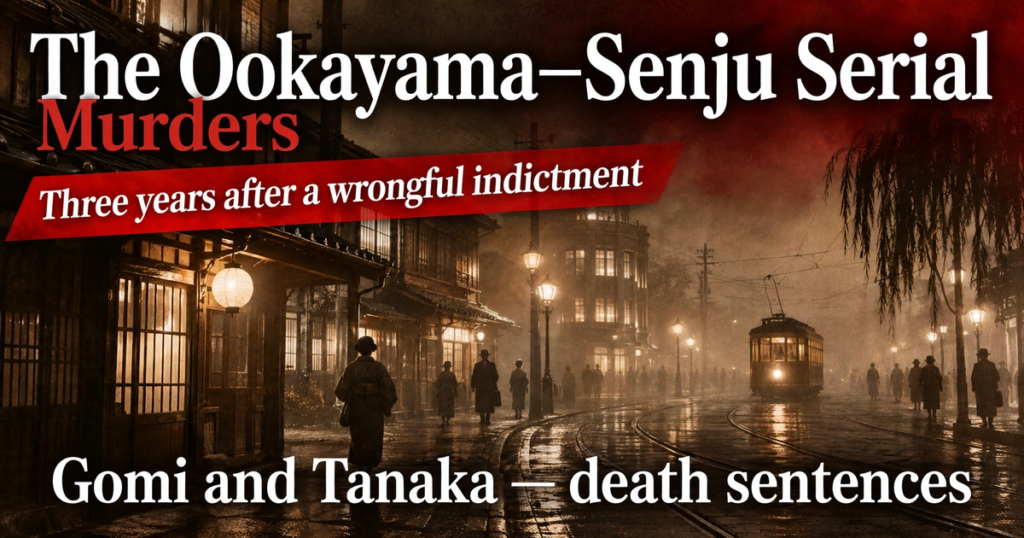
Three people were found dead in a home in Ookayama
In September 1925, three people were found dead at a residence in Ookayama, then part of Hifumura in Ebara District, Tokyo Prefecture, and now within Meguro Ward, Tokyo. The victims were Nakayama, Shimizu and a nine-year-old girl adopted by the actress in the household. Early newspaper reports were confused about the victims' identities and relationships. Because the bodies were found in a room arranged in a way that initially suggested a possible poisoning or suicide, the first reports did not immediately describe the event as a straightforward robbery-murder. The investigation later concluded that the three had been strangled.
A missing bankbook and a witness description shaped the early investigation
Investigators found that a bankbook had disappeared and that money had been withdrawn shortly after the deaths. A bank employee described a man who came to withdraw the money with a bandage or eye covering over one eye. The police pursued several possible leads, but the case lacked strong physical evidence. Newspaper reports sometimes named people who were only under suspicion, and the public account shifted as new information emerged. The early uncertainty matters because the later prosecution of Tamiya depended heavily on his confession, while the objective evidence did not clearly establish that he had been in the house.
Tamiya confessed and was indicted despite the lack of physical evidence
In the autumn of 1926, Tamiya came to police attention in connection with a separate fraud complaint. Investigators questioned him about the Ookayama deaths, and he eventually made a statement admitting that he had entered the home to commit robbery. He was indicted for robbery-murder in October 1926. Contemporary newspaper coverage noted that the confession had not been supported by clear physical exhibits. The police nevertheless regarded the statement as consistent with the scene and used a reconstruction to test its details. A photograph showing Tamiya wearing an eye covering was also circulated, reflecting the bank employee's description of the man who had withdrawn the money.
The pretrial examination delayed the case from reaching a public trial
Under the criminal procedure then in force, an indictment did not lead directly to the kind of public trial familiar today. A preliminary judicial examination, known as a pretrial inquiry, could be conducted before a case was sent to a public hearing. Tamiya's case remained in that stage for a prolonged period. The lack of physical evidence and questions about whether one person could have carried out all three killings were among the issues later discussed in historical accounts. Tamiya's defence was therefore never tested in a full public trial where the confession could be examined through the modern adversarial process.
Tamiya died in custody before the case reached trial
Tamiya became seriously ill with kidney tuberculosis while in custody. He died on 27 January 1928, during the preliminary examination. Some later accounts report that he had told his lawyer he intended to retract the confession at trial, but no public trial occurred and his intended testimony cannot be established as a court record. The important legal point is that Tamiya did not receive an acquittal. His case ended because he died before the proceedings reached a judgment. It is equally inaccurate to describe him as a convicted murderer: no court delivered a guilty verdict against him for the Ookayama killings.
A second three-person killing occurred in Senju in 1928
In August 1928, three people were killed in Senju: a soy-sauce merchant, his wife and their 16-year-old employee. The early investigation was confused, including an initial mix-up over the identities of bodies found in a house and in a river channel. A postcard written by Yamada on the day of the crime helped investigators trace a former tenant and debtor, Gomi. Gomi had lost his job and was in financial difficulty. He involved Tanaka, and the two men were arrested by the end of August.
Evidence from Senju led investigators back to the earlier Ookayama case
Gomi and Tanaka admitted involvement in the Senju murders. Investigators then connected them to the 1925 Ookayama case. Gomi had previously been linked to the Nakayama family through his wife, who was related to one of the victims. Items believed to have been stolen from the Ookayama home were also found in connection with the later investigation. The evidence was materially different from the case against Tamiya, which had rested heavily on a confession and lacked comparable physical support. The discovery of other suspects did not automatically resolve the procedural position of Tamiya, who had already died.
Gomi and Tanaka were tried, sentenced to death and executed
Gomi and Tanaka were prosecuted for the Senju murders and later for the earlier Ookayama killings. On 20 April 1931, the Tokyo District Court sentenced both men to death. Their cases proceeded through the appellate process, and both death sentences became final. They were executed on 7 March 1933. The judgments established their criminal responsibility for the murders. The later convictions of Gomi and Tanaka made the earlier accusation against Tamiya appear gravely mistaken, but they did not produce a formal posthumous acquittal for him.
The distinction between an erroneous accusation and an acquittal matters
Tamiya's story is often described as a wrongful-conviction case, but technically he was indicted and died before a public trial or judgment. A court did not find him not guilty, and no retrial could be held after his death. The more precise description is that he was accused and indicted on the strength of a confession, then died during the preliminary examination; later, two other men were convicted of the same Ookayama murders. The case illustrates the danger of treating a confession as conclusive when it lacks independent support. It also shows why the legal stages of accusation, indictment, trial and acquittal must not be collapsed into one another.
Original Japanese record: 大岡山・千住連続殺人事件|自白で起訴された田宮頼太郎と、3年後に現れた五味銕雄・田中藤太
Last updated:
Related articles
Case record
The TEPCO Employee Murder: An Acquittal, a Reversed Conviction and DNA Evidence That Led to a Retrial
Case record
The Fukawa Case: Two Men Exonerated After 44 Years
Case record
The Kodaira Murders: Ten Murder Charges, Seven Convictions and a Postwar Pattern of Predation
Case record