
The Schindler Elevator Death: An Open-Door Movement, a Teenager's Death and Acquittals on Appeal
On June 3, 2006, 16-year-old high-school student Daisuke Ichikawa was killed at City Heights Takeshiba in Tokyo's Minato Ward when an elevator began moving upward while its doors were open. The investigation focused on the brake system and the maintenance arrangements shared by Schindler Elevator and the service contractor SEC. The Tokyo District Court initially convicted three SEC managers, but the Tokyo High Court overturned those convictions in March 2018. By the end of the appeals, every surviving defendant had been acquitted. The result did not deny that the accident occurred; it reflected the prosecution's failure to prove individual criminal negligence beyond reasonable doubt.
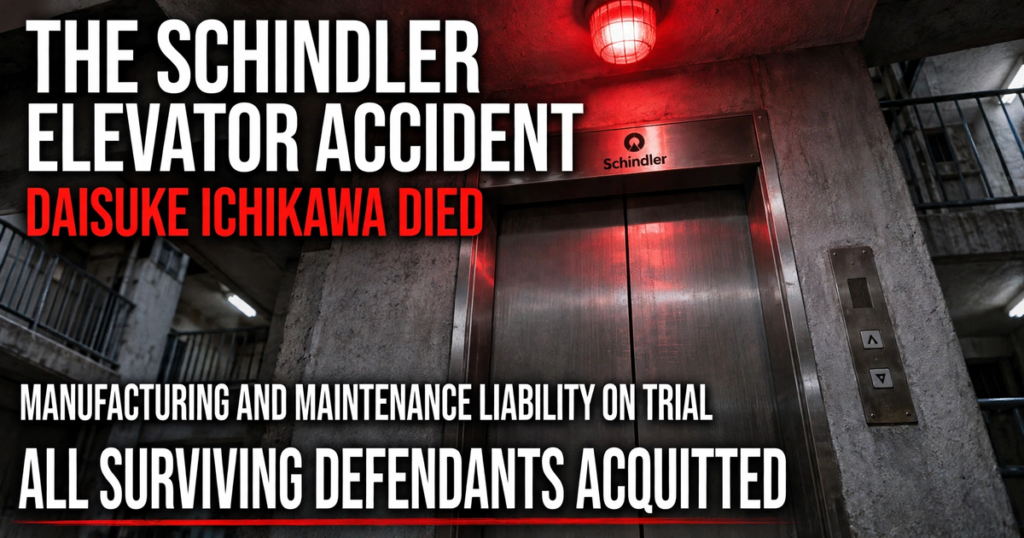
A 16-year-old student was trapped as the elevator moved with its doors open
On June 3, 2006, 16-year-old high-school student Daisuke Ichikawa was using an elevator at City Heights Takeshiba, a residential building in Minato Ward, Tokyo. He was travelling with a bicycle. When the elevator stopped and its doors opened, he began to leave the car. The car then moved upward while the doors remained open, trapping him between the floor of the elevator car and the entrance frame. He died from the injuries. The event became one of Japan's most closely examined elevator accidents because the basic safety expectation that an elevator should not move with its doors open had failed.
The accident involved an open-door movement and a brake problem
The Minato Ward investigation identified inadequate brake holding force as central to the accident. The brake was supposed to hold the elevator car in place when it stopped at a floor. If the braking system could not hold the car, it could move even though the doors were open. Investigators examined the condition of brake components, wear and adjustment, and the work performed by maintenance contractors. The technical explanation of how the elevator moved was not the same as proof that a particular person had committed a crime. Criminal responsibility required proof about what a defendant could have known at a specific inspection date.
Schindler and SEC had different roles in the equipment's history
Schindler Elevator was the manufacturer and had been responsible for maintenance at an earlier stage. SEC Elevator later handled maintenance. Prosecutors examined a former Schindler maintenance supervisor and three people associated with SEC, including its former president and managers. The case required the court to examine the chain of responsibility for an elevator that had been installed years earlier and whose maintenance arrangements had changed. It was not enough to say that one company manufactured the equipment or another company serviced it; the prosecution had to show which defendant had a concrete duty and failed to perform it.
The criminal trial began years after the accident
The defendants were charged with professional negligence resulting in death. The investigation and technical examination took years, and the trial did not begin until 2013. A major issue was whether abnormal wear in the brake lining had already developed by the time of the inspection nine days before the accident. If the wear had been present and detectable, the maintenance staff might have been able to prevent the fatal movement. If the prosecution could not prove that the defect existed at the relevant time, it could not establish the required negligence merely by showing that the elevator later failed.
The Tokyo District Court reached different conclusions for the two companies
On September 29, 2015, the Tokyo District Court acquitted the Schindler maintenance supervisor but convicted three SEC managers. The SEC defendants received prison terms ranging from one year and two months to one year and six months, all suspended for three years. The court's reasoning treated the maintenance system and the inspection work as deficient. The split result reflected the different duties and evidence relating to each defendant. It did not establish that every person involved in the elevator's history was criminally responsible.
The Tokyo High Court overturned the SEC convictions in March 2018
The SEC defendants and the prosecution appealed. On March 14, 2018, the Tokyo High Court overturned the convictions of the three SEC managers and acquitted them. The court found that the evidence did not establish beyond reasonable doubt that the abnormal brake-lining wear had already existed at the inspection nine days before the accident. Without proof of that critical fact, the prosecution could not establish that the defendants should have detected the condition and prevented the death. The Schindler-side acquittal was also maintained by the High Court in January 2018, and the prosecution did not appeal that result.
The acquittals did not mean that no accident or mechanical failure occurred
The final criminal outcome was that all surviving defendants were acquitted. One defendant died during the proceedings, and the case against him ended through dismissal. The acquittals did not mean that Ichikawa had not been killed or that the elevator had not moved with its doors open. They meant that the prosecution had not proved the individual criminal negligence charged against the defendants to the required standard. This distinction is important in cases involving complex equipment: a technical cause can be identified even when the evidence does not support a criminal conviction of a particular maintenance worker or manager.
The accident led to changes in elevator-safety requirements
The government reviewed elevator safety after the accident. Measures included stronger requirements for protection against unintended car movement while doors were open and additional braking safeguards for new installations. The Ministry of Land, Infrastructure, Transport and Tourism describes the 2006 death as a trigger for a wider review of elevator safety. The regulatory response addressed system design and prevention, while the criminal case addressed the conduct of named individuals. Those are separate questions, and the fact that criminal charges ended in acquittals does not remove the need for improved engineering safeguards.
The case remains a lesson in proof and maintenance accountability
The Schindler accident exposed the danger of an elevator moving with its doors open and the difficulty of assigning responsibility when equipment has passed through several manufacturers, owners and maintenance contractors. A safe system needs reliable brakes, suitable inspection procedures, clear records and staff who understand the equipment they maintain. A criminal court must nevertheless decide each defendant's liability on the evidence, not on the seriousness of the outcome alone. The final acquittals should therefore be reported accurately alongside the fatal accident, the technical findings and the safety reforms that followed.
Original Japanese record: シンドラーエレベーター死亡事故|市川大輔さん死亡、製造・保守責任をめぐり存命被告は全員無罪
Last updated:
Related articles
Case record
Fukushima Daiichi and the Criminal Trial of TEPCO's Former Executives: Two Final Acquittals and a Separate Shareholder Lawsuit
Case record
The Fukushima Prefectural Ono Hospital Case: A Maternal Death, a Doctor's Prosecution and a Final Acquittal
Case record
The Kabukicho Building Fire: Forty-Four Deaths, an Unidentified Fire-Setter and the Failure of Fire Management
Case record