
The Fukushima Prefectural Ono Hospital Case: A Maternal Death, a Doctor's Prosecution and a Final Acquittal
On December 17, 2004, a 29-year-old woman died after a caesarean section at Fukushima Prefectural Ono Hospital. The operation involved total placenta previa and an adherent placenta, followed by severe bleeding. The obstetrician, Katsuhiko Kato, was arrested in February 2006 and indicted for professional negligence causing death and failure to report the death under Article 21 of the Medical Practitioners Act. The Fukushima District Court acquitted him of both charges on August 20, 2008. Prosecutors did not appeal, and the acquittal became final on September 4, 2008.
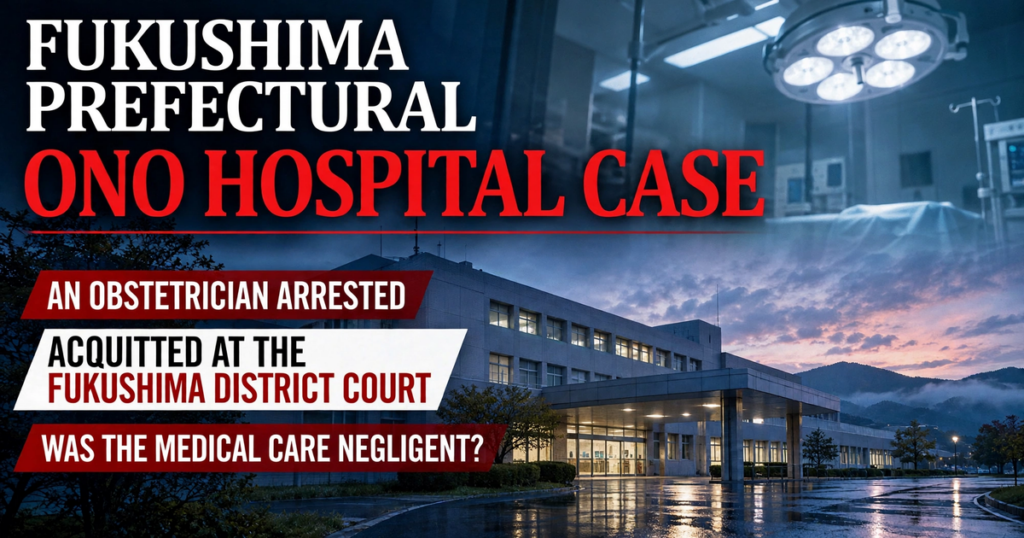
A 29-year-old patient died during an obstetric emergency
On December 17, 2004, a 29-year-old woman died after a caesarean section at Fukushima Prefectural Ono Hospital. Before the operation, she had been diagnosed with total placenta previa and had a history of one previous caesarean section. During surgery, the placenta did not separate normally from the uterine wall, and placenta accreta became a central concern. Severe bleeding followed. The medical team administered blood products and performed a hysterectomy, but the patient died. The case became a major national debate because the obstetrician was later arrested and prosecuted for decisions made during a high-risk operation.
The prosecution focused on the decision to continue placental separation
The indictment alleged that the obstetrician, Katsuhiko Kato, continued attempting to detach the placenta after recognising that it was adherent to the uterus and that continuing could cause massive bleeding. Prosecutors argued that he should have stopped the separation and moved to hysterectomy earlier. A second allegation concerned his failure to report the patient's death to the police within 24 hours, as required by Article 21 of the Medical Practitioners Act in the circumstances alleged by the prosecution. The case therefore involved both clinical judgment and a statutory reporting duty.
The doctor was arrested more than a year after the patient's death
Kato was arrested on February 18, 2006, while working at the hospital. He was indicted on March 10, 2006, for professional negligence causing death and violation of Article 21 of the Medical Practitioners Act. The arrest of a practising physician in a medical-accident case provoked strong concern among obstetricians and other medical professionals. Medical associations questioned whether criminal prosecution was an appropriate way to evaluate a complex treatment decision made under emergency conditions.
The clinical timeline mattered to the legal analysis
The case was not simply about whether the patient had died or whether severe bleeding had occurred. The court examined what information was available before and during the operation, when the adherent placenta was recognised, what treatment options were medically available at each stage and whether the doctor's actions departed from the standard of care that could reasonably be expected at the time. The Japanese Medical Association's later case study records the clinical sequence, including the start of surgery, delivery, blood loss, transfusion and the eventual decision to perform a hysterectomy.
The first charge required proof of a specific duty and causal link
For professional negligence causing death, the prosecution had to prove more than a tragic outcome. It had to establish that Kato had a specific duty to stop the placental separation at a particular point, that he failed to meet that duty and that the failure caused the patient's death. The defence challenged whether the clinical findings at the time made it clear that placental separation should have been stopped. The trial examined the limits of hindsight in evaluating an emergency operation.
The second charge concerned the statutory duty to report a death
The indictment also alleged that Kato had failed to report the death to the police within 24 hours under Article 21 of the Medical Practitioners Act. This allegation was separate from the question of whether his surgical decisions amounted to negligence. The prosecution relied on the statutory reporting obligation and the circumstances following the death, including the post-mortem findings. The court had to decide whether the legal conditions for the reporting offence were satisfied. The final acquittal covered this charge as well as the professional-negligence allegation.
The Fukushima District Court acquitted Kato on August 20, 2008
After a series of hearings, the Fukushima District Court delivered its judgment on August 20, 2008, and acquitted Kato of both charges. The court did not find that the patient's death had not occurred or that the operation had been free of medical difficulty. It concluded that the prosecution had not proved the criminal offences alleged. The distinction is essential: the acquittal was a judicial determination that the evidence did not establish criminal liability under the charges, not a general finding that every aspect of the medical care was beyond criticism.
The prosecution did not appeal, and the acquittal became final
The Fukushima District Public Prosecutors Office did not appeal the acquittal. The judgment became final on September 4, 2008. There was therefore no High Court or Supreme Court judgment reviewing the merits of the case. The final procedural status is a first-instance acquittal that became final because prosecutors chose not to appeal. It should not be described as an appellate acquittal or as a decision by the Supreme Court.
The case changed the debate about medical accidents and criminal law
The prosecution had a major effect on obstetric services and on discussion of medical safety in Japan. Some hospitals and doctors feared that a difficult clinical outcome could expose them to criminal arrest even when medical judgment was complex and evolving. The case contributed to debate about how medical accidents should be investigated, how experts should assess clinical decisions and how patient safety systems can learn from deaths without automatically treating them as crimes. Those wider debates are important, but they do not alter the precise legal result: Kato was acquitted of both charges, and that acquittal became final in September 2008.
Original Japanese record: 福島県立大野病院事件|帝王切開中の死亡で産婦人科医を逮捕、福島地裁が過失を否定し無罪
Last updated:
Related articles
Case record
Fukushima Daiichi and the Criminal Trial of TEPCO's Former Executives: Two Final Acquittals and a Separate Shareholder Lawsuit
Case record
The JR Fukuchiyama Line Derailment: 107 Dead, 562 Injured and the Questions of Speed, Safety Systems and Corporate Oversight
Case record
The Schindler Elevator Death: An Open-Door Movement, a Teenager's Death and Acquittals on Appeal
Case record