
The 1999 Tomei Expressway Drunk-Driving Crash: Two Young Sisters Killed and a Four-Year Sentence
On November 28, 1999, a drunk truck driver rear-ended a family car returning from a trip to Hakone. The two young daughters, aged three and one, died in the resulting fire, while their parents survived with injuries. The driver received four years for professional negligence causing death and injury. The case became part of the public pressure that preceded the 2001 creation of the dangerous-driving offence.
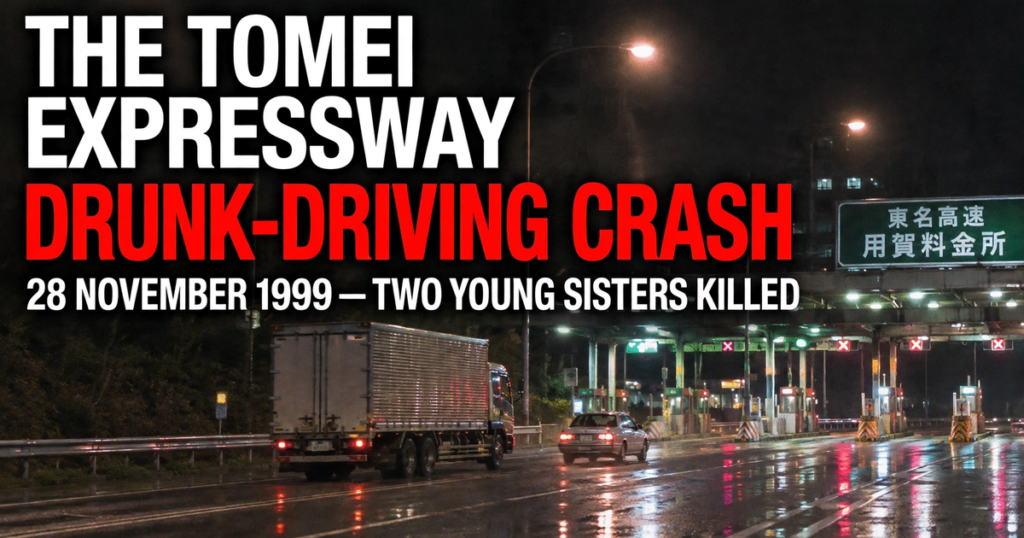
A family returning from Hakone was struck by a drunk truck driver
On November 28, 1999, a family of four was travelling home after a trip to Hakone when a large truck struck their passenger car from behind on the Tomei Expressway. The truck driver had been drinking and was in an intoxicated condition. The impact caused a fire in the family vehicle. The two young daughters, one aged three and the other one, died in the fire. Their parents survived, but both were injured; the father suffered serious burns that left lasting effects. The crash turned an ordinary family journey into a fatal incident and became a prominent example in the debate over the punishment of drunk driving.
The two children were trapped in the burning vehicle
The victims were two sisters who were still at the beginning of childhood. They were travelling with their parents after a family outing and were seated in the car when the truck struck from behind. The resulting fire made escape impossible for the children. The parents survived but were left with severe physical and emotional injuries. The official Fukuoka Prefectural Police review of major drunk-driving cases later quoted the court's description of the two girls' deaths and the profound impact on their parents. The record should not reduce the case to a statistic of two fatalities: it involved the loss of both children in a single family and long-term consequences for the surviving parents.
The driver had consumed alcohol before continuing to operate a heavy vehicle
The truck driver had been drinking before the collision. The Japanese source article describes him as heavily intoxicated, and contemporary reporting examined the circumstances of his drinking and driving before the crash. A heavy truck carries substantial momentum, and the risk of a rear-end collision is magnified when the driver cannot maintain attention or react appropriately. The legal proceedings treated the event under the law that existed in 1999. It is important not to apply a later offence retrospectively simply because the conduct would now be considered under a more severe statutory framework.
The prosecution proceeded under the law then in force
At the time of the crash, Japan did not yet have the modern offence of dangerous driving causing death or injury. The driver was prosecuted for professional negligence resulting in death and injury, together with the relevant traffic offences. That legal classification reflected the statutory framework available in 1999. It did not mean that the court regarded the loss of the two children as minor. Rather, the prosecution and the court were constrained by the offences and sentencing ranges then in force.
The Tokyo District Court imposed four years in prison
In June 2000, the Tokyo District Court sentenced the driver to four years' imprisonment. The prosecution considered the sentence too lenient and appealed. The judgment was widely discussed because two children had died after a driver chose to operate a truck while intoxicated. Families affected by drunk-driving crashes questioned whether the existing law provided a punishment proportionate to the harm. The four-year sentence became a focal point in public debate about whether negligence-based offences were sufficient for conduct involving extremely dangerous intoxication and driving.
The Tokyo High Court upheld the sentence in January 2001
In January 2001, the Tokyo High Court dismissed the prosecution's appeal and maintained the four-year sentence. The prosecution did not take the matter further, and the sentence became final. The appeal history matters: the four years were not simply the result of a district-court judgment that was later increased or overturned. The High Court left the sentence in place under the law applicable to the 1999 offence. The final sentence must be described as a conviction for professional negligence causing death and injury, not as a conviction under the later dangerous-driving offence.
The 2001 dangerous-driving offence did not apply retroactively
Japan created the offence of dangerous driving causing death or injury through a 2001 amendment to the Penal Code. The reform responded to concerns that existing negligence offences did not adequately address highly dangerous driving, including serious cases involving alcohol. The new offence was not applied retrospectively to the 1999 Tomei crash. The driver was sentenced under the earlier law, and the later statute belongs to the legal history of the case rather than its conviction. This distinction is essential when comparing the four-year sentence with penalties imposed in later drunk-driving cases.
The family's advocacy became part of the wider campaign against drunk driving
The surviving father, Yasutaka Inoue, continued to speak publicly about the deaths of his daughters and the effects of the crash. The family joined a wider movement of bereaved relatives who sought stronger legal measures against drunk driving. Their efforts included remembrance and public education as well as calls for legal reform. The 2001 amendment did not arise from one accident alone; it followed pressure from multiple families and a broader debate about the inadequacy of existing penalties. The Tomei case was one of the prominent incidents that helped make the problem visible.
The legal history must be separated from the later social impact
The established legal sequence is clear: the crash occurred on November 28, 1999; two sisters aged three and one died; the driver was convicted under the law then in force; the Tokyo District Court imposed four years in June 2000; and the Tokyo High Court dismissed the prosecution appeal in January 2001. The dangerous-driving offence was created later and was not used in this case. The family's public work continued beyond the end of the criminal proceedings. Remembering the children and understanding the limits of the law at the time are both necessary to describe the incident accurately.
Original Japanese record: 東名高速飲酒運転事故|幼い姉妹2人の死と懲役4年、危険運転処罰を変えた声
Last updated:
Related articles
Case record
The Tomei Expressway Road-Rage Deaths: Why Kazuho Ishibashi Was Convicted of Dangerous Driving Causing Death or Injury Without Hitting the Victims
Case record
The Ikebukuro Runaway-Car Crash: Two Deaths, a Five-Year Sentence and the Driver's Death in Custody
Case record
The Kabukicho Building Fire: Forty-Four Deaths, an Unidentified Fire-Setter and the Failure of Fire Management
Case record