
The Sankebetsu Brown Bear Attack: Six Days of Attacks in a Hokkaido Settlement
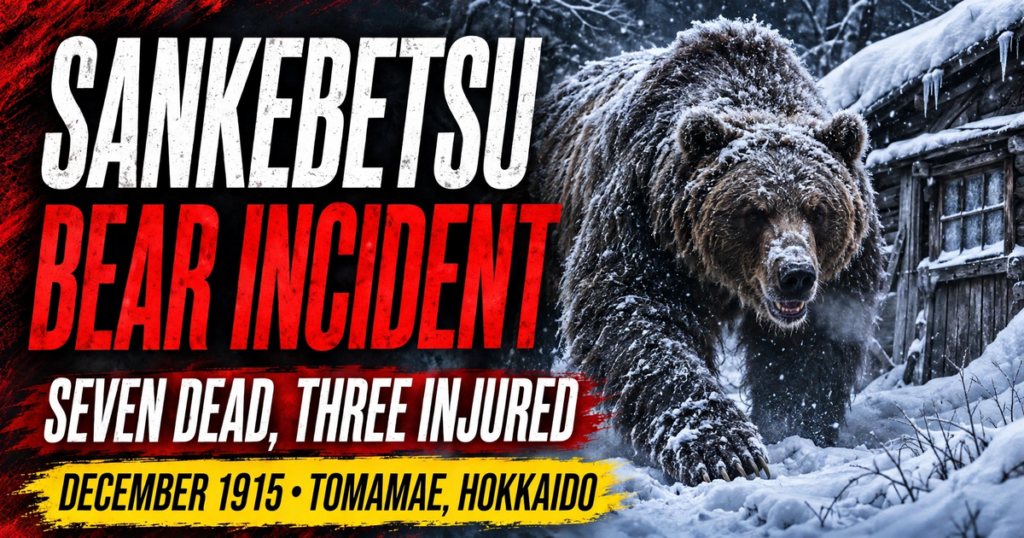
Between December 9 and 14, 1915, a brown bear repeatedly entered homes in the Sankebetsu settlement in Hokkaido. The official summary is seven deaths and three injuries; some later accounts count eight deaths when a child who died years later is included.
A series of attacks in a remote Hokkaido settlement
Between December 9 and 14, 1915, a large brown bear repeatedly entered homes in the Rokusensawa settlement of Sankebetsu, then part of Tomamae Village in Hokkaido. The area is now within Tomamae Town. The Hokkaido Regional Forest Office of the Forestry Agency describes the bear as weighing approximately 340 kilograms and the incident as the largest wildlife attack in Japan's recorded history. The commonly cited immediate tally is seven deaths and three injuries. The detailed chronology familiar today relies heavily on interviews collected decades after the event, so contemporary records and later reconstructions must be kept distinct.
The bear had appeared around farms before the first fatal attack
Accounts collected later by Moritake Kimura describe a large bear appearing around farms in the settlement during November 1915 and damaging stored corn. Residents sought help from hunters and tried to track the animal, but it was not killed. These earlier sightings are important to the history of the incident, although many details about individual encounters and the exact timing come from later interviews rather than a continuous official log written in 1915.
The first fatal attack occurred at the Ota household on December 9
The first fatal attack took place at the Ota household on December 9. According to Kimura's reconstruction, thirty-four-year-old Mayu Abe and six-year-old Mikio Hasumi were attacked. Hasumi died in the house, while Abe was carried away by the bear and found during the search the following day. The bear did not leave the surrounding settlement after this attack. On December 10, residents organized searches for Abe and attempted to track the animal.
The bear returned to the Ota home during the wake
On the evening of December 10, a wake was held at the Ota home for the victims. Kimura's account, considered alongside later examination of contemporary newspaper reports, places another appearance by the bear at approximately 8:30 p.m. People at the house fled, and no additional injuries were recorded during that visit. The bear then moved downstream toward the Myokei household, where women and children had gathered. The attack at that house caused the largest group of casualties in the incident.
The Myokei household suffered further deaths and injuries
Kimura's account records the deaths of thirty-four-year-old Take Saito, three-year-old Kinzo Myokei, three-year-old Haruyoshi Saito and six-year-old Iwao Saito. Saito was pregnant, and the unborn child also died. The injured included Yayo Myokei, Umekichi Myokei and Yokichi Nagamatsu. The official summary of seven deaths and three injuries is the clearest standard figure for the immediate incident. Graphic details of the injuries are not needed to understand the scale of the loss or the sequence of the attacks.
Why some sources report seven deaths and others eight
The difference between seven and eight deaths is a matter of counting criteria, not evidence of two separate incidents. The widely used seven-death total includes the unborn child of Saito, in addition to the six people who died during the attacks. Some accounts also include Umekichi Myokei, who had been injured and died approximately two years and eight months later. When that later death is counted as a consequence of the attack, the total becomes eight. The Forestry Agency's public summary describes ten people killed or injured but does not itself specify the seven-versus-eight death-count convention.
The date of the Myokei attack differs between later accounts and early reporting
The chronology generally followed in Kimura's research and the Tomamae town history places the Myokei household attack on the night of December 10, after the wake at the Ota home. An early report in the Hokkai Times, however, described the second attack as occurring on December 11. A 2026 review of contemporary newspaper material highlighted this one-day discrepancy. The December 10 date is the standard reconstruction, but the discrepancy should not be hidden when explaining how the historical account was assembled.
Residents evacuated and a large hunting party was organized
After the Myokei attack, residents left Rokusensawa and took shelter in nearby locations, including a school. The bear continued to appear around unoccupied homes. Later accounts describe a large response involving police, hunters, local residents and military personnel. The force is often estimated at approximately 600 people in total over several days, including about thirty soldiers, with roughly sixty firearms and more than ten hunting dogs. The exact details of the deployment are based largely on later interviews, but the scale of the response is consistent across several later accounts.
The bear was killed on December 14
The bear was tracked in the mountains and is said to have been shot by hunter Heikichi Yamamoto on the morning of December 14, six days after the first fatal attack. A later account places the killing at approximately 10 a.m. The Forestry Agency gives the animal's weight as about 340 kilograms. Other measurements and descriptions vary among sources and should not be combined into a single supposedly exact set of dimensions.
The documentary record and the limits of later reconstructions
The incident was reported in newspapers in December 1915, including Hokkai Times headlines referring to the bear and the casualties. Those early reports did not always agree on the number of people killed or injured. The detailed account became widely known through Kimura, a forestry official who began interviewing survivors, relatives and members of the hunting party about half a century later. His work is indispensable, but the names, household arrangements, timings and actions of individual participants often come from retrospective testimony rather than contemporary official records. Claims that the bear had attacked people in other districts or that it had a particular behavioral history should be treated as separate hypotheses unless independently corroborated.
The reconstructed site remains within bear habitat
A reconstruction site has been established in present-day Tomamae Town, with buildings and displays illustrating the settlement. It is a memorial and educational site, not a preserved original crime scene. The town warns that brown bears may still occur in the surrounding area. The incident is best understood as a historical wildlife disaster involving a remote settlement, human land use and a dangerous animal—not as a criminal case or a supernatural legend.
Original Japanese record: 三毛別羆事件|太田家・明景家を襲った6日間と「死者7人/8人」表記の違い
Last updated:
Related articles

Case record
The Snow Brand Milk Poisoning Outbreak: A Power Failure, Heat-Stable Toxin and Two Different Patient Counts
Case record
The Daisetsuzan SOS Mountain Incident: A Giant Signal, a Recorded Cry for Help and a Corrected Bone Identification
Case record
The Sinking of the KAZU I: Twenty Confirmed Deaths, Six Missing and the Company President's Five-Year Sentence
Case record