
The Daisetsuzan SOS Mountain Incident: A Giant Signal, a Recorded Cry for Help and a Corrected Bone Identification
On 24 July 1989, a Hokkaido police helicopter searching for other missing hikers spotted a huge SOS made from fallen trees near Mount Asahidake in the Daisetsuzan range. A ground search found human remains, a backpack, a cassette recorder and personal items. A recording captured a man calling for help. The remains were initially assessed as female, but later re-examination established that they belonged to a man who had gone missing in the mountains in July 1984. No evidence established a criminal offence.
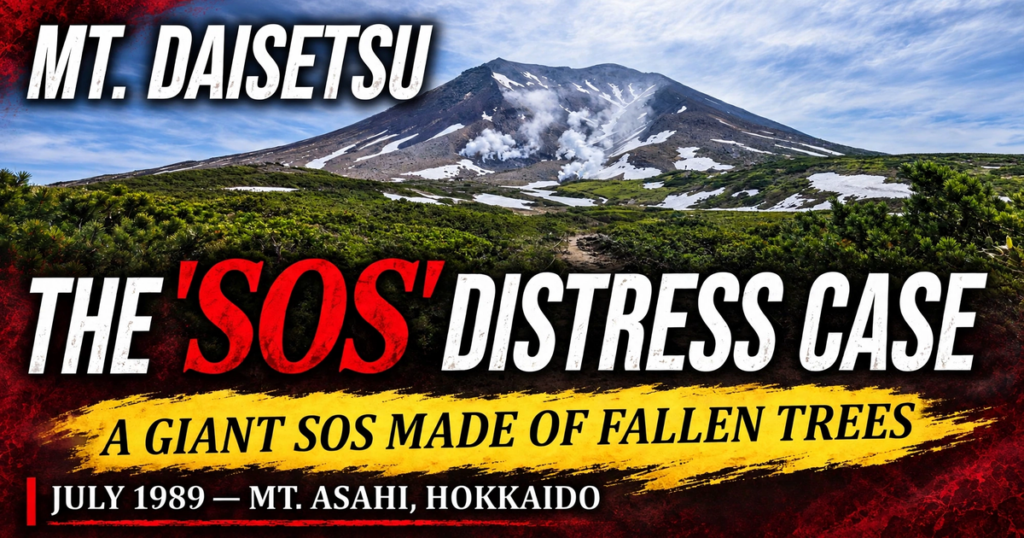
A helicopter spotted a huge SOS while searching for other hikers
On 24 July 1989, a Hokkaido police helicopter was searching for hikers who had become lost in the Daisetsuzan range when its crew noticed enormous letters spelling SOS on a wetland near Mount Asahidake. The letters had been assembled from fallen tree trunks and were visible from the air. The hikers being sought were later found safe about two to three kilometres to the north. They said they knew nothing about the signal. The discovery therefore did not solve the search that had brought the helicopter into the area; it opened a separate question about who had made the sign and whether someone else had been stranded nearby.
A ground search found remains and the belongings of someone who had lived in the mountains
Police sent a ground team to the location on the following day. Searchers found fragments of human bone near the wooden letters, together with a backpack, a cassette recorder, tapes and everyday items. Later searches located additional remains and equipment. The objects suggested that someone had spent time in the area rather than merely passing through. The wetland and surrounding terrain were difficult, with streams, marshy ground and dense bamboo grass. The sign was reported to have been made from roughly thirty fallen trunks and to have measured about fifteen metres across.
A cassette contained a recorded request for rescue
One cassette was wet when it was found. After it was dried, investigators were able to play a recording of a young male voice calling for help. The recording lasted about two minutes and seventeen seconds. The speaker repeatedly asked for rescue and described being unable to move on a cliff, with thick bamboo grass preventing him from climbing farther. He asked to be lifted out. The recording was important evidence that a person in the area had been in distress. It did not, by itself, prove that the speaker had made the wooden SOS or establish exactly where the recording had been made.
The belongings pointed to a man missing since July 1984
The investigation found a connection between the recovered items and a 25-year-old company employee from Konan City in Aichi Prefecture who had entered the Daisetsuzan area in July 1984 and never returned. Identification documents, a youth-hostel membership card, a personal seal and other belongings were found during later searches. Reports also described comparisons involving footwear, the cassette contents and handwriting on an entry record. These details linked the items to the missing man. The SOS was discovered about five years after he disappeared, so the date on which the sign was found must not be mistaken for the date on which the man became lost.
The first examination mistakenly identified the bones as female
The initial examination of some of the bones led investigators to believe that they might belong to a woman. Contemporary reports described an estimated adult female age range and physical measurements. That assessment conflicted with the male voice on the cassette and the male belongings found nearby. It encouraged speculation that two people, a man and a woman, might have been lost in the same area. At that stage, however, the possible presence of a second person had not been established. The difference between an early forensic assessment and a later identification became one of the most important features of the case.
A later re-examination corrected the sex identification
Further examination eventually corrected the initial assessment. The recovered bones were identified as those of a man who had gone missing in the area in July 1984. The earlier interpretation that the bones belonged to a woman was no longer accepted. This correction removed a major basis for the theory that an unidentified woman had also died at the site. The cassette voice, the personal effects and the remains could be understood as relating to one missing male hiker. It is important to preserve the order of these findings: the female identification was an early conclusion that was later corrected, not a second victim confirmed by the investigation.
The sign does not prove that its maker could have walked out safely
The size of the wooden letters led to a recurring question: if a person had enough strength to move so many trunks, why could that person not descend the mountain? The recording, however, described a cliff and dense bamboo grass that prevented movement. The ability to move wood in one place does not establish that a safe route down was available. The records do not show exactly how long it took to assemble the sign, whether the person worked alone or what physical condition he was in at each stage. It would be speculation to use the sign's size alone to infer that another person must have been involved.
The exact route and final days cannot be reconstructed
The recovered belongings and remains provided a strong link to the missing man, but they did not explain every part of his final journey. The surviving materials do not establish the precise route he took after entering the mountains, the order in which he made the sign and the recording, how long he survived after becoming trapped or the exact time of death. The location was remote and difficult to search, and the remains were discovered years after the disappearance. A careful account must leave these questions open rather than fill them with a dramatic theory.
The case is a mountain disappearance, not a proven homicide
The initial female-bone assessment, the unexplained wooden letters and the recording gave the incident an enduring mystery. They also led to theories involving a second victim or a crime. The later identification corrected the central forensic error, and the materials reviewed do not establish that another person killed the missing man. There was no criminal trial in which a perpetrator was convicted. The most supportable description is a mountain disappearance in which a large distress signal, human remains and a recorded plea for help were discovered five years after a man went missing. The unanswered details concern the circumstances of the accident, not a proven criminal conspiracy.
Original Japanese record: SOS遭難事件|巨大な倒木文字と録音、人骨の「女性鑑定」が覆るまで
Last updated:
Related articles

Case record
The Protection of Chinese Influencer Umi in Cambodia: A Missing-Person Search, Consular Assistance and Her Return

Case record
The Shiromaru-kun Case
Case record
The Disappearance of Naoko Nagao: A Commuter Who Vanished in Sapporo in 1981
Case record