
The Snow Brand Milk Poisoning Outbreak: A Power Failure, Heat-Stable Toxin and Two Different Patient Counts
In late June 2000, people across Japan became ill after drinking low-fat milk and other products made at Snow Brand's Osaka plant. The contamination was traced to skimmed milk powder manufactured at the company's Taiki plant in Hokkaido. A power failure on March 31 had disrupted temperature control, allowing Staphylococcus aureus to produce enterotoxin A. The toxin remained in the powder and later products. Official records distinguish 14,780 people who reported symptoms after consuming relevant products, 13,420 whose illness was considered probably related to consumption, and 4,852 cases considered almost certainly linked. Those figures describe different evidentiary categories.
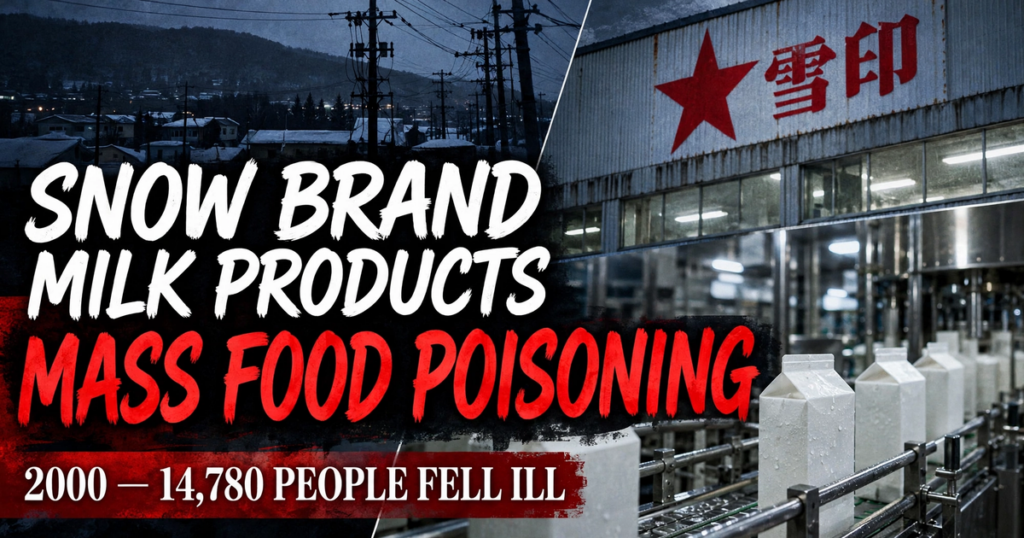
A nationwide outbreak began with low-fat milk made in Osaka
In late June 2000, people who had consumed low-fat milk and other dairy products manufactured by Snow Brand Milk Products' Osaka plant began reporting vomiting, diarrhoea and other symptoms. Reports reached public-health authorities from several prefectures, and the scale of the outbreak grew quickly. The company had to stop shipments and recall affected products while investigators worked to identify the source. The outbreak became one of the largest food-poisoning incidents in post-war Japan and damaged public confidence in the dairy industry.
The source was traced from the finished product back to Hokkaido
The Osaka plant was the final manufacturing site for the low-fat milk, but investigators traced the shared ingredient back through production records. The relevant skimmed milk powder had been manufactured at Snow Brand's Taiki plant in Hokkaido. The contaminated powder had been shipped to Osaka and used in several products. The investigation therefore moved beyond the plant where consumers bought the finished milk and examined the earlier manufacturing process, the lot records and the way raw material was handled after an abnormal production event.
A power failure disrupted the Taiki plant's temperature control
On March 31, 2000, a power failure at the Taiki plant interrupted production. Cooling and ventilation equipment stopped during the outage and the recovery work. Raw milk remained in the production system longer than normal. The investigation concluded that Staphylococcus aureus multiplied under those conditions and produced enterotoxin A. Skimmed milk powder was subsequently manufactured from the affected material and later used in the Osaka products. The source of the outbreak was therefore connected to an abnormal production process months before consumers became ill.
The toxin could remain even after bacteria were killed
The outbreak involved a toxin-mediated food poisoning. Staphylococcus aureus itself can be reduced or killed by heat, but enterotoxin A is relatively heat-stable. Ordinary heating in a later stage of dairy production could not be assumed to make the contaminated powder safe again. The distinction matters because the absence of live bacteria in a finished product does not necessarily mean that a bacterial toxin is absent. Investigators detected enterotoxin in the low-fat milk and in retained samples of the skimmed milk powder.
The official figures describe different categories, not competing final totals
The December 20, 2000 final report by the joint expert committee of the Ministry of Health and Osaka City recorded 14,780 symptomatic people who had consumed relevant Osaka-plant products, excluding products known not to be contaminated. Within that group, 13,420 people were classified as having symptoms and product-consumption histories considered probably related to the contaminated powder. A narrower group of 4,852 was considered almost certainly linked because they had consumed products with the same shelf-life date as products in which the toxin was detected. These are different evidentiary categories, not contradictory counts of one identical group.
The response and recall were criticised for being too slow
Public-health authorities received reports of illness from around June 27. On July 2, enterotoxin A was detected in low-fat milk, and Osaka City identified the products as the source and prohibited operations at the Osaka plant. The company's early response and communication were criticised because the recall and public notification did not move quickly enough as reports increased. In a widespread food-distribution system, waiting for every technical question to be resolved can allow more consumers to be exposed to a product that is already suspected of causing illness.
The contamination investigation reached retained powder samples
On August 18, investigators confirmed enterotoxin A in skimmed milk powder produced at the Taiki plant and used as an ingredient in the affected products. Hokkaido authorities announced further findings on August 23, including the power interruption and the use of powder that did not meet bacterial-count standards. The investigation also examined retained samples from powder produced on April 1 and April 10. The findings connected the March 31 disruption to the later products and explained why the contaminated ingredient had passed through more than one factory.
Food-safety oversight changed after the outbreak
The incident led authorities to review sanitation management and the handling of abnormal production batches. The Ministry of Health and Welfare issued a notice in November 2000 to revise the operation of the comprehensive sanitation-control approval system based on HACCP. The case also highlighted the need to preserve lot records, trace ingredients across factories, discard material produced under uncontrolled conditions and respond rapidly to clusters of illness. A later manufacturing step cannot reliably correct an upstream failure when a heat-stable toxin has already formed.
The company's responsibility extended beyond the laboratory result
The scientific investigation identified the toxin and traced it to the Taiki plant, but the public response also examined management decisions. The company had to account for the use of powder produced during an abnormal process, the movement of that powder into later products and the timing of its recall and announcements. The outbreak became a lesson in both process control and crisis communication. It demonstrated that food safety depends on the decisions made when production first deviates from normal conditions, not only on testing the final product before it reaches consumers.
Original Japanese record: 雪印乳業集団食中毒事件|停電で生じた毒素が低脂肪乳へ、1万人超被害と回収遅れ
Last updated:
Related articles
Case record
The Daisetsuzan SOS Mountain Incident: A Giant Signal, a Recorded Cry for Help and a Corrected Bone Identification

Case record
The Sankebetsu Brown Bear Attack: Six Days of Attacks in a Hokkaido Settlement

Case record
The Kanemi Yusho Poisoning: PCB-Contaminated Rice Oil and a Relief System Still Operating Decades Later
Case record