
The Bibai Beauty Salon Dormitory Fire: Ten Deaths, Smoke-Filled Escape Routes and an Undetermined Cause
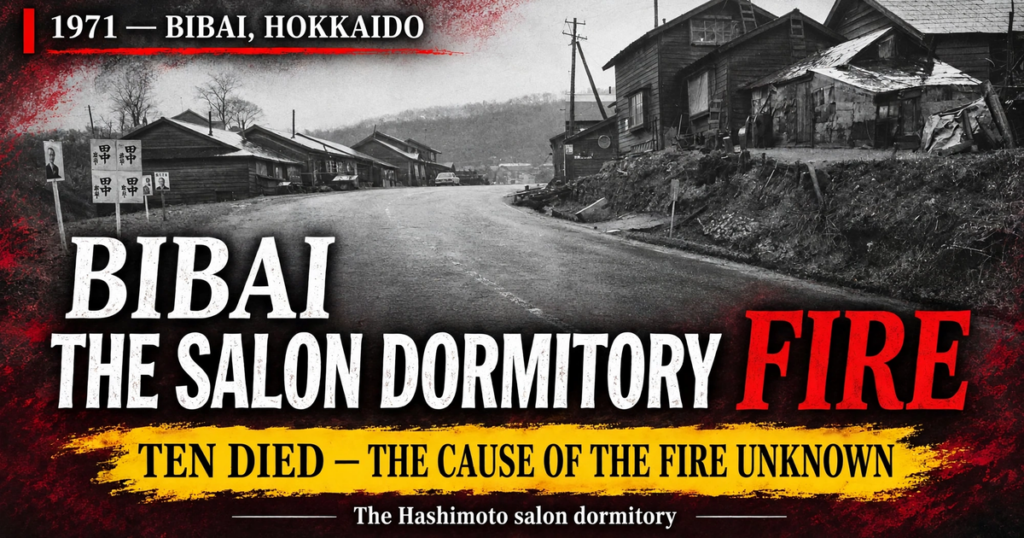
A fire broke out at the Hashimoto Beauty Salon dormitory in Bibai, Hokkaido, on 31 January 1971. Eleven people were sleeping on the second floor. They tried to escape by the stairs, but smoke spread into the route; ten died and one escaped through a window. A Fire Agency official explained the circumstances to the Diet in May 1971. Hokkaido's official fire statistics list the cause as unknown, so later claims that the fire was deliberately set cannot be treated as established fact.
A fire broke out at a workers' dormitory in Bibai
On 31 January 1971, a fire occurred at the Hashimoto Beauty Salon dormitory in Bibai City, Hokkaido. The building combined the owner's residence and accommodation for beauty workers. Eleven people were sleeping on the second floor when the fire began in a room on the first floor, according to an explanation later given by the Fire Agency to the National Diet. Ten people died. One person survived after breaking a window and escaping. The incident became a major example in discussions about the danger of smoke in small residential and workplace buildings.
The people on the second floor tried to use the stairs
The eleven occupants on the second floor noticed the fire and attempted to evacuate by the staircase. The Fire Agency official told the House of Representatives that smoke had spread into the stairway and the occupants were caught in it. Ten died, while one person escaped through a window. The official described the incident as a typical fire in which people died from smoke. This account is more precise than a short description that says simply that ten people were burned to death. The government's explanation focused on the smoke-filled escape route and the inability of most occupants to get out.
The survivor escaped through a window
The one person who survived did not use the stairs. According to the Fire Agency's explanation, the person broke a window and escaped from the building. The difference between the staircase and the window is central to the recorded sequence: the normal route down from the second floor had become dangerous because smoke had entered it, while an alternative exit allowed one occupant to get outside. The public materials reviewed do not provide a full account of the survivor's injuries or later life, and this translation does not add details that are not established in the available record.
The Diet examined why smoke caused so many deaths
On 20 May 1971, the House of Representatives Local Administration Committee questioned the Fire Agency about the Bibai fire. Committee members asked how ten people could die in a building that appeared to be an ordinary two-storey structure. Fire Agency Prevention Division official Akira Nagase explained that the fire began in a first-floor room and that the second-floor occupants tried to descend by the stairs before being overcome by smoke. The exchange moved beyond the individual fire to broader concerns about smoke, combustion gases and the safety of building materials.
The official explanation focused on smoke and combustion gases
The Fire Agency discussed how smoke from burning materials could make an escape route impassable even when the upper floor was not completely consumed by flames. The first floor included a shop handling women's underwear, and the official said smoke from burning contents may have contributed to the conditions. Carbon monoxide and other combustion products were also discussed. These explanations were given in the context of a general safety inquiry; they should not be turned into a precise toxicological finding for each victim. The official account establishes that smoke was the central danger, not a detailed medical cause for every death.
Some reports mentioned clothing and personal belongings, but did not prove why people died
During the Diet discussion, members referred to newspaper reports that some occupants had put on coats or carried handbags before trying to escape. The Fire Agency acknowledged that local reports mentioned such details. It did not conclude that dressing or collecting belongings caused the deaths. The official explanation continued to identify smoke as the main factor. Later summaries sometimes present the fire as a case in which people delayed their escape to get dressed, but that stronger causal claim is not established by the government's recorded answer. The translation therefore distinguishes the reported observations from conclusions about why ten people died.
The cause of ignition remains unknown in the official fire statistics
A central correction concerns the fire's cause. Later online accounts have described theft from the first-floor shop and suggested that a thief set the fire. However, Hokkaido's official fire statistics list the cause of the 31 January 1971 Hashimoto Beauty Salon dormitory fire as unknown. The same statistical table gives specific causes for other fires where they were identified, including stove accidents and arson. The Bibai entry is not labelled arson. The public official records reviewed do not establish an arrested or convicted arsonist. The event should therefore not be presented as a proven theft-and-arson case.
A contemporary technical report was preserved
The National Diet Library catalogue records an article titled 'The Fire at a Beauty Salon Dormitory in Bibai City,' written by the Bibai Fire Department and published in the Japan Association for Fire Science journal Fire, volume 21, issue 3, in August 1971, pages 162–164. The article appeared as one of three reports on fires in which people died. The catalogue confirms the existence, author, publication and page range of the report. Its full text is not freely visible in the general catalogue record, so this translation does not pretend to quote details from pages that were not directly available.
The fire became an example in a wider debate about building safety
The Diet discussion used the Bibai fire to examine the danger of smoke and toxic gases, not only the ability of construction materials to resist flames. Officials discussed research into smoke production and the possibility of incorporating it into standards for building materials. The available record does not show that this single fire alone caused a particular amendment to building law. It does show that the disaster was used as a concrete example in a wider debate about how smoke could kill occupants before flames reached their rooms. That is the documented significance of the case.
The accurate record is a fatal fire with an undetermined ignition cause
The established facts are that the Hashimoto Beauty Salon dormitory caught fire on 31 January 1971, eleven people were on the second floor, ten died after smoke entered the stairway, and one escaped through a window. The official Hokkaido fire statistics record the cause as unknown. Later theft or arson explanations are not equivalent to a finding by investigators or a court. There is no verified criminal judgment establishing deliberate ignition in the materials reviewed. The event is best recorded as a multiple-fatality fire disaster whose human consequences were discussed in the Diet and whose precise ignition cause remains undetermined.
Original Japanese record: 美唄市美容院宿舎火災|10人死亡、北海道消防年報が出火原因を「不明」と記録
Last updated:
Related articles
Case record
The Kabukicho Building Fire: Forty-Four Deaths, an Unidentified Fire-Setter and the Failure of Fire Management

Case record
The Sankebetsu Brown Bear Attack: Six Days of Attacks in a Hokkaido Settlement
Case record
The Sinking of the KAZU I: Twenty Confirmed Deaths, Six Missing and the Company President's Five-Year Sentence
Case record