
The Nagasaki Stalking Murders: Two Family Members Killed, Three Police Forces Criticised and a Final Death Sentence
On December 16, 2011, Gota Tsutsui killed the mother and grandmother of a woman he had stalked in Saikai, Nagasaki Prefecture. The family had repeatedly consulted police in three prefectures. The Supreme Court upheld Tsutsui's death sentence in 2016, while reviews identified serious failures in inter-prefectural police coordination.
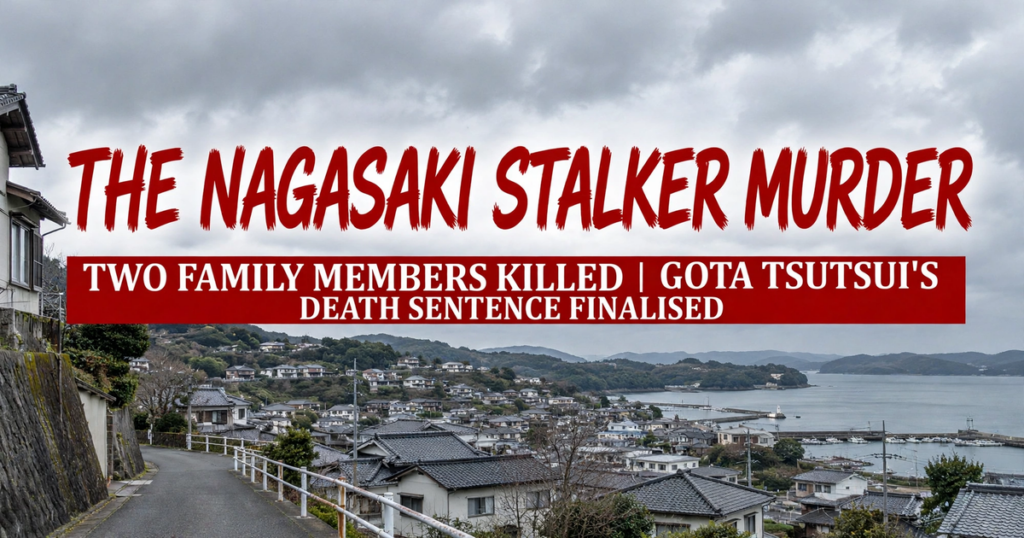
Two women were killed in a home in Saikai, Nagasaki
On December 16, 2011, Mitsuko Yamashita, aged 56, and her mother, Hisae Yamashita, aged 77, were killed in their home in Saikai, Nagasaki Prefecture. Neither woman was the person at the centre of the relationship dispute. They were family members who had tried to protect Mitsuko's third daughter from a former boyfriend, Gota Tsutsui. Tsutsui did not accept that the daughter had chosen to leave him. He believed, without a proper basis, that her family had taken her away against her wishes. He treated the family as an obstacle to getting her back. The killings therefore arose from a stalking situation that had already involved threats and repeated consultations with police.
Threats spread from the woman to her family and other people
After the daughter separated from Tsutsui, he sent threatening emails not only to her but also to people around her. The Supreme Court judgment found that he sent a total of 17 threatening messages to eight people, including family members, friends and workplace contacts. Some messages included threats to kill. The risk was therefore not confined to the woman herself. Her family had reason to fear that Tsutsui might harm them as well. This wider pattern mattered when the police response was reviewed. A person may stop contacting a former partner directly while continuing to threaten relatives or people who support that partner. The absence of direct contact does not necessarily mean that the danger has diminished.
The family had consulted police in three prefectures
The woman and her relatives sought help from police in Chiba, where she was living, Nagasaki, where her family home was located, and Mie, which was connected to Tsutsui. The case crossed prefectural boundaries, so information gathered by one police force needed to be shared with the others. Later reviews found that the police did not adequately combine the information or assess the threat as one continuing situation. The risk was not recognised as a coordinated pattern involving the woman and her family. The failure was not simply that one officer missed a single fact. It involved the organisation's ability to share information, assess danger and decide what protective measures were needed.
A complaint at Narashino Police Station was not handled promptly
On December 6, ten days before the killings, the woman and her father went to Narashino Police Station in Chiba Prefecture to report an assault by Tsutsui. The complaint was not accepted and processed at that visit; it was deferred to a later date. At the time, the family was also dealing with threats and ongoing harassment. The decision to postpone the complaint became a major focus of the later review. Investigators also examined the fact that officers from the station, including personnel from relevant departments, took part in a recreational trip around the same period. The initial review did not fully disclose the trip, leading to a further examination of the police organisation's handling of the case.
Tsutsui prepared for the journey and the killings
The Supreme Court judgment found that Tsutsui had bought a large kitchen knife before travelling and used the internet to research where the woman's family lived. He travelled from Mie Prefecture to Saikai in Nagasaki. On December 16, he entered the homes of Hisae and Mitsuko Yamashita. Although he had brought a knife, he found a larger deba knife at the grandmother's home and used it in the attacks. Both women died from blood loss. After the killings, Tsutsui took their wallets in order to obtain money to escape. The court regarded the prior purchase of a weapon, the online address research and the long-distance journey as evidence of planning.
Tsutsui was arrested the following day and later denied the crimes
Tsutsui was located in Nagasaki City on December 17, the day after the killings. During the investigation, he initially made statements admitting the offences, but later denied being the perpetrator at trial. He claimed that his statements had been coerced and challenged the evidence. The Nagasaki District Court considered blood traces, the victims' wallets, the circumstances at the homes and the consistency of the evidence with his earlier statements. It found him guilty. The Fukuoka High Court upheld the conviction and death sentence. The Supreme Court later examined the appeal and the findings concerning the planning, the killings and the motive.
The Supreme Court upheld the death sentence in July 2016
On July 21, 2016, the Supreme Court's First Petty Bench dismissed Tsutsui's final appeal. The Court considered that he had become increasingly angry because he believed the family had prevented him from seeing the woman. He treated the relatives as barriers to regaining the relationship and decided to eliminate them. The Court described the motive as one-sided and without mitigating justification. It upheld the death sentence, taking account of the advance preparation, the repeated stabbing of two defenceless victims and the threats and violence directed at the woman and people around her. The sentence became final after the related correction procedure was rejected.
The police review identified failures in risk assessment and coordination
After the killings, the National Police Agency and the prefectural forces reviewed the handling of the case. The review identified three major problems: insufficient recognition that a relationship dispute could develop into a serious violent crime, weak organisational response within the police stations, and inadequate information sharing among Chiba, Nagasaki and Mie police. A second review also examined why the first report had not fully described the officers' recreational trip and how that omission had occurred. The case led to stronger procedures for assessing stalking risks, coordinating life-safety and criminal-investigation departments, sharing information between prefectures and helping victims make informed decisions about protection and reporting.
The death sentence remained in force in the latest published status check
The Japanese source's status field records that, as of August 28, 2026, there had been no public confirmation that Tsutsui's death sentence had been carried out. The article was subsequently updated on October 29, 2026 and continued to list the death sentence as final, without reporting an execution. His legal status was therefore a final death sentence awaiting execution. This status note should not be read as a guarantee that no later development has occurred; it reflects the public information stated in the source article. The case remains important for two separate reasons. Tsutsui was criminally responsible for the murders, while the police response was independently criticised for failing to recognise and coordinate around the danger. Keeping those questions separate is necessary to understand both the criminal judgment and the institutional lessons.
Original Japanese record: 長崎ストーカー殺人事件|家族2人殺害と3県警の対応不備、最高裁が死刑を維持した理由
Last updated:
Related articles
Case record
The Mitaka Stalking Murder: A Twenty-Two-Year Sentence, a Retrial on Remand and Digital Abuse
Case record
The Zushi Stalker Murder: Rie Miyoshi, the Disclosure of Her Address and Gaps in the Law

Case record
The Murder of Misa Kato: A One-Victim Death Sentence Finalized by Withdrawal of Appeal
Case record