
The Ishinomaki Triple Attack
On 10 February 2010, 18-year-old Yutaro Chiba attacked people at a home in Ishinomaki, Miyagi Prefecture. Two young women were killed, a man was seriously injured, and Chiba wounded and abducted his former girlfriend. He was 18 years and seven months old at the time; his death sentence became final in 2016.
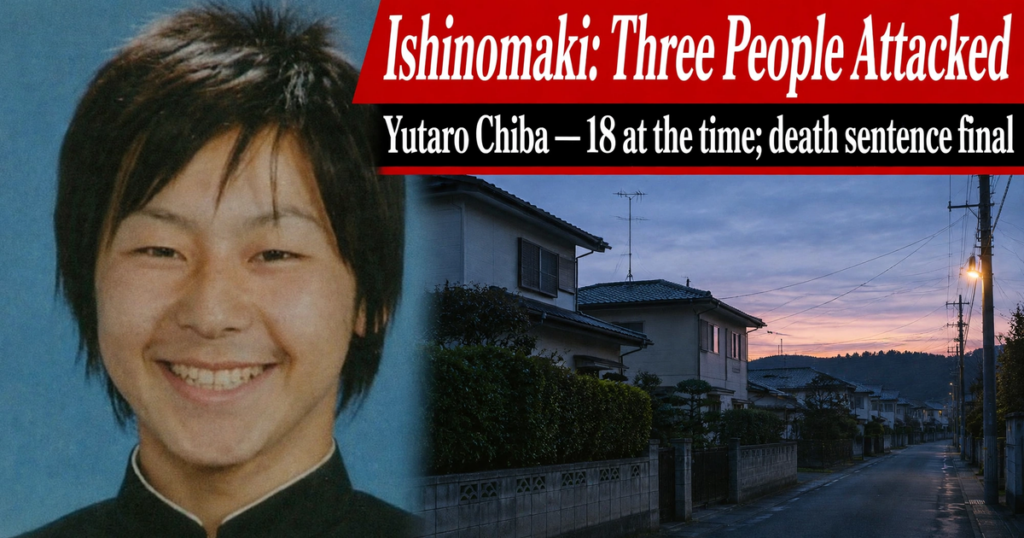
Two young women were killed in an attack on 10 February 2010
At approximately 6:40 a.m. on 10 February 2010, Yutaro Chiba attacked people with a bladed weapon at a home in Ishinomaki City, Miyagi Prefecture. Misa Nanbu, aged 20, and Mikako Omori, an 18-year-old high-school student, were killed. A man was seriously injured. Chiba also wounded his former girlfriend and took her away from the scene. He was apprehended approximately six hours later. The case involved two deaths as well as serious injuries, attempted killings and the abduction.
Chiba was 18 years and seven months old
Chiba's age at the time of the offences was 18 years and seven months. This detail is important because Japan's age of majority and the age threshold used in juvenile criminal procedure are not interchangeable. At the time, people under 20 were generally treated as juveniles under the Juvenile Act, even if they were already 18. Serious cases could nevertheless be referred by a Family Court to prosecutors for criminal proceedings. The age recorded in the judgment was not an estimate: it was 18 years and seven months.
Violence against the former girlfriend had preceded the killings
The case did not begin with an isolated argument on the morning of the attack. Chiba had previously been violent toward his former girlfriend. The Japanese article, citing a review of police handling, reports that she had consulted local police twelve times over approximately one year about his violence. On the day before the attack, she was at a police station and was encouraged to submit a formal victim report the following day. Chiba then went to the home the next morning.
The events of 9 February formed part of the court's account
The court's account described Chiba's attempt on 9 February to bring the woman back. When he failed to do so, he formed a plan to kill people he regarded as obstacles to the relationship and then take the woman away. The article emphasises this preparatory sequence because describing the case simply as a sudden dispute between former partners would omit the planning recognised by the court. The earlier violence and the failed attempt to regain control of the woman were part of the context for the next morning's attack.
The attack involved more than the two fatal injuries
The two women who died were not the only people harmed. A male victim suffered serious injuries, and Chiba's former girlfriend was also injured before being taken away against her will. The criminal case therefore included offences beyond the two completed murders, including one attempted murder, injury and abduction. It is important not to collapse all the victims into the headline's reference to three people attacked at the home, nor to omit the separate injury and abduction of the former girlfriend. The prosecution charged multiple offences reflecting the different harms.
Police consultations became a separate public-safety issue
After the attack, attention turned to the way police had responded to the former girlfriend's repeated consultations. The twelve consultations and the discussion about filing a formal report were examined in later reviews and commentary. That issue should be kept distinct from the criminal trial, which determined Chiba's responsibility for the offences. The trial did not convict police officers of causing the attack. Rather, the case raised questions about how repeated reports of domestic violence and stalking should be assessed before they escalate into lethal violence.
The Sendai District Court imposed the death penalty in 2010
On 25 November 2010, the Sendai District Court sentenced Chiba to death. The judgment considered the number and seriousness of the offences, the planning described by the prosecution and accepted by the court, and the fact that Chiba had attacked people he regarded as obstacles before abducting his former girlfriend. The sentence was particularly significant because Chiba was only 18 years and seven months old at the time. It was still subject to appellate review.
The High Court and Supreme Court upheld the sentence
On 31 January 2014, the Sendai High Court dismissed Chiba's appeal and maintained the death sentence. On 16 June 2016, the Supreme Court dismissed his further appeal. The death sentence consequently became final. These dates should not be compressed into a single judgment: the district court imposed the sentence, the High Court reviewed the appeal, and the Supreme Court considered the further challenge. The final judgment followed those successive stages.
A later retrial challenge did not overturn the conviction
Chiba later sought a retrial. In 2021, the Supreme Court maintained the decision not to reopen the case. A request for retrial is a post-conviction procedure that asks whether new evidence or another legally recognised ground justifies a new trial. It is not the same as an ordinary appeal and does not by itself suspend a final judgment. The result reported in the article was that the death sentence remained final; no acquittal or retrial judgment had replaced it.
The case must be understood as a sequence of coercion and violence
The criminal record includes the earlier violence against the former girlfriend, the police consultations, the events of 9 February, the attack on 10 February, the deaths of Nanbu and Omori, the serious injury to another man, and the injury and abduction of the former girlfriend. The defendant's age is also central to understanding the legal history. The English account should neither reduce the case to a relationship dispute nor confuse the police-response review with the courts' findings about Chiba's crimes.
The accompanying juvenile was not given the same criminal responsibility
Another juvenile accompanied Chiba. The court proceedings treated the principal offender's direct killings and attempted killing separately from the accompanying boy's conduct. The latter was convicted of aiding murder and related offences and received an indeterminate sentence, not the death sentence imposed on Chiba. This distinction matters in a case involving more than one young person: presence at the scene or participation in a plan does not automatically establish the same role, intent or criminal liability for every participant. The courts assessed each person's acts and responsibility separately.
Original Japanese record: 石巻3人殺傷事件|18歳7か月の元少年に死刑、量刑で争われた計画性と更生可能性
Last updated:
Related articles
Case record
The Kitakyushu Confinement Murders: Seven Deaths Without Recovered Bodies and the Separate Sentences for Futoshi Matsunaga and Junko Ogata

Case record
The Toyama–Nagano Serial Abduction and Murder Case: Two Victims, One Death Sentence and One Acquittal
Case record
The Nagasaki Stalking Murders: Two Family Members Killed, Three Police Forces Criticised and a Final Death Sentence

Case record