
The Hachioji Supermarket Murders: Three Victims and an Investigation Still Open
At about 9:15 p.m. on July 30, 1995, three women were shot and killed in the second-floor office of the Nanpei Owada supermarket in Hachioji, Tokyo. About ¥5.26 million remained in the safe. Police have published footwear and witness information, reconstructed the area in a 3D video in 2026 and continue to seek information. No suspect has been arrested or charged.
Three women were killed in a supermarket office
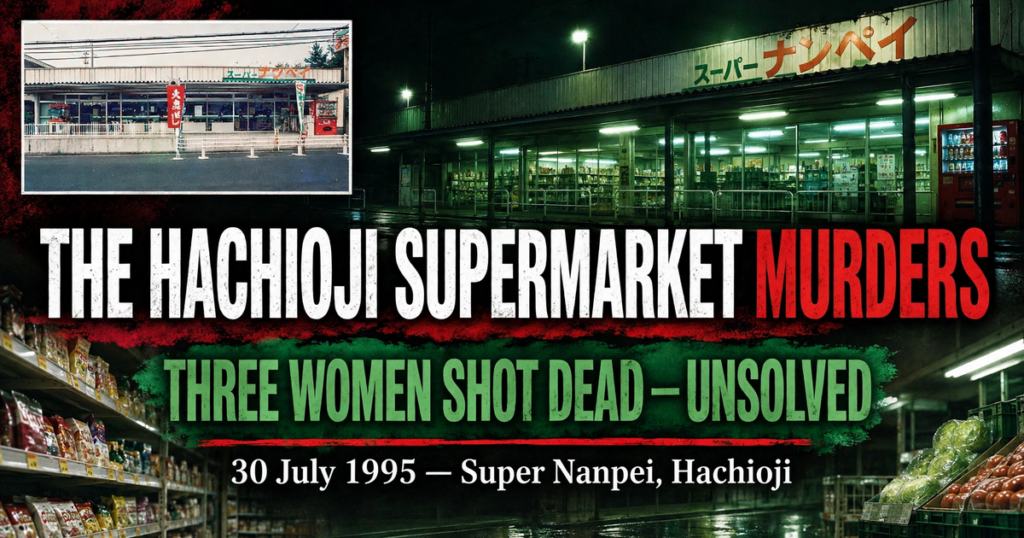
At about 9:15 p.m. on July 30, 1995, three women were shot and killed in the second-floor office of the Nanpei Owada supermarket in Owada-machi, Hachioji City, Tokyo. The victims were Noriko Inagaki, aged forty-seven, a part-time employee, and two high-school students working at the store: Megumi Yabuki, seventeen, and Hiromi Maeda, sixteen. The store’s sales floor was on the first floor, while the office was upstairs and could be reached by an external staircase. The killings occurred shortly after the store’s evening activity was winding down. The police treated the incident as a firearm robbery-murder and established a special investigation headquarters. More than thirty years later, the offender has not been apprehended.
The layout of the store and the timing of the attack
The external staircase meant that anyone entering or leaving the second-floor office would have passed outside the building. A Bon dance event had been held at nearby Kitanohara Park from 6:00 p.m. and ended at about 9:06 p.m. The timing of the event and the movement of people around the store form part of the context for the investigation. The police have asked for information about people who went up or down the staircase, left the premises, or were near the parking area around the time of the murders. The physical layout also matters when considering whether the offender left on foot or used a vehicle to reach a nearby road. The Japanese article relies on the police’s current reconstruction rather than assuming that a particular person seen nearby was the offender.
The safe was struck by a bullet, but the cash remained
One of the most puzzling features of the scene was the safe in the office. A bullet mark was found on it, suggesting that the safe had been targeted or that an attempt had been made to open it. Yet approximately ¥5.26 million in cash remained inside, and the room was not extensively ransacked. This combination has led to questions about whether the offender intended to steal money, was interrupted, or had another objective. The official police classification remains a firearm robbery-murder. The fact that the cash was left behind does not prove that money was irrelevant to the motive. Several explanations remain possible, and because no suspect has been tried, there has been no judicial finding establishing why the safe was fired upon or why the money was not taken.
Footwear evidence has narrowed the possible shoe models
The Metropolitan Police Department has published information about two commercially available sneaker models whose soles matched footwear impressions at the scene. Both were size 26 centimetres and were not brand-new at the time of the crime. One model was sold around 1990 to 1991 in stores in Tokyo, Kanagawa and Saitama; the police identified 439 pairs in the relevant distribution. The other model was sold around 1993 to 1994 through 49 stores nationwide, with 94 pairs identified and nineteen sold in Tokyo. Investigators have asked people to look at photographs and albums from around 1990 to 1995 and recall whether anyone they knew wore the same shoes. The sales figures help define a group of possible purchasers, but they do not identify the person who left the prints.
The last customers are sought as possible witnesses, not suspects
The police are also seeking a man and a woman believed to have been among the last customers in the store. At about 8:56 p.m., they reportedly paid for seven items totalling ¥1,754, including tax, and went toward the parking area. The man was described as approximately 177 centimetres tall, with hair that appeared closely cut at the sides. The woman was described as having straight, shoulder-length hair and wearing dark clothing resembling a dress. They were reportedly associated with a white sedan. The police have not announced that the pair were involved in the crime. They are being sought because they may have seen something important while leaving the store shortly before the murders. Treating a witness lead as a suspect would go beyond the published information.
A 2026 three-dimensional reconstruction renewed the appeal
On July 30, 2026, the Metropolitan Police Department updated its public appeal and released a three-dimensional video reconstructing the area around the scene as it appeared at the time. The building is no longer in the same condition, so the reconstruction is intended to help people recall the external staircase, roads and surrounding environment. The police also provided prompts linked to events on the night of July 30, 1995, including the nearby Bon dance and television, sports and music programmes. The aim is to help people remember where they were and what they saw on that particular evening. Such prompts are especially important in a long-unsolved case, where a date alone may not bring back a useful memory.
A large investigation has not produced an arrest
By the thirtieth anniversary in July 2025, reports said that the police had deployed more than 220,000 investigators over the course of the case; some reports put the figure at approximately 226,000. The investigation has examined the firearm and ammunition, fingerprints, DNA, footwear, adhesive tape, overseas information and earlier witness statements. In 2010, Japan abolished the prosecution limitation period for murder and certain other fatal offences; the change allowed this investigation to continue without the former time limit. People have been reported as persons of interest or questioned in various contexts, but none has been arrested and prosecuted for the murders. The existence of a lead or a person of investigative interest is not proof of guilt. As of the Japanese article’s August 2026 update, the police had not announced an arrest. There has been no criminal trial and no judicial determination of the offender’s identity or motive.
The reward can reach ¥6 million through July 2027
The National Police Agency’s special investigative reward provides up to ¥3 million for information that leads to the arrest of the offender or resolution of the case. A separate private reward offered by a group supporting the investigation provides up to another ¥3 million. The combined maximum is ¥6 million. The current period runs from July 30, 2026, through July 29, 2027. The full amount is not paid simply because someone contacts the police; the amount depends on the value of the information and its contribution to resolving the case. The case remains an active investigation, not merely a historical incident. The central questions—who entered the office, why the three women were killed and what happened to the offender afterward—remain unanswered.
Original Japanese record: 八王子スーパー強盗殺人事件|女性3人射殺から31年、残る靴跡と最大600万円の公開捜査
Last updated:
Related articles

Same case · Feature
The Hachioji Supermarket Robbery-Murders: The Killer Left ¥5.26 Million Behind — Thirty-One Years of Clues and the Final Nineteen Minutes
Case record
The Tama City Manhole Murder: A Missing Woman Found in a Roadway Chamber Ten Months Later
Case record
The Shooting of Japan's National Police Chief: Four Arrests, Competing Accounts and No Prosecution
Case record