
The Shooting of Japan's National Police Chief: Four Arrests, Competing Accounts and No Prosecution
National Police Agency Commissioner-General Takaji Kunimatsu was shot outside his Tokyo home on March 30, 1995, and survived serious injuries. Four people were arrested in 2004 but not prosecuted. A separate man claimed responsibility, but no perpetrator was judicially identified before the statute of limitations expired in 2010.
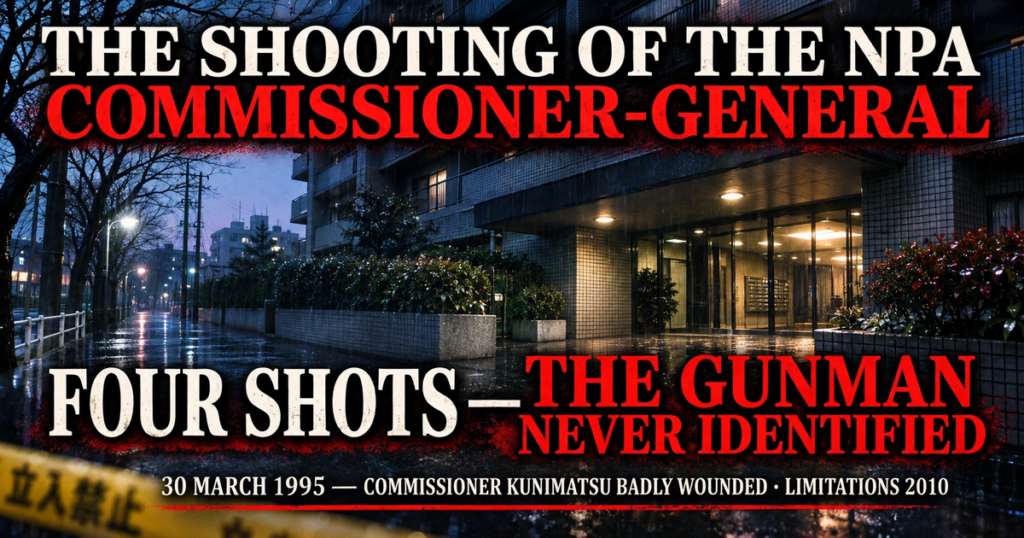
The National Police Agency commissioner-general was shot outside his home
At approximately 8:30 a.m. on March 30, 1995, Takaji Kunimatsu, then Commissioner-General of Japan's National Police Agency, was shot shortly after leaving his apartment building in Minami-Senju, Arakawa Ward, Tokyo. A gunman who had been waiting nearby fired four shots from a handgun. Three bullets were reported to have hit Kunimatsu. He suffered severe injuries and substantial blood loss but survived. The attack was an extraordinary assault on the head of the national police organization. Investigators examined the possibility that the attacker had watched Kunimatsu's routine and knew when he would leave home. The shooter escaped, and no one was arrested at the scene.
The attack occurred ten days after the Tokyo subway sarin incident
The shooting took place ten days after the March 20, 1995 sarin attack on the Tokyo subway system. Police were already conducting a major investigation into Aum Shinrikyo, and the possibility of a connection between the cult and the attack on Kunimatsu quickly became a central line of inquiry. The timing made the theory understandable, but chronology alone could not establish who had fired the shots. The Metropolitan Police Department established a special investigation headquarters at Minami-Senju Police Station. Investigators examined eyewitness accounts, ballistic evidence, possible routes of escape and the movements of people who might have known Kunimatsu's schedule. The case remained open for years without a prosecution.
Four people were arrested in 2004, but none was charged
In 2004, nine years after the shooting, police arrested four people, including a former Metropolitan Police Department sergeant who had been associated with Aum Shinrikyo. Investigators examined statements about reconnaissance near the scene and scientific analysis of microscopic particles found on a coat associated with the former officer. Reports said that some particles contained elements consistent with the composition of the bullets used in the attack. The evidence was considered significant, but it did not establish who had pulled the trigger or what role each of the four people had played. Prosecutors concluded that the evidence was insufficient to prove the necessary criminal participation. All four were released and ultimately not prosecuted.
A former officer's changing account was not enough to establish guilt
The former officer had at times made statements suggesting that he had carried out the shooting. However, the content of his account changed, and parts of it did not fit with other information about the attack. A statement that someone has confessed is not the same as a reliable confession that can be proved in court. The prosecution had to establish the identity of the shooter and any accomplices, not merely show that the suspect had links to the religious organization or possessed an item containing potentially relevant particles. The coat evidence could indicate some connection with the investigation, but it could not independently identify the person who fired the weapon. No criminal trial tested the allegations through examination and cross-examination.
Yasu Nakamura separately claimed that he had fired the shots
A different investigative line concerned Yasu Nakamura, who was serving a prison sentence for another offence. Nakamura said that he himself had shot Kunimatsu and left accounts describing his alleged preparations and knowledge of the scene. Investigators examined the details of his statements, but he was never indicted for the commissioner-general shooting. His claim remained a claim, not a judicial finding. Nakamura died on May 22, 2024, aged ninety-four, while serving a life sentence in an unrelated case. His death did not change the legal position of the Kunimatsu case. There was no trial in which a court determined whether his account was true.
The statute of limitations expired on March 30, 2010
The shooting occurred under the limitation rules then in force, and the fifteen-year period expired on March 30, 2010. By that date, no one had been prosecuted for the attack. The expiry closed the ordinary path to a criminal trial, even though the police had investigated several theories and arrested four people. The legal consequence should not be confused with a finding that the shooting never occurred or that the people investigated were affirmatively proved innocent. It meant that the state could no longer bring the case to court under the limitation period applicable to the 1995 offence. The identity of the gunman remained unresolved in criminal proceedings.
The police publicly attributed the attack to an Aum group, but that was not a criminal judgment
On the day the limitation period expired, the Metropolitan Police Department publicly stated that it believed the attack had been an organized and planned terrorist operation by a group of Aum Shinrikyo followers acting under the will of the cult's leader. That was the police's investigative assessment, not a verdict. No defendant had been prosecuted and no criminal court had found that Aum members carried out the shooting. A later civil lawsuit by the successor organization Aleph challenged the police announcement. In 2013, the Tokyo District Court ordered Tokyo Metropolitan Government to pay ¥1 million in damages; the High Court maintained the compensation order while overturning the order to issue an apology, and the civil proceedings ended in 2014.
The perpetrator and motive remain unestablished in court
The established facts are that Kunimatsu was shot four times, suffered serious injuries and survived; that four people were arrested in 2004 and not prosecuted; that Nakamura separately claimed responsibility but was never charged; and that the limitation period expired in 2010. The police's theory of an Aum operation, the former officer's changing statements and Nakamura's claim must remain distinct. None resulted in a criminal conviction for the shooting. The civil litigation concerned the legality of the police's public attribution, not the identity of the gunman. As of 2026, no person has been judicially identified as the shooter, and the motive has not been established by a criminal judgment.
Original Japanese record: 警察庁長官狙撃事件|2004年の4人逮捕と「自白」、時効後も犯人未特定
Last updated:
Related articles

Case record
The Hachioji Supermarket Murders: Three Victims and an Investigation Still Open
Case record
The Hijacking of All Nippon Airways Flight 61: A Captain Killed, 517 People Aboard and a Final Life Sentence
Case record
The Wanted Case of Tsuyoshi Yoshiya: The 1999 Ayase Group Attack

Case record