
The Tama City Manhole Murder: A Missing Woman Found in a Roadway Chamber Ten Months Later
A woman in her thirties who lived in Tama City disappeared in February 1996 after leaving work and parting from a colleague. On 14 January 1997, her body was found inside a roadway manhole at 1-65 Kaidori, Tama City, Tokyo. Police believed she had been killed soon after she went missing and established a special investigation headquarters. A key witness account concerns a man, a van and roadwork barricades near the manhole on a night in late February 1996. The case remains unsolved.
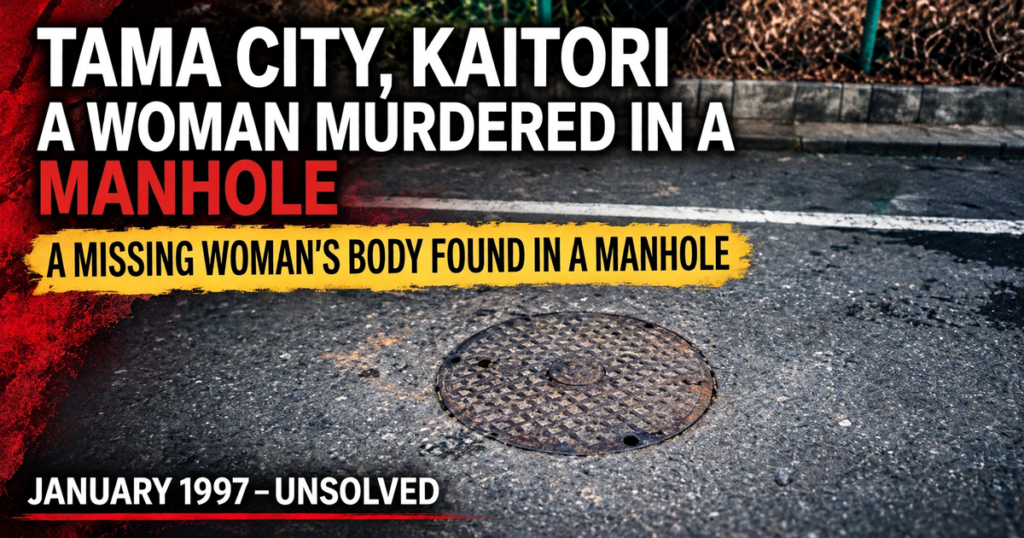
A woman disappeared after leaving work in February 1996
A woman in her thirties who lived in Tama City, Tokyo, disappeared in February 1996. According to the Tokyo Metropolitan Police Department, she was last known to have left her workplace and parted from a colleague. Her family or other relatives filed a missing-person report. The public police record does not provide a detailed account of her route after leaving work or identify a confirmed last location beyond the separation from the colleague. Her disappearance was later connected to a body found inside a roadway manhole in the same city.
Her body was found inside a manhole on 14 January 1997
On 14 January 1997, the body of a woman was discovered inside a manhole at 1-65 Kaidori, Tama City. The location was on a road west of Kamakura Kaido and south of the elevated railway structures used by the Odakyu Tama Line and Keio Sagamihara Line. At the time, the road was near the parking area of a supermarket known as Olympic Tama Kaito. The body was clothed, and decomposition had progressed. Investigators estimated that death had occurred several months or more before the discovery.
The remains were identified as the woman who had gone missing the previous year
The woman was identified as a Tama City resident in her thirties who had disappeared in February 1996. The gap between the disappearance and the discovery was approximately ten months. The police considered it likely that she had been killed not long after she went missing and that her body had been placed in the manhole. A special investigation headquarters was established for the case, which was treated as murder and abandonment of a body. The public police record does not disclose the woman's name, and this translation does not attempt to identify her beyond the information released by police.
The manhole location became a central part of the investigation
A roadway manhole is normally opened for specific maintenance or inspection work. Placing a body inside such a space requires access to the cover and an opportunity to work at the roadside. The location was not an isolated mountain or remote field; it was on a road near railway structures and a supermarket parking area. The body was hidden from ordinary view until the discovery in January 1997. Police therefore examined who might have been near the site, what vehicles had been present and whether anyone had seen work that appeared unusual.
A man, a van and roadwork barricades were seen on a night in late February
One of the most specific public leads concerns a night in late February 1996. Police say a man was seen near the manhole with a van parked nearby and roadwork-style barricades placed around the area. The police have asked for information about the man and about anyone who saw a similar scene. The sighting is important because it occurred soon after the woman's disappearance and involved equipment that could make activity around a manhole appear ordinary. However, the public notice does not state that the man has been identified or that the sighting proves he was the offender.
Police have asked for more than information about the one witness description
The Tokyo Metropolitan Police Department has sought information about people who had disputes with the victim, people who showed unusual interest in the case, and anyone who behaved suspiciously near the location during February and March 1996. It has also asked about people opening manholes, carrying large items or using vehicles in the area. These are investigative requests. They do not establish that a particular person had a dispute with the woman, that a van was used to transport her or that the manhole was opened by the person seen with the barricades.
The investigation remains open and the offender has not been identified
The police's public page states that the offender has not been identified. No suspect has been publicly arrested or indicted in connection with the murder. The special investigation headquarters examined the woman's relationships and sightings around the time she disappeared, but the publicly available information does not provide a complete reconstruction of her final movements. The man and van seen near the manhole remain an information lead rather than a judicially established offender. The case must therefore be described as unsolved.
The 2010 limitation reform allowed the murder investigation to continue
When the woman disappeared in 1996, murder was subject to a limitation period under Japanese law. The 2010 reform abolished the limitation period for murder and other offences punishable by death, and it applied to cases in which the former limitation period had not yet expired when the reform took effect. The 1996 case had not reached the end of the former 15-year period by 2010. The reform therefore allowed the investigation to continue without the previous limitation deadline. This legal position is different from older cases whose limitation periods had already expired before the reform.
The most important remaining evidence may be a memory from the neighbourhood
The official appeal continues to ask people who were in the area in February and March 1996 to recall vehicles, roadwork, unusual activity around a manhole or people carrying large objects. The passage of time makes such memories difficult to retrieve, and the appearance of the neighbourhood has changed. The police have preserved maps and photographs of the scene to help people compare their recollections with the location as it existed in 1997. The body was found in a specific place, but the identity of the person who put it there and the reason for the killing remain unknown.
Original Japanese record: 多摩市貝取一丁目マンホール内女性殺人事件|失踪10カ月後の発見と、工事を装うような男の目撃
Last updated:
Related articles
Case record
The Wanted Case of Tsuyoshi Yoshiya: The 1999 Ayase Group Attack
Case record
The Shibamata Student Murder and Arson: The 1996 Killing of Junko Kobayashi

Case record
The Sugamo 3-chome Fortune-Teller Murder

Case record