
The United Red Army Case: Twelve Deaths at the Mountain Bases, the Asama-Sanso Hostage Siege, and the Final Appeals
The United Red Army emerged from the merger of two radical left-wing armed groups in 1971. At mountain bases in Gunma Prefecture, 12 members were killed in the name of internal “self-criticism.” In February 1972, five fugitives occupied the Asama-Sanso lodge in Nagano and held its manager’s wife hostage for ten days. Three people died in the siege, and the subsequent criminal proceedings led to death sentences that became final in 1993.
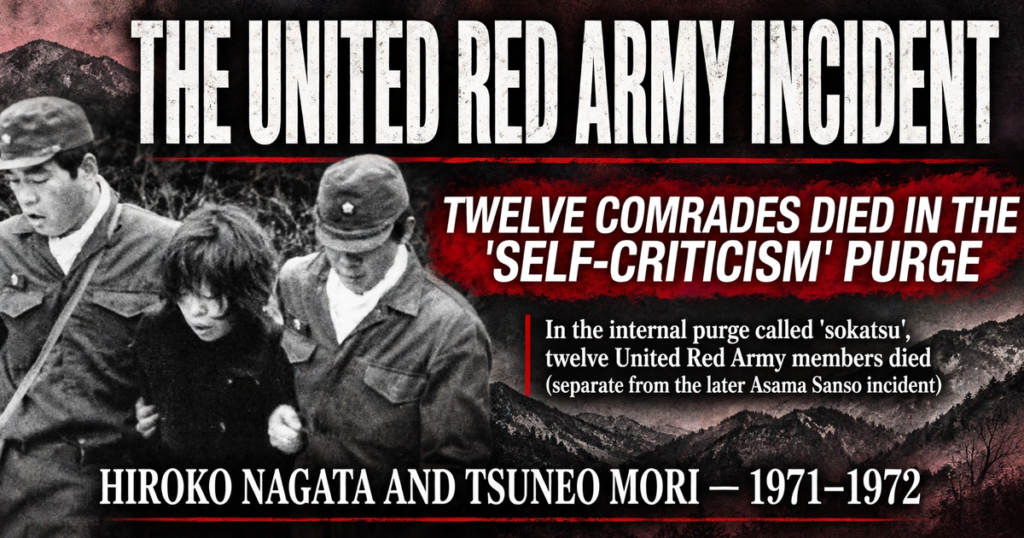
Two radical groups joined to form the United Red Army
The United Red Army was formed in 1971 through the integration of the military organizations of the Communist League Red Army Faction and the Japanese Communist Party Revolutionary Left. The groups had different histories and internal cultures, but they joined forces for armed struggle. The police account describes an organization that moved among mountain bases in several prefectures, including Yamanashi, Kanagawa, Shizuoka, and Gunma. Its members conducted armed training and prepared for violent operations against police facilities. The organization’s internal violence later became the central issue in the mountain-base killings.
The language of “self-criticism” became a justification for violence
From late 1971 into early 1972, members at mountain bases in Gunma were subjected to repeated violence under the label of “sōkatsu,” commonly translated as self-criticism or self-examination. People were accused of insufficient commitment, disobedience, weakness in training, or a possible intention to flee. The term was used within the organization as a political and ideological demand, but the criminal investigation concerned specific acts of assault, killing, and concealment of bodies. Describing the deaths simply as internal discipline would obscure the criminal conduct established in the subsequent proceedings.
Twelve members were killed at the mountain bases
According to the National Police Agency’s historical account, 12 of the 29 members gathered in the organization were killed during the mountain-base period. Seven of the dead were associated with the Revolutionary Left and five with the Red Army Faction. Their bodies were buried in the mountains in an effort to prevent discovery. The number 12 refers specifically to the killings after the organization’s formation. It should not be confused with the figure of 14 sometimes used in broader accounts, which adds two earlier deaths in the separate Inbanuma incident before the merger.
The Inbanuma deaths belong to an earlier and distinct episode
Before the United Red Army was formally assembled, members of the Revolutionary Left had killed two people who were regarded as having fled or betrayed the group. Their bodies were buried near Inbanuma in Chiba Prefecture. Those deaths are historically connected to the movement and are often discussed alongside the mountain-base killings, but they occurred in a different phase. Keeping the two cases separate explains why official accounts give 12 victims for the mountain-base incident while some summaries refer to 14 victims across the wider sequence of internal killings.
A vehicle report led police to the mountain bases
On 7 February 1972, Gunma Prefectural Police followed up on information from a member of the public about a suspicious abandoned vehicle. The investigation led officers into the mountains around Mount Haruna, where a base was discovered beneath snow. The discovery exposed the killings and prompted an intensive search for members who had escaped. As police moved into the area, the organization’s remaining members dispersed. Some were arrested during the investigation, while five continued their flight and eventually entered the Asama-Sanso lodge in Karuizawa, Nagano Prefecture.
Five fugitives took the lodge manager’s wife hostage
On 19 February 1972, Hiroshi Sakaguchi, Kunio Bando, Masakuni Yoshino, Michinori Kato, and Motohisa Kato entered the Kawai Musical Instruments recreation lodge known as Asama-Sanso. They held the 31-year-old wife of the lodge manager hostage and barricaded themselves inside with firearms. Police from Nagano and the Tokyo Metropolitan Police Department, among others, were deployed in a large-scale operation. The siege lasted ten days, through severe winter conditions, while officers attempted to protect the hostage and bring the armed occupants out alive.
Three people died and 27 were injured during the siege
The Asama-Sanso incident resulted in the deaths of two police officers and one civilian man who approached the lodge. The National Police Agency’s account records injuries to 26 police officers and one civilian. On 28 February, police entered the building and rescued the hostage. All five occupants were arrested; none was shot dead during the final operation. The television images of the siege became widely known, but the hostage incident also brought national attention to the earlier discovery that 12 members had already died inside the organization’s mountain bases.
The investigation recovered extensive evidence and identified the wider group
The police investigation led to the arrest of all 17 members who had gathered at the mountain bases. Twenty-seven additional people were apprehended in connection with providing shelter or other assistance, and investigators also pursued related offences, including the theft of firearms. Police records describe 397 categories of seized material, comprising 10,568 individual items, including guns and ammunition. These materials helped reconstruct the movement of members between bases, the weapons available to them, and the sequence of killings and other offences.
The criminal trials covered several connected but distinct offences
The prosecutions did not concern one single incident or one undifferentiated count of “terrorism.” The cases included murder, injury resulting in death, concealment of bodies, robbery involving firearms, murder and attempted murder during the Asama-Sanso siege, and obstruction of public duties. On 18 June 1982, the Tokyo District Court sentenced Hiroko Nagata and Hiroshi Sakaguchi to death. The Tokyo High Court upheld the death sentences on 26 September 1986. The Supreme Court’s Third Petty Bench dismissed the appeals on 19 February 1993, making the relevant judgments final.
Nagata died in custody without execution, and the Japanese Red Army was separate
Nagata died at the Tokyo Detention House on 5 February 2011, aged 65, before her death sentence was carried out. The distinction between the United Red Army and the Japanese Red Army is also important. Although the names are similar and both arose from the wider radical-left milieu, they were not the same organization. The Japanese Red Army developed an overseas base of operations, and its actions abroad, including the 1975 Kuala Lumpur incident, must not be confused with the United Red Army’s domestic criminal proceedings. The case is best understood by separating the mountain-base killings, the Asama-Sanso siege, and the earlier Inbanuma killings.
Original Japanese record: 連合赤軍事件|山岳ベース12人殺害、あさま山荘事件と死刑確定まで
Last updated:
Related articles
Case record
The Kiyoshi Okubo Murders: Eight Women Killed in Forty-One Days
Case record
The Nakano City Four-Victim Murder: A Death Sentence, a Dispute Over Criminal Responsibility and an Appeal
Case record
The Maebashi Snack Bar Shooting: Four Killed, Including Three Uninvolved Customers
Case record