
The Maebashi Snack Bar Shooting: Four Killed, Including Three Uninvolved Customers
Two gunmen attacked a snack bar in Maebashi on January 25, 2003, killing four people, including three customers with no connection to the gang conflict. Three defendants received final death sentences in separate trials.
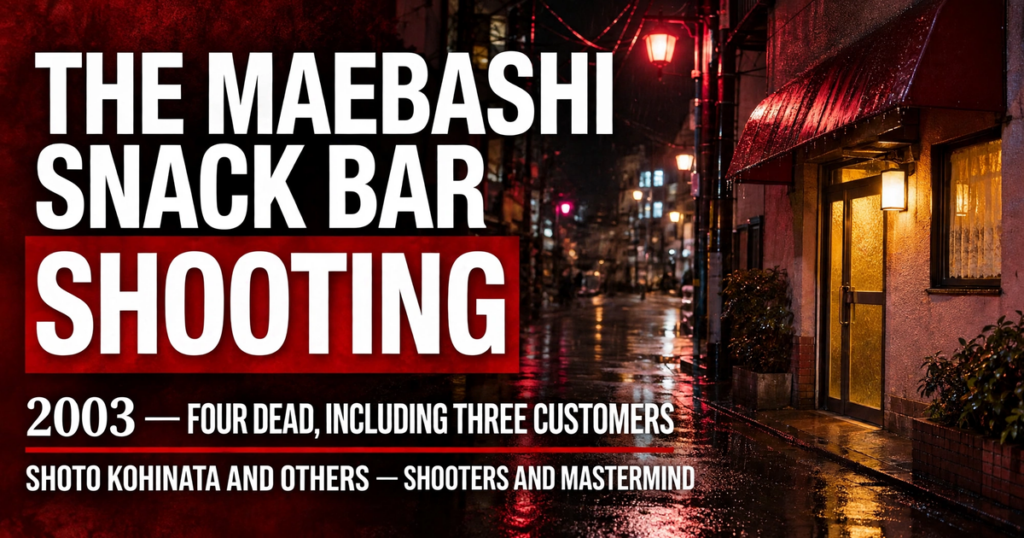
A late-night attack killed four people in Maebashi
At about 11:25 p.m. on January 25, 2003, two armed men attacked a snack bar in Mitsumata-cho, Maebashi, Gunma Prefecture. Their intended target was a former organized-crime boss who was in conflict with a rival group. The attack did not remain confined to the intended target. A man serving as his guard was shot outside the premises, and the gunmen then entered the operating bar and fired at people inside. Four people died. Three of them were ordinary customers who had no part in the gang dispute. The former boss and another customer were seriously injured but survived. The event became known as the Maebashi Snack Bar Shooting.
The guard was shot outside before the gunmen entered the bar
According to the account given by the Gunma police chief to the prefectural assembly, the two attackers wore white full-face helmets. They first fired at the guard, a former gang member who was outside the snack bar, killing him. They then moved into the bar and shot toward the former boss and the customers who were eating and drinking. At the time, the premises contained the former boss, eight customers and a female operator. The three customers who died inside were not the intended target of the conflict. Police established a special investigation headquarters with approximately 110 personnel. The number and sequence of the shots, the movements of the attackers and the identity of the people who prepared the operation became important parts of the subsequent cases.
Three ordinary customers were among the dead
The three customers who died were Fukuji Mizuishi, aged fifty-three; Hatsuko Satori, aged sixty-six; and Teruji Okawara, aged fifty. Contemporary reporting described Mizuishi as a company employee and Satori as a part-time worker at a wedding venue. They were present at the snack bar as part of ordinary daily life, not as participants in the gang conflict. The fourth person killed was the guard outside. The former boss who had been targeted survived despite being seriously wounded, as did another customer who was also seriously injured. Describing the event only as a gang-related shooting can hide the fact that most of the people killed were customers who had no role in the dispute.
The intended target had been attacked before
The shooting did not occur in a vacuum. The former boss had also been shot and injured in October 2002 after returning from a golf outing. The Gunma police chief told the prefectural assembly that police were investigating the relationship between that earlier attempted murder and the January 2003 attack. Later court materials concerning Yano Osamu described a series of attacks directed at the rival group, including an arson plan and shootings. The January snack-bar attack was part of a broader campaign against the opposing organization. That background explains why the former boss was targeted, but it does not reduce the responsibility for firing into a public business where customers were present.
The prosecution distinguished the two shooters from the person who directed them
The two men treated as the direct shooters were Masato Kohinata and Kenichiro Yamada. Osamu Yano was prosecuted as the person who directed or led the operation. The court record concerning Yano included preparations such as obtaining firearms and stolen vehicles, arranging test-firing and later concealing evidence. After the attack, steps were also taken to help the shooters leave Japan using travel documents in other people's names. The three men were not tried together in one single proceeding. Each had a separate trial, and the facts used to support Yano's death sentence extended beyond the snack-bar shooting to other attacks and a separate killing of a gang member in a hospital.
The courts found joint responsibility for the deaths inside the bar
Yamada argued in the appellate proceedings that some of the fatal shots had been fired by the other shooter. The courts did not accept an approach that divided responsibility solely according to which defendant's bullet caused each death. The two shooters had acted together under a common plan to kill the intended target, and they jointly fired into the occupied premises. Their criminal responsibility therefore extended to the deaths and injuries resulting from the attack. The distinction between the identity of the person who fired a particular shot and the responsibility of co-principals acting under a common plan was central to the judgments. The three defendants ultimately received death sentences, but the factual scope of each sentence was not identical.
Three separate trials produced three final death sentences
Kohinata was sentenced to death by the Maebashi District Court on March 28, 2005. The Tokyo High Court dismissed his appeal on March 16, 2006, and the Supreme Court dismissed his final appeal on July 10, 2009. Yamada was sentenced to death on January 21, 2008; his appeal was dismissed on September 10, 2009, and the Supreme Court dismissed his appeal on June 7, 2013. Yano was sentenced to death by the Tokyo District Court on December 10, 2007; his appeal was dismissed on November 10, 2009, and the Supreme Court dismissed his appeal on March 14, 2014. The staggered dates reflect separate proceedings and separate evidentiary issues.
The later legal status of the three men must be stated separately
Yano died in custody at the Tokyo Detention House on January 26, 2020; authorities described the death as a suspected suicide. Kohinata died in custody on January 23, 2026, after being taken to hospital. His death was not an execution. Yamada remained in custody as a person under a final death sentence in the latest located public update dated August 21, 2026. Yano later claimed involvement in two other murders, but a separate trial rejected the allegations and his acquittal became final in 2018. Those two cases cannot be added as proven additional murders. The established Maebashi record is four deaths and two serious injuries, with three separate final death sentences and different subsequent outcomes for the defendants.
Original Japanese record: 前橋スナック銃乱射事件|水石福治さんら一般客3人を含む4人死亡、3人に死刑
Last updated:
Related articles
Case record
The Osaka Private Video Booth Fire: Sixteen Deaths, a Final Death Sentence and a Second Retrial Denial
Case record
The Nabari Poisoned Wine Case: Five Deaths, a Reversed Acquittal and the Eleventh Posthumous Retrial Request
Case record
The Kiyoshi Okubo Murders: Eight Women Killed in Forty-One Days
Case record