
The Nakano City Four-Victim Murder: A Death Sentence, a Dispute Over Criminal Responsibility and an Appeal
On May 25, 2023, four people were killed in Ebe, Nakano City, Nagano Prefecture. Aoki Masanori attacked two women who were walking near his home and then shot two police officers who arrived in response to an emergency call. The victims were Yukie Murakami, aged 66; Yasuko Takeuchi, aged 70; police officer Takuo Ikeuchi, aged 61; and police officer Yoshiki Tamai, aged 46. Aoki barricaded himself in his home for about twelve hours and was taken into custody early the next morning. After a ten-session lay-judge trial focused on criminal responsibility, the Nagano District Court imposed the death penalty on October 14, 2025. The defence appealed on October 27. The archive page was updated on November 14, but its latest explicitly dated procedural checkpoint is August 28, 2026, when the appeal hearing had not been scheduled.
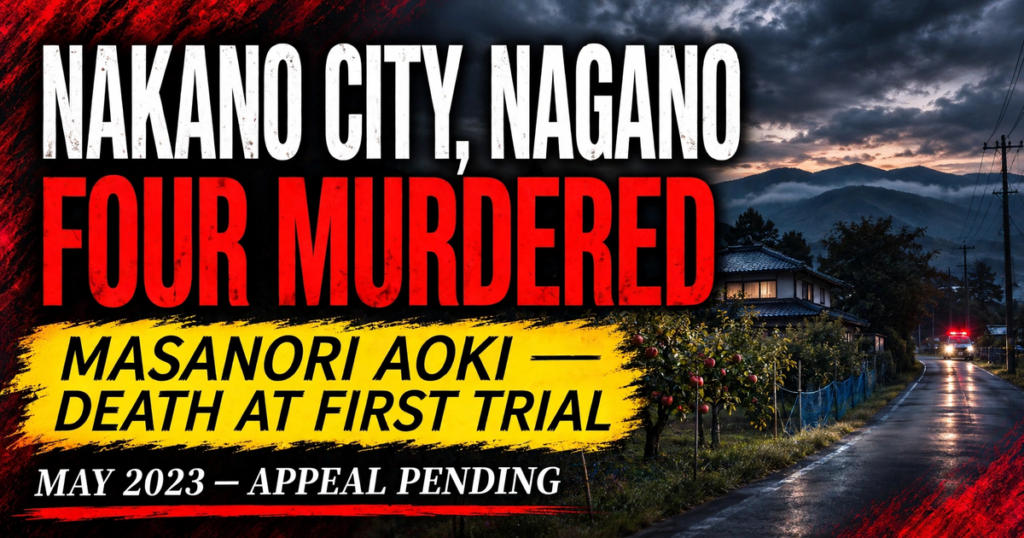
Two women were attacked while walking in Ebe
At about 4 p.m. on May 25, 2023, Yukie Murakami, aged 66, and Yasuko Takeuchi, aged 70, were walking in the Ebe area of Nakano City, Nagano Prefecture. Aoki Masanori approached them near his home and attacked them with a knife. At about 4:26 p.m., a resident who witnessed the incident called emergency services. The attack on the two women was the beginning of a rapidly escalating event that soon involved police officers who arrived in response to the report.
Two police officers were shot after they arrived
Police officers Takuo Ikeuchi, a 61-year-old sergeant, and Yoshiki Tamai, a 46-year-old inspector, travelled to the scene in a patrol car. Aoki fired a half-rifle at the officers and also used a knife, according to the charges and the court record. All four victims died from blood loss. The two officers were posthumously promoted by two ranks. The attack on residents and the subsequent attack on responding officers occurred within a short period, prompting police to secure the surrounding area and ask residents to remain indoors or evacuate.
Aoki barricaded himself in his home for about twelve hours
After the attacks, Aoki returned to his house and remained inside with a hunting firearm. Family members were in the residence, and police continued efforts to secure their safety and persuade him to come out. The family eventually escaped and was protected. At about 4:37 a.m. on May 26, Aoki came out of the house and was taken into custody. Approximately twelve hours had passed since the first emergency call. Police then investigated the four deaths, the knife and firearm, and Aoki's actions before and after the attacks.
A psychiatric examination was conducted before prosecutors indicted him
The Nagano District Public Prosecutors Office ordered an expert psychiatric detention from August to November 2023 to assess Aoki's criminal responsibility. On November 16, 2023, prosecutors indicted him for the murders of the four victims and offences under firearms and weapons laws. During the investigation, Aoki was reported to have spoken about believing that the two women had mocked him. Later proceedings examined whether these beliefs reflected delusions and how any mental symptoms affected his ability to understand his actions and control his behaviour at the time.
The trial began on 4 September 2025, and Aoki largely remained silent
The lay-judge trial began at the Nagano District Court on September 4, 2025. When asked about the charges, Aoki said that he would remain silent. He also largely declined to answer questions during the defendant examination. As a result, the court considered evidence from the investigation, family testimony, psychiatric assessments, messages sent before the attacks and his conduct before, during and after the incident. The trial lasted ten hearings and focused particularly on criminal responsibility and the appropriate sentence.
The prosecution and defence disagreed over the effect of mental illness
The prosecution accepted that Aoki had experienced delusional symptoms but argued that he retained full criminal responsibility. It pointed to the preparation of a knife, messages sent to his younger brother in April 2023 that included statements about killing people, and actions taken after the attacks. The defence argued that schizophrenia symptoms had returned or worsened and had substantially impaired his ability to distinguish right from wrong and act in accordance with that understanding. The legal issue was not simply whether a diagnosis existed, but how the symptoms affected his mental abilities at the time of the offences.
The court considered planning, conduct and expert testimony
Psychiatrists who had conducted assessments and members of Aoki's family testified during the ten-session trial. The court examined how the delusional beliefs had developed and whether they controlled his choices and actions. It also considered evidence that he had bought a knife and sharpened it before the incident, the message sent to his brother, his selection of the two women, his response to arriving police officers and his conduct during the barricade. A psychiatric diagnosis alone did not determine criminal responsibility; the court had to assess whether his ability to understand the wrongfulness of his actions or control them had been lost or significantly impaired.
The prosecution sought death, while the defence asked the court to recognise diminished responsibility
At closing submissions on September 24, 2025, prosecutors sought the death penalty. They relied on the deaths of four people, the nature of the attacks and the strength of the intent they said had been demonstrated. The defence argued that Aoki had acted under the strong influence of schizophrenia and that diminished responsibility should be recognised, which would weigh against imposing death. Aoki made a final statement referring to persecution by beings from another dimension and expressing an apology to those who had been harmed. The court then deliberated on responsibility and sentence.
The Nagano District Court imposed the death penalty on 14 October 2025
On October 14, 2025, the Nagano District Court found that Aoki had full criminal responsibility and sentenced him to death. It concluded that, although mental symptoms had influenced his behaviour to some extent, his ability to understand the nature and wrongfulness of his actions and to control his conduct had not been substantially impaired. The court treated the deaths of four people, the sequence of attacks on two residents and two police officers, and the preparation of weapons as serious aggravating circumstances. The defence filed an appeal on October 27, 2025.
The death sentence remains under appeal and has not become final
A death sentence imposed by a first-instance court is not final while an appeal remains pending. The Nagano District Court judgment was appealed by the defence, and the case moved to the Tokyo High Court. The Japanese archive's entry, updated on November 14, 2026, still described the appeal as pending and reported that a hearing date had not been set in the information it cited. The sentence must therefore be described as a first-instance death sentence under appeal, not as a final death sentence. The same source records that the case also prompted stricter rules for certain half-rifles under a 2024 amendment to the Firearms and Swords Control Law.
Original Japanese record: 長野県中野市4人殺害事件|青木政憲に一審死刑、控訴審は未開始
Last updated:
Related articles

Case record
The United Red Army Case: Twelve Deaths at the Mountain Bases, the Asama-Sanso Hostage Siege, and the Final Appeals

Case record
The Osaka Dog-Lover Serial Murders: Five Victims and the Death Sentence of Yoshinori Ueda
Case record
The Matsumoto Sarin Attack: A Chemical Strike on a Residential Area and the First Reporter Who Came Under Suspicion
Case record