
The Shimane University Student Murder: Miyako Hiraoka's Disappearance, a Deceased Suspect and 57 Images
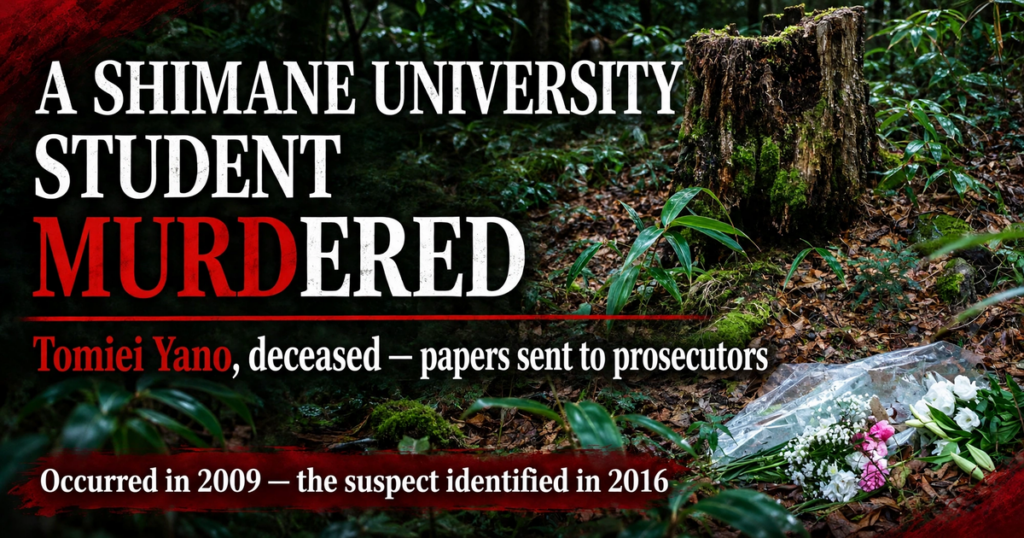
Nineteen-year-old university student Miyako Hiraoka disappeared after leaving her part-time job in Hamada on 26 October 2009. Remains were found on Mount Garyu in Kitahiroshima, Hiroshima Prefecture, between 6 and 19 November. In 2016, police referred a man who had died in a road crash shortly after the disappearance on suspicion of murder and related offences. Prosecutors declined to indict him because he was dead; there was no criminal trial or judicial conviction.
A university student disappeared after work
Miyako Hiraoka, a 19-year-old first-year student at Shimane Prefectural University, disappeared on the night of 26 October 2009 after leaving her part-time job in Hamada, Shimane Prefecture. Her disappearance led to a major search and investigation. Between 6 and 19 November, parts of her remains were found on Mount Garyu in Kitahiroshima, Hiroshima Prefecture. The location across the prefectural boundary required cooperation between police in Shimane and Hiroshima. The case became one of the most closely followed investigations in the region, but the person later identified as the suspect had already died before police could question him about the crime.
The discovery of remains and the investigation across two prefectures
The remains were found in separate discoveries over a period from 6 to 19 November 2009. Investigators had to identify the victim, establish the circumstances of her disappearance and death, and determine whether the locations where remains were found were connected. A joint investigation involving the Shimane and Hiroshima police forces followed. The separation between the place where Hiraoka was last known to be working and the mountain where remains were found made the movement of people and vehicles an important part of the investigation. The public record should preserve the dates and locations without adding unsupported detail about the manner of death.
A man who later became the suspect had died in a road crash
The man later identified by investigators was Yoshiharu Yano, who was 33. He died on 8 November 2009, two days after the first discovery of remains. Yano was travelling with his mother on the Chugoku Expressway in Yamaguchi Prefecture when their vehicle crashed and caught fire; both died. The crash was treated as a traffic accident. Because Yano had died, investigators lost the opportunity to question him, test his account or bring him before a court. The proximity in time between the crash and the murder later attracted speculation, but the source does not establish that the collision was deliberately caused.
The 57 images found on digital media
Investigators later examined a digital camera, USB memory and other storage media connected to Yano. They recovered 57 images showing what appeared to be Hiraoka's remains, knives and Yano's own feet. Some images contained details about the case that had not been publicly known before the remains were found. Investigators also linked the image locations to the interior of a residence where Yano had lived in Masuda. The images were important objective material supporting the police assessment, but they did not create a criminal trial because Yano had died.
The case remained open for years
For several years, police pursued leads without being able to identify a suspect who could be questioned and prosecuted. The case became eligible for a public investigation reward in February 2010, and police continued to appeal for information. In March 2017, the National Police Agency paid a total of 3 million yen to three people whose information contributed to resolving the case. The later recovery of digital evidence changed the direction of the inquiry and enabled police to identify a person they believed was responsible.
Police referred Yano to prosecutors in December 2016
On 20 December 2016, police referred Yano to prosecutors on suspicion of murder, destruction of a corpse and abandonment of a corpse. The referral was made after his death. In Japan, a police referral sends the investigative file and the suspect-related material to the prosecutor for a decision; it is not an indictment and does not amount to a court finding. The prosecutor reviewed the case and on 31 January 2017 decided not to prosecute because the suspect had died. The legal status must be stated exactly: the matter did not proceed to a criminal trial.
Police described the case as solved, but there was no judicial verdict
Police announced that the case had been solved in the investigative sense after identifying Yano and assembling the evidence. That description is not the same as a criminal conviction. A court did not hear the evidence, assess witnesses in an adversarial trial or issue a judgment finding Yano guilty. The prosecutor's decision not to indict because of death closed the possibility of ordinary criminal proceedings. The public may understand who police believe was responsible, but that is not a judicial determination.
What remains established and what remains legally untested
The established chronology is that Hiraoka disappeared on 26 October 2009, remains were found on Mount Garyu between 6 and 19 November, Yano died in a road crash on 8 November, and police referred him to prosecutors in December 2016. The prosecutor declined to indict him on 31 January 2017 because he was dead. The 57 images were a major investigative development. What does not exist is a criminal judgment against Yano. The record should therefore describe a case police declared solved, with a deceased suspect and no trial, rather than a conviction or a judicially tested account.
Original Japanese record: 島根女子大生殺人事件|平岡都さん失踪から7年、死亡した被疑者と57枚の画像
Last updated:
Related articles

Same case · Feature
The Shimane Prefectural University Student Murder: Fifty-Seven Image Files Found Seven Years Later — The Suspect's Death Closed the Courtroom
Case record
The Tokushima–Awaji Father-and-Son Murders: Eleven Years of Flight, No Trial

Case record
The Takatsuki Murder of Naoko Takai
Case record