
The Tomei Expressway Road-Rage Deaths: Why Kazuho Ishibashi Was Convicted of Dangerous Driving Causing Death or Injury Without Hitting the Victims
On 5 June 2017, Kazuhisa and Tomoka Hagiyama were killed when a truck struck their stopped vehicle on the Tomei Expressway. Kazuho Ishibashi had repeatedly obstructed the family’s car and forced it to stop in an expressway lane. Although his vehicle did not hit the couple, the courts found that his dangerous driving caused the fatal crash. The Supreme Court dismissed his final appeal on 19 January 2026, leaving an 18-year prison sentence in place.
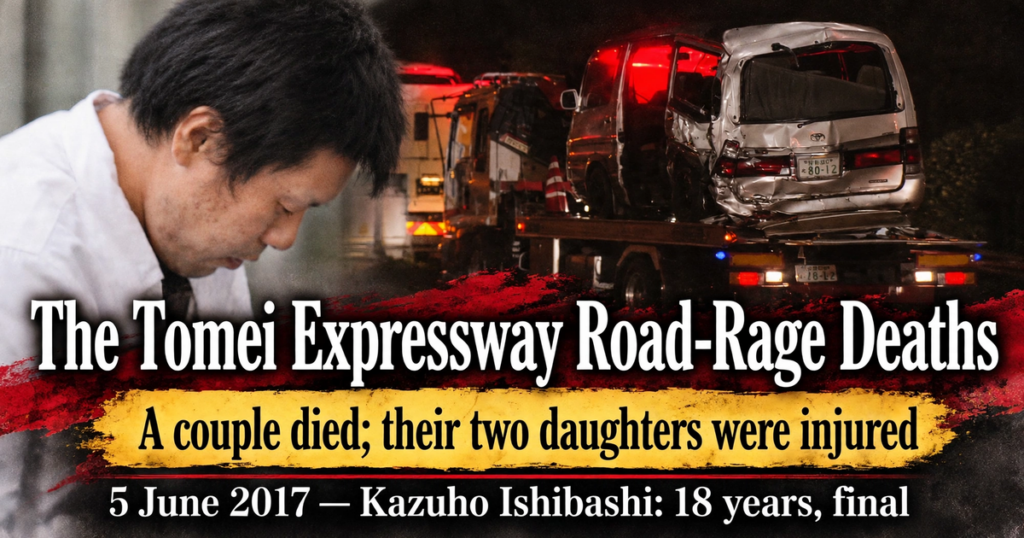
A family car was stopped on the Tomei Expressway
On the night of 5 June 2017, a family travelling along the Tomei Expressway in Kanagawa Prefecture was forced to stop in a lane on the main carriageway. Tomoka Hagiyama, aged 39, was driving. Her husband, Yoshihisa Hagiyama, aged 45, and their two daughters were in the vehicle. A large truck approaching from behind struck the stopped car. Both parents died, while their daughters were injured. The truck, not the car driven by Kazuho Ishibashi, made the physical impact that killed the couple. That distinction became the central legal question in the criminal proceedings.
A dispute at a parking area turned into repeated obstruction
The family had stopped at the Nakai Parking Area while travelling towards Shizuoka. Yoshihisa Hagiyama criticised the way Ishibashi had parked because his vehicle was obstructing traffic. The two men had not known one another before this encounter. Angered by the criticism, Ishibashi followed the family’s vehicle after it left the parking area. On the expressway, he repeatedly moved in front of it, slowed down and approached closely, forcing the driver to take evasive action. The courts treated the repeated manoeuvres as a continuous course of driving intended to obstruct the family’s passage, rather than as an isolated exchange between motorists.
The repeated manoeuvres forced the family to stop in a live lane
The Tokyo High Court’s 2019 judgment described four episodes in which Ishibashi moved in front of the family car and slowed or approached it at close range. In the final sequence, he moved into the lane immediately ahead and brought his own vehicle to a stop. The family’s car was left stopped in the third traffic lane, the overtaking lane, where vehicles normally travel at high speed and are not expected to encounter stationary traffic. Ishibashi then got out and approached Kazuhisa, grabbing him by the clothing. Tomoka also left the vehicle, while the daughters remained inside. A truck approaching from behind then collided with the family car.
The central issue was causation, not who made the final impact
The defence argued that the deaths and injuries occurred after the vehicles had stopped and were caused by the truck driver’s collision, not by Ishibashi’s driving. The prosecution argued that the repeated dangerous manoeuvres had forced the family into an exceptionally hazardous position on an expressway, and that the resulting collision was the realisation of the danger created by those manoeuvres. The courts had to consider whether the intervening events—the forced stop, Ishibashi’s confrontation with Kazuhisa and the truck’s failure to avoid the car—broke the legal connection between the original driving and the deaths. The fact that Ishibashi’s car never struck the victims did not, by itself, answer that question.
The first conviction was set aside because of a procedural error
On 14 December 2018, the Yokohama District Court, sitting as a lay-judge trial, convicted Ishibashi of dangerous driving causing death or injury and imposed an 18-year prison sentence. The prosecution had sought 23 years. On 6 December 2019, the Tokyo High Court quashed that judgment and remanded the case to the district court. It did not acquit Ishibashi or rule that the dangerous-driving offence could not apply. The problem concerned the pretrial arrangement of the issues: the trial court had earlier indicated that the offence would not be established, then changed its legal position without giving the defence a sufficient opportunity to respond. The High Court held that this had impaired the defendant’s right to prepare and present a defence. A new trial before a newly selected panel of lay judges was required.
The retrial and second appeal upheld the 18-year sentence
At the retrial, the Yokohama District Court again found that the dangerous driving and the fatal collision were causally connected. On 6 June 2022, it sentenced Ishibashi to 18 years in prison. The court examined the manner of obstruction, the movement of the vehicles, available video and location evidence, and the circumstances in which the truck approached the stationary car. Ishibashi appealed again, but on 26 February 2024 the Tokyo High Court dismissed the appeal and upheld the sentence. The second appellate proceedings therefore ended with the same punishment as the retrial judgment.
The Supreme Court dismissed the final appeal in January 2026
Ishibashi then appealed to the Supreme Court. On 19 January 2026, the Supreme Court’s First Petty Bench dismissed the appeal, leaving the 18-year sentence final. This was a dismissal of the appeal, not a withdrawal by the defendant. The proceedings had taken more than eight years from the crash. Their length reflected two separate issues: how the law of dangerous driving applied when a third party’s truck caused the immediate impact, and the procedural defect that had required the first conviction to be set aside. The final result confirmed that an offender need not personally collide with a victim for dangerous driving to be legally connected to a fatal outcome.
Later legal reforms were not applied retroactively
After the crash, Japan strengthened its response to road-rage driving. A new offence of obstructive driving under the Road Traffic Act took effect on 30 June 2020. Amendments to the Act on Punishment of Acts Inflicting Death or Injury by Driving a Motor Vehicle also added categories of dangerous driving involving obstruction of other vehicles. Those later provisions were not applied retrospectively to Ishibashi’s conduct in 2017. His conviction was based on the law in force at the time of the incident. The distinction matters: the case did not depend on a later offence being used to punish earlier conduct, but on the courts’ interpretation of the dangerous-driving provisions that already existed.
The case is about both causation and procedural fairness
The surviving daughters lost both parents and were required to face the proceedings again after the first judgment was quashed. The retrial nevertheless had to respect the defendant’s procedural rights and examine the evidence under the correct legal framework. The case is often described as a road-rage incident in which the driver who caused the deaths did not strike the victims. Its legal significance is more precise. Repeated high-speed obstruction created a foreseeable danger on an expressway; the family was forced to stop in a live lane; and the truck collision followed while that danger remained. The Supreme Court’s 2026 dismissal left the conviction and 18-year sentence in force.
Original Japanese record: 東名あおり運転死亡事故|追突していない石橋和歩に危険運転致死傷罪が成立した理由
Last updated:
Related articles
Case record
The Ikebukuro Runaway-Car Crash: Two Deaths, a Five-Year Sentence and the Driver's Death in Custody
Case record
The 1999 Tomei Expressway Drunk-Driving Crash: Two Young Sisters Killed and a Four-Year Sentence
Case record
The Kyoto Kameoka Runaway Crash: Three Deaths, Seven Injuries and the Limits of the Former Dangerous-Driving Law
Case record