
The Tokyo Metropolitan Police Dormitory Bombings
On 1 November 1990, a bomb exploded at the Tokyo Metropolitan Police Department's Seiwa Dormitory in Shinjuku, killing one police officer and injuring seven people. Another Metropolitan Police dormitory was also targeted in the same campaign, but the Japanese source does not identify the second site by name. The device used a double-operation mechanism: it could detonate if moved or when its preset time arrived. The 15-year murder limitation period expired in November 2005 under the transitional rule introduced by the 2004 amendment; the 2010 abolition of limitation did not revive the case.
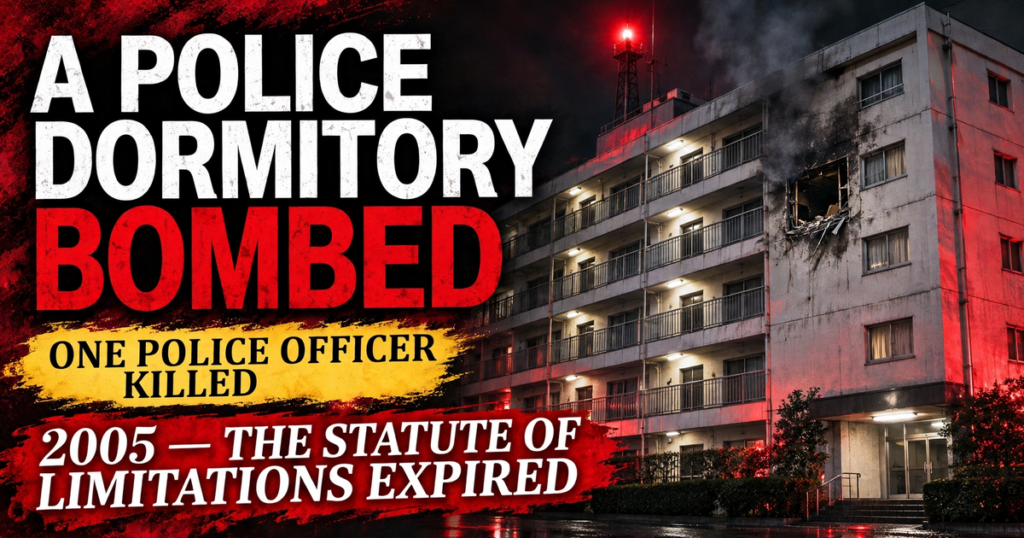
A bomb exploded at the Seiwa police dormitory in Shinjuku
On the night of 1 November 1990, a bomb exploded at the Tokyo Metropolitan Police Department's Seiwa Dormitory in Kita-Shinjuku, Shinjuku Ward. The building housed single police officers, including personnel from Shinjuku Police Station. One officer died and seven people were injured.
Seven people were injured
Seven people were injured in the attack, including police officers, dormitory-related personnel and members of the public. Alongside the officer who died, the casualties extended beyond the police officers living at the dormitory.
A second police dormitory was also targeted
From the same night into the early hours of 2 November, explosives were also confirmed at another Tokyo Metropolitan Police dormitory. A book on public-security investigations published by Shinchosha discusses the sequence in which a second dormitory was targeted after Seiwa Dormitory. The use of more than one police dormitory as a target led investigators to treat the incidents as a connected series directed at the police organisation, rather than as an isolated attack on a single facility.
The devices were described as a double-operation system
The devices used a double-operation mechanism. A device could detonate if it was moved, and it could also detonate when its preset time arrived even if it was left untouched. The two independent activation routes made the device dangerous both to someone attempting to move it and to someone who left it in place.
The National Police Agency attributed the campaign to Kakurōkyō Hazama-ha
The National Police Agency's 1991 White Paper on Police described the series as an attack carried out by the Kakurōkyō Hazama faction, a radical left-wing group involved in violent political activity at the time. The agency placed the bombings within the faction's broader campaign of terrorist and guerrilla-style attacks. This is an official police assessment of organisational responsibility. It should not be confused with a criminal judgment against a named individual. No specific person was brought to trial and found guilty of placing the devices or causing the fatal explosion.
The political background was opposition to the Enthronement Ceremony and Daijōsai
The attacks took place in the period surrounding the 1990 Enthronement Ceremony and the Daijōsai, the major accession-related rites held that November. The Kakurōkyō Hazama faction was engaged in anti-imperial and anti-ceremonial activism, and police understood the dormitory bombings as part of that political campaign. The selection of police accommodation as a target was consistent with an attack directed at the police as an institution. Even so, the political context does not by itself identify the person who prepared or planted each device. The broader factional attribution and the individual criminal responsibility remained distinct questions.
No individual perpetrator was prosecuted
Investigators examined the devices, the manner in which they were installed, the sequence of explosions and possible connections with earlier attacks. They also considered the routes by which the components had been obtained and the expertise needed to assemble the devices. The investigation did not lead to an individual being identified and prosecuted for the bombings. The National Police Agency's attribution to the faction therefore remained an organisational assessment rather than a finding made after a trial of a named defendant. The case illustrates the difference between identifying a suspected political group and proving the criminal responsibility of a particular person.
The murder limitation period expired in November 2005
At the time of the 1990 bombing, the limitation period for murder was 15 years. The 2004 amendment extended the limitation period for murder to 25 years, but its transitional provision kept the former period for offences committed before the amendment. The 15-year period therefore continued to run in this case and expired in November 2005. In 2010, the law abolished limitation periods for murder and other offences punishable by death. That reform did not revive cases in which the limitation period had already expired. Because the limitation period for the 1990 killing had been completed in 2005, the 2010 amendment did not restore the ability to prosecute an individual for the murder.
Original Japanese record: 警視庁独身寮爆破事件|清和寮で警察官1人死亡、二重作動式爆弾と2005年の時効
Last updated:
Related articles
Case record
The 1995 Tokyo Subway Sarin Attack: Victims, Criminal Trials and a Continuing Legacy
Case record
The Mitsubishi Heavy Industries Bombing and the East Asia Anti-Japan Armed Front's Corporate Bombing Campaign
Case record
The Tama City Manhole Murder: A Missing Woman Found in a Roadway Chamber Ten Months Later
Case record