
The Tokushima Radio Shop Murder: A Wrongful Conviction Overturned in a Posthumous Retrial
On 5 November 1953, radio-shop owner Kamesaburo Saegusa was stabbed to death in Tokushima City. His common-law wife, Shigeko Fuji, was also wounded but was later prosecuted and convicted of his murder. The conviction rested heavily on testimony from two live-in shop assistants and was finalised after Fuji withdrew her appeal in 1958. After new records were disclosed and the witnesses admitted that their earlier testimony was false, Fuji's relatives pursued a retrial after her death. She was acquitted in July 1985, the first posthumous retrial acquittal in Japan.

A radio-shop owner was killed in the early hours of 5 November 1953
In the early hours of 5 November 1953, an intruder entered a combined electrical shop and residence in central Tokushima City. The owner, Kamesaburo Saegusa, was stabbed and killed. His common-law wife, Shigeko Fuji, was also stabbed in the abdomen and other areas and survived. Their young daughter was asleep in the same room. The case initially appeared to be a murder committed by someone who had entered from outside. The later decision to treat Fuji as the perpetrator would become the central source of the wrongful conviction.
Fuji was a victim at the scene before she became the main suspect
The fact that Fuji herself had been injured was important to the early understanding of the crime. Saegusa and Fuji had been sleeping in the same room with their daughter between them when an unknown person entered and attacked them. Police initially considered an outside intruder. About nine months later, however, the investigation changed direction and Fuji was arrested. The shift was later discussed in the Diet, where lawmakers questioned how the authorities had moved from an outside-offender theory to a case against a woman who had also been wounded in the attack.
The prosecution relied heavily on the statements of two shop assistants
Two young men, Nishino and Abe, had lived and worked at the shop. Their statements became central to the prosecution's case. The authorities developed a theory that Fuji had been jealous of Saegusa's relationships with other women and had decided to kill him because of concerns about her future. Fuji made a statement during questioning that was treated as an admission, but she later withdrew it and maintained her innocence at trial. The case was unusual because the physical evidence was limited while the testimony of the two employees carried decisive weight.
The first conviction imposed thirteen years' imprisonment
On 18 April 1956, the Tokushima District Court convicted Fuji of murder and sentenced her to 13 years' imprisonment. The prosecution had sought life imprisonment. Fuji appealed, but on 21 December 1957 the Takamatsu High Court upheld the conviction. She then appealed to the Supreme Court. On 10 May 1958, she withdrew that appeal. The conviction therefore became final through the withdrawal, not because the Supreme Court examined the evidence and issued a decision upholding the conviction. That procedural distinction is important when describing the history of the case.
Later developments undermined the testimony that had supported the conviction
Around the time the conviction became final, a man claiming to be the real killer reportedly went to Shizuoka Prefectural Police. That report did not establish the man's guilt in court, but it raised questions about whether the prosecution's theory of an inside job was complete. Fuji's relatives also obtained a written account from one of the former shop assistants in which he said that his earlier statements and testimony were not true. The two former employees eventually acknowledged that their testimony in the original trial had been false. The credibility of the central witnesses was therefore seriously undermined after the conviction had become final.
The relatives pursued repeated retrial applications and obtained undisclosed records
Fuji continued to seek a retrial after her conviction. She made five applications during her lifetime, the fifth in January 1978. During that process, prosecutors disclosed 22 volumes of investigative records that had not been submitted to the original court. The records reportedly contained material pointing toward an outside perpetrator and information inconsistent with the original theory. The case also drew attention from the Japan Federation of Bar Associations, which began investigating possible human-rights violations in the investigation in 1959. The later disclosure showed how material held by the prosecution but not presented at trial could change the assessment of a final conviction.
Fuji died before a retrial could be ordered, but relatives continued the case
Fuji's health deteriorated after she developed kidney cancer. On 8 November 1979, four siblings filed a sixth retrial application on her behalf. Fuji died on 15 November 1979, before the court decided whether to reopen the case. Japanese criminal procedure allows certain close relatives to seek a retrial for a deceased person in order to restore that person's legal reputation. The Tokushima District Court accepted the relatives' application and continued examining the evidence. This was not an ordinary appeal by a living defendant; it was a posthumous proceeding pursued in the deceased person's interest.
A retrial was ordered in 1980 and confirmed in 1983
On 13 December 1980, the Tokushima District Court ordered a retrial, finding that the original conclusion that Fuji was the killer could no longer be maintained. Prosecutors filed an immediate appeal. On 12 March 1983, the Takamatsu High Court dismissed it. Prosecutors did not take the matter to the Supreme Court, and the retrial order became final. Even after the retrial was authorised, the case did not end immediately. The retrial hearing itself required further examination of the witnesses and evidence, and the prosecution continued to argue that the original conviction should stand.
The retrial ended in acquittal, but it did not identify the killer
At the retrial, prosecutors again sought a 13-year sentence and called witnesses, but the Tokushima District Court acquitted Fuji on 9 July 1985. The court recognised evidence pointing to the presence of an outside perpetrator and rejected the case against her. Prosecutors did not appeal, and the acquittal became final on 19 July 1985. Fuji had died nearly six years earlier and could not hear the judgment. The acquittal erased the legal finding that she had murdered Saegusa, but it did not convict another person or establish who had killed him. The case is remembered as Japan's first final acquittal obtained through a posthumous retrial.
Original Japanese record: 徳島ラジオ商殺し事件|被害者から被告人へ、冨士茂子さんの死後再審無罪
Last updated:
Related articles
Case record
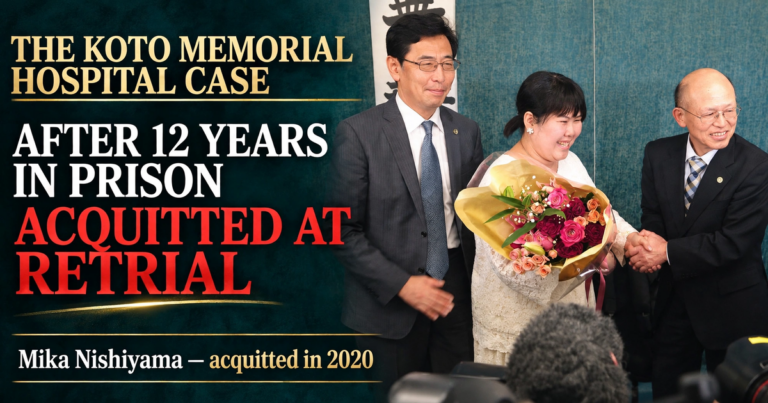
The Koto Memorial Hospital Case: A Twelve-Year Sentence Overturned by Retrial, and a Death Not Proven to Be Homicide
Case record
The Himi Case: A Wrongful Conviction, a Prosecutor's Retrial Request and an Acquittal
Case record
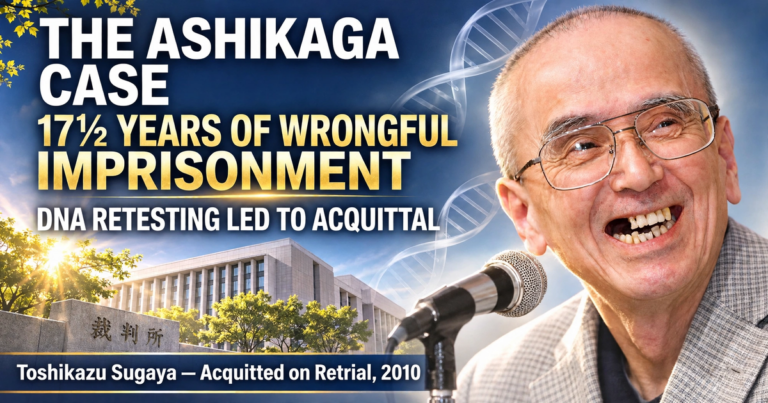
The Ashikaga Case: How DNA Evidence and a False Confession Led to a Wrongful Conviction
Case record