
The Matsubase Case: A Confession Undone by a Surviving Piece of Cloth
Hiroki Miyata was convicted of a 1985 murder largely on the basis of a confession that conflicted with physical evidence. A retrial acquitted him of murder in 2019; a separate damages case continued through a major appellate ruling in July 2026.
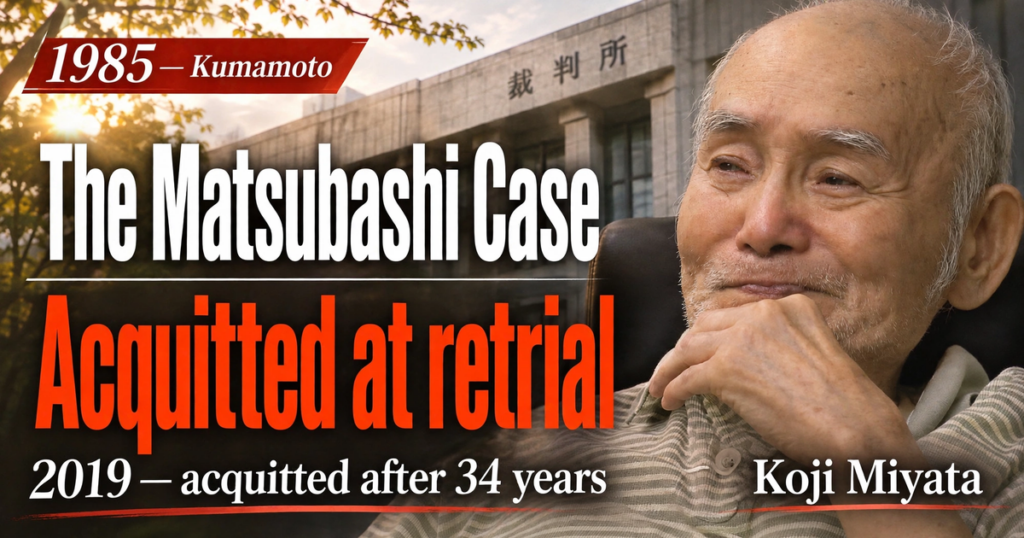
A 59-year-old man was found dead in Matsubase in January 1985
The Matsubase Case began in January 1985 in Matsubase Town, then part of Shimomashiki District in Kumamoto Prefecture and now within Uki City. Matao Okamura, a 59-year-old man, was found dead inside his home at about 9:30 a.m. on 8 January. He had multiple injuries to his face and neck. The retrial judgment identified the cause of death as blood loss from a severed left common carotid artery and found that he had been attacked with a blade-like weapon around 6 January. Hiroki Miyata, an acquaintance of the victim and a fellow shogi player, became the focus of the investigation. The later retrial showed how a confession had been accepted even though important details conflicted with physical evidence. The issue was whether the evidence proved that Miyata was the killer.
Miyata confessed after repeated questioning and was indicted
Police questioned Miyata repeatedly from the evening of 8 January through 19 January. On 20 January, he made a statement admitting that he had killed the victim and was arrested. He continued to make admissions during the investigation and was indicted on 10 February. The prosecution's account, later accepted in the original final judgment, described an argument during drinking and resentment that Miyata had held toward the victim. According to that account, Miyata took a small utility knife and stabbed the victim in the neck more than ten times. Miyata admitted the murder at the first hearing but later changed his position during the trial and denied the charge. The Kumamoto District Court nevertheless accepted the confession as voluntary and credible. On 22 December 1986, it convicted him of murder and related firearms offences and sentenced him to 13 years in prison. The central problem was that the confession contained specific details that could be tested against physical evidence.
The original conviction relied heavily on the confession
The Fukuoka High Court dismissed Miyata's appeal in 1988, and the Supreme Court rejected his final appeal in 1990. The conviction became final on 26 January 1990. Miyata was released on parole on 25 March 1999, and his sentence ended on 22 July of that year. The later retrial judgment made clear that evidence independent of the confession linking Miyata to the murder was limited. The confession said he had cut a piece from his shirt, wrapped it around the handle of the knife to avoid blood, and burned it after the attack. If that detail was false, it undermined a central part of the prosecution's reconstruction. A confession must still be tested against physical evidence and the circumstances in which it was obtained.
The missing piece of cloth was actually preserved
The most important new evidence concerned a piece cut from the left sleeve of Miyata's shirt. He had said that he removed the cloth, wrapped it around the handle of the utility knife, used the knife and then burned the cloth. Disclosure of evidence during the retrial proceedings showed that pieces of the shirt, including material from the left sleeve, had in fact been retained by the authorities. When the fragments were assembled, the relevant sleeve portion could be reconstructed. No blood was detected on the reconstructed area. The statement that the cloth had been cut away and burned could not be reconciled with the fact that it remained in police or prosecution custody. The inconsistency was not a minor error about an incidental detail. It concerned the alleged weapon's handling and the supposed destruction of evidence after the killing. The relationship between the blade and the victim's wounds also raised questions about whether the small knife was the actual weapon.
A retrial was ordered after years of litigation
Miyata's side filed a second retrial request on 12 March 2012, after he had already completed his prison sentence. The request relied on the surviving shirt fragments, new forensic assessments and the mismatch between the knife and the victim's injuries. On 30 June 2016, the Kumamoto District Court ordered a retrial, finding that the weapon identified in the confession and the wounds were materially inconsistent and that the account about wrapping the knife handle in cloth might be false. Prosecutors appealed. On 29 November 2017, the Fukuoka High Court dismissed the immediate appeal, and on 10 October 2018 the Supreme Court's Second Petty Bench rejected the prosecution's special appeal. The retrial order therefore became final. A retrial order does not itself mean that the defendant has been acquitted; it allows a new criminal trial in which the old evidence and newly disclosed material can be examined again.
The retrial acquitted Miyata of murder but not every separate offence
On 28 March 2019, the Kumamoto District Court acquitted Miyata of the murder. It accepted that the victim had been killed by someone using a blade-like weapon but concluded that there was no evidence establishing that Miyata was the killer. Prosecutors did not present new evidence to prove the murder charge at the retrial and did not appeal the acquittal, which therefore became final. The legal result must be described precisely. Miyata had also been prosecuted for possessing a handgun and ammunition at his home. The 2019 retrial judgment acquitted him of murder but imposed a one-year sentence for the separate firearms-related offence. It is therefore inaccurate to say that every offence in the original case ended in an acquittal. Miyata died on 29 October 2020 at the age of 87, about a year and seven months after the murder acquittal.
A separate civil damages case reached a new ruling in July 2026
The retrial acquittal did not end the dispute over how the investigation and prosecution had been conducted. Miyata's family continued a damages action against the national government and Kumamoto Prefecture after his death. On 14 March 2025, the Kumamoto District Court found unlawful conduct by prosecutors and ordered the state to pay approximately 23.8 million yen, while dismissing the claim against the prefecture concerning police conduct. Both sides appealed. On 27 July 2026, the Fukuoka High Court held that Kumamoto Prefecture, as well as the national government, had liability. It ordered the prefecture to pay each of the two plaintiffs 11,905,831 yen plus interest, jointly with the state, and dismissed the state's appeal. The national government filed a further appeal to the Supreme Court on 7 August 2026. The civil case is therefore not finally resolved.
The case exposed the risks of confession-led investigations
The Matsubase Case is not a story in which a new suspect was later identified. Its central issue is that Miyata was convicted largely on a confession whose key detail was contradicted by physical material that remained available. The shirt fragment, the knife and the wounds required a fresh examination of the original account. The retrial court found that the evidence did not prove Miyata had committed the murder. The later civil proceedings examined the conduct of police and prosecutors, but those proceedings address state liability rather than criminal guilt. As of November 2026, the criminal acquittal is final, while the national government's appeal from the July 2026 civil judgment is pending. Those two legal tracks must remain separate.
Original Japanese record: 松橋事件|岡村又雄さん殺害で懲役13年、燃やしたはずの布片から再審無罪へ
Last updated:
Related articles
Case record
The Menda Case: Japan's First Postwar Retrial Acquittal of a Death-Row Prisoner
Case record
The Fukui Junior High School Girl Murder: A Reversed Conviction, a Retrial Acquittal and a Prosecutorial Review
Case record
The Oita Midoriso Case: An Acquittal After Hair Evidence and DNA Testing Were Reexamined

Case record