
The Sennichi Department Store Fire: 118 Deaths and the Supreme Court's Ruling on Fire-Management Duties
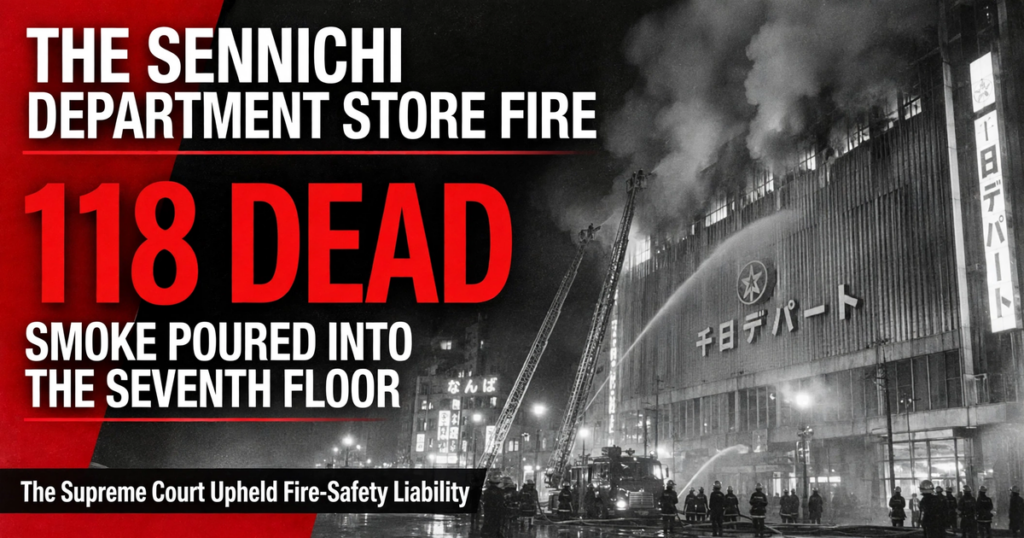
A fire broke out near the third-floor sales area of Osaka's Sennichi Department Store at about 10:25 p.m. on May 13, 1972, while the building was undergoing electrical work. Smoke rose to the seventh-floor Playtown cabaret, where customers and employees were still present. The disaster killed 118 people and injured 81. The criminal case moved from acquittal to conviction on appeal, and the Supreme Court upheld the convictions on November 29, 1990.
A fire began on the third floor after the store had closed
At approximately 10:25 p.m. on May 13, 1972, a fire broke out near the sales area on the third floor of the Sennichi Department Store in Osaka's Minami Ward, as it was then known. Electrical work was being carried out on that floor after the department store had closed. The building was a large mixed-use property with retail, food and entertainment businesses. While the sales floors were closed, the Playtown cabaret on the seventh floor was still operating and had customers and employees inside. The fire's point of origin was identified as the third-floor area, but the cause of ignition itself was not conclusively established.
Smoke rose from the third floor to the operating cabaret
Smoke travelled upward through stairs, elevator shafts, ducts and other openings in the building. The seventh-floor Playtown was separated from the department store's closed retail floors by distance and different business operations, but the internal openings allowed smoke and toxic gases to reach it. The fire did not need to burn through the entire seventh floor to create a fatal environment. Smoke reduced visibility, impaired breathing and left people with little time to find an escape route. The disaster became one of Japan's most serious building fires because 118 people died, many of them in the cabaret on the seventh floor.
The total toll was 118 dead and 81 injured
The overall casualty figures for the fire are 118 deaths and 81 injuries. The number of people killed was not limited to those directly exposed to flames. Smoke inhalation and the failure of evacuation arrangements were central to the loss of life. Some court documents use different figures for the particular deaths and injuries attributed to individual defendants, because criminal responsibility was assessed according to each person's duty and the consequences that could legally be linked to that breach. The overall disaster toll should therefore be kept distinct from the narrower figures used in particular parts of the criminal case.
The building's separate businesses created divided management responsibilities
The Sennichi Department Store contained retail and entertainment facilities that were operated and managed by different organisations. This arrangement created separate lines of authority across the building. The criminal case examined three people with different responsibilities: the department store's management-section chief and fire-safety manager, the Playtown manager and fire-safety manager, and the president of the company operating the cabaret. The question was not simply who held the highest title. The courts considered what each person could actually do to prevent the spread of fire, preserve escape routes, train employees and supervise safety work.
The department-store manager had duties during construction work
The department-store management chief was responsible for fire safety on the retail side. During the electrical work on the third floor, the Supreme Court considered whether he should have closed fire shutters where possible and arranged for security staff or another person to remain present and monitor the work. The court found that he could have taken those measures under his own authority or sought instructions from a superior. Fire shutters and compartment barriers are intended to slow the movement of smoke and flames. The failure to manage them during work therefore formed part of the negligence findings.
The Playtown manager had a duty to prepare and practise evacuation
The Playtown manager was responsible for the safety of customers and employees on the seventh floor. The court considered whether he should have inspected escape routes, understood which route could lead people safely to the ground and conducted evacuation training. The B stairway was identified as an available route that could have been understood in advance. The fact that warning information from lower floors was not properly passed on did not eliminate the manager's responsibility to prepare the cabaret staff to guide customers. An evacuation system is effective only when employees know where to direct people and have practised doing so.
The operating company's president had a supervisory duty
The company president was examined in relation to the condition of escape equipment and the supervision of the Playtown manager's fire-safety work. The record included problems with the maintenance and replacement of an escape chute and inadequate evacuation training. The court considered whether the president had known of these conditions and failed to ensure that the manager performed the required safety duties. This was different from the responsibility of a person who would personally direct customers during an emergency. The case recognised that management responsibility can include creating and supervising a system that allows staff to carry out their duties.
The first-instance acquittal was overturned by the Osaka High Court
The criminal proceedings lasted for many years. The first-instance court acquitted the defendants, but the Osaka High Court reversed that outcome in 1987 and found the relevant managers guilty. The appellate court assessed the duties attached to each person's position and the steps that could reasonably have been taken to prevent the disaster's consequences. The case was not decided on the basis that every manager in a large building automatically bears responsibility for every death. It examined the concrete powers and obligations of the individual defendants, including fire-shutter management, monitoring of construction work and evacuation arrangements.
The Supreme Court upheld the convictions in 1990
On November 29, 1990, the Supreme Court rejected the appeals and maintained the Osaka High Court's convictions. More than eighteen years had passed since the fire. The decision became an important precedent on the way criminal negligence is assessed in large building disasters. It emphasised that responsibility depends on the authority a person actually held and the specific safety measures that person could have taken. The case therefore remains significant not only because of the 118 deaths but also because it clarified how courts can assess the duties of several managers whose responsibilities overlap within a complex building.
The fire's lesson was about practical management, not equipment alone
The seventh floor had escape equipment and exits, but their existence did not guarantee that customers could use them safely during a rapidly developing fire. Fire prevention includes maintaining shutters and doors, ensuring that construction work does not compromise compartments, keeping escape routes clear, repairing emergency equipment and training employees to direct people. The Sennichi disaster showed how a fire on a closed floor can endanger an entirely different business operating above it. The final court decisions treated those responsibilities as concrete duties attached to particular roles, rather than abstract obligations shared equally by everyone.
Original Japanese record: 千日デパート火災|118人死亡、7階へ流れた煙と最高裁が認めた防火管理責任
Last updated:
Related articles
Case record
The Expo Land Roller-Coaster Crash: A Fatigue-Cracked Axle, a Missed Inspection and Criminal Liability
Case record
The Uminonakamichi Bridge Crash: Three Children Killed and a 20-Year Sentence
Case record
The Bibai Beauty Salon Dormitory Fire: Ten Deaths, Smoke-Filled Escape Routes and an Undetermined Cause
Case record