
The Uminonakamichi Bridge Crash: Three Children Killed and a 20-Year Sentence
At about 10:48 p.m. on August 25, 2006, a car driven by a drunk Fukuoka City employee struck a family vehicle on Uminonakamichi Bridge. The family car fell into the sea, and three children aged one, three and four died; their parents were injured. The first court imposed seven years and six months for negligent driving, but the Fukuoka High Court applied the dangerous-driving offence and imposed 20 years. The Supreme Court dismissed the appeal on October 31, 2011.
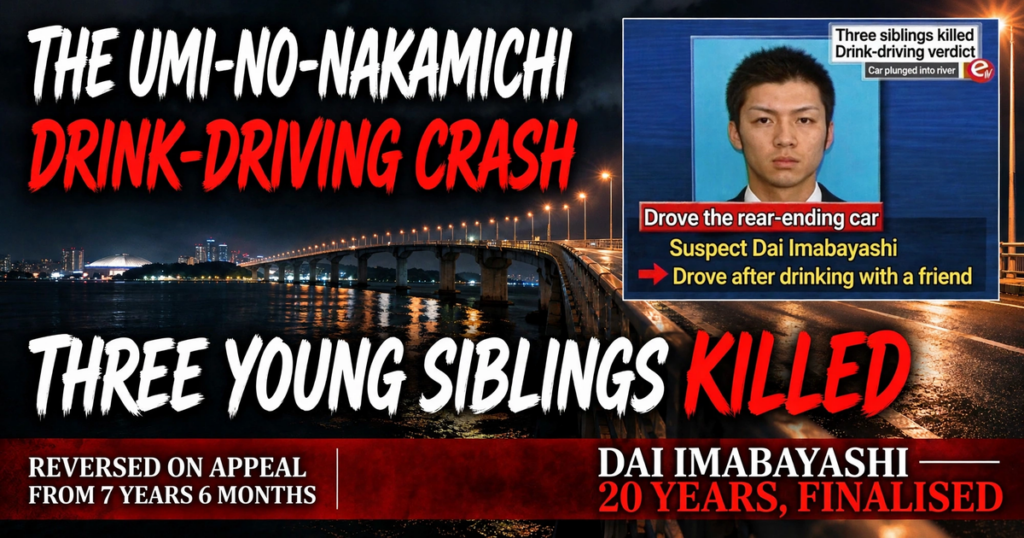
A family car was struck on Uminonakamichi Bridge
At about 10:48 p.m. on August 25, 2006, a passenger car driven by Fukuoka City employee Dai Imabayashi struck a family vehicle on Uminonakamichi Bridge in Higashi Ward, Fukuoka City. The family car was knocked from the bridge and fell into the sea. Three young children travelling in it died. Their parents survived but were injured. The crash became one of Japan's most widely discussed drunk-driving cases because the children were killed in a collision caused by a driver who had been drinking heavily and because the legal charge applied at the first trial became a major issue.
The three children were aged one, three and four
The children who died were one, three and four years old. Their parents had been travelling with them in the family vehicle. The official court judgment records the deaths by age and describes injuries to both adults. The family vehicle fell from the bridge into the water after the impact, and the parents were unable to save all three children. The event left two parents with the loss of their children and became a major focus of public debate about the consequences of driving after drinking.
The driver had consumed alcohol before getting behind the wheel
The court record describes Imabayashi drinking at home during the evening and then continuing to drink with friends at an izakaya and a snack bar. He later drove a passenger car with a friend on board. The road across the bridge had a speed limit of 50 kilometres per hour. The appellate court found that he was travelling at about 100 kilometres per hour when he struck the family vehicle. The collision occurred after he had consumed a substantial amount of alcohol, and the court found that his ability to drive normally was impaired by alcohol.
He left the scene and tried to conceal his drinking
After the collision, Imabayashi did not immediately stop to provide assistance or report the accident. The appellate court found that he left the scene because he feared that his drinking would be discovered and that he might lose his job. He contacted a friend and asked for help in concealing the drinking; he also sought to arrange for another person to take responsibility. The failure to stop and assist formed a separate part of the criminal case, alongside the dangerous driving that caused the deaths and injuries.
The first court did not apply the dangerous-driving offence
The Fukuoka District Court delivered its judgment on January 8, 2008. It did not find that the prosecution had proved the statutory requirement for dangerous driving causing death or injury: that the driver was in a condition in which normal driving was difficult because of alcohol. Instead, it convicted him of professional negligence resulting in death or injury and related Road Traffic Act offences, including leaving the scene. The court imposed a prison term of seven years and six months. The prosecution appealed, arguing that the dangerous-driving offence should have been applied.
The High Court replaced the first judgment with a 20-year term
On May 15, 2009, the Fukuoka High Court quashed the first-instance judgment and imposed a 20-year prison sentence. It found that Imabayashi had driven under the influence of alcohol in a state that made normal driving difficult. The High Court assessed the evidence about the amount he had consumed, the manner of driving, the speed, the collision and his conduct immediately afterwards. It concluded that the statutory elements of dangerous driving causing death or injury were established. The High Court also treated the failure to stop and provide assistance as part of the offences.
The Supreme Court dismissed the appeal in 2011
Imabayashi challenged the High Court judgment, but on October 31, 2011, the Supreme Court dismissed his appeal. The 20-year prison sentence therefore became final. The final result was not a return to the district court's seven-year-and-six-month sentence. The appellate ruling that applied the dangerous-driving offence remained in force. The distinction between the first-instance offence and the final appellate offence is central to the history of this case.
The statutory test was more demanding than proof of drinking
The legal dispute was not whether Imabayashi had consumed alcohol; that fact was established. The question was whether his condition met the narrower legal test of being unable to drive normally because of alcohol. Under the law applicable at the time, alcohol consumption alone did not automatically establish dangerous driving causing death or injury. The prosecution had to prove the required level of impairment. The first court found the threshold unproven, while the High Court evaluated the same evidence differently and concluded that the threshold was met.
The crash became a turning point in public discussion of drunk driving
The deaths of the three children intensified public demands for stronger measures against drunk driving. The case was discussed alongside other serious crashes and legislative changes designed to deter dangerous driving. The 2007 amendments to the Road Traffic Act and the dangerous-driving provisions changed the legal framework after the collision, while the 2013 Act on Punishment of Acts Inflicting Death or Injury by Driving later reorganised offences concerning dangerous driving. Those later statutes should not be described as the legal basis for a 2006 offence where the applicable provisions were different.
The final legal outcome and the family's loss should not be reduced to a slogan
The Uminonakamichi crash is remembered for the loss of three very young children, but its legal history also matters. The first court and the High Court reached different conclusions about the dangerous-driving threshold. The Supreme Court left the 20-year sentence in place in 2011. The case also involved leaving the scene and attempts to conceal the drinking. A careful account must distinguish the accident, the first-instance negligence conviction, the appellate dangerous-driving conviction and the final sentence, while recognising the severe harm suffered by the surviving parents.
Original Japanese record: 福岡海の中道大橋飲酒運転事故|幼い3きょうだい死亡、一審7年6月から危険運転で懲役20年へ
Last updated:
Related articles

Case record
The Paloma Water-Heater Deaths: Twenty-Eight Carbon-Monoxide Accidents and a Failure to Act on Warning Signs
Case record
The Expo Land Roller-Coaster Crash: A Fatigue-Cracked Axle, a Missed Inspection and Criminal Liability
Case record
The Kochi White Police Motorcycle Collision: One Retrial Rejected, a Second in Preparation
Case record