
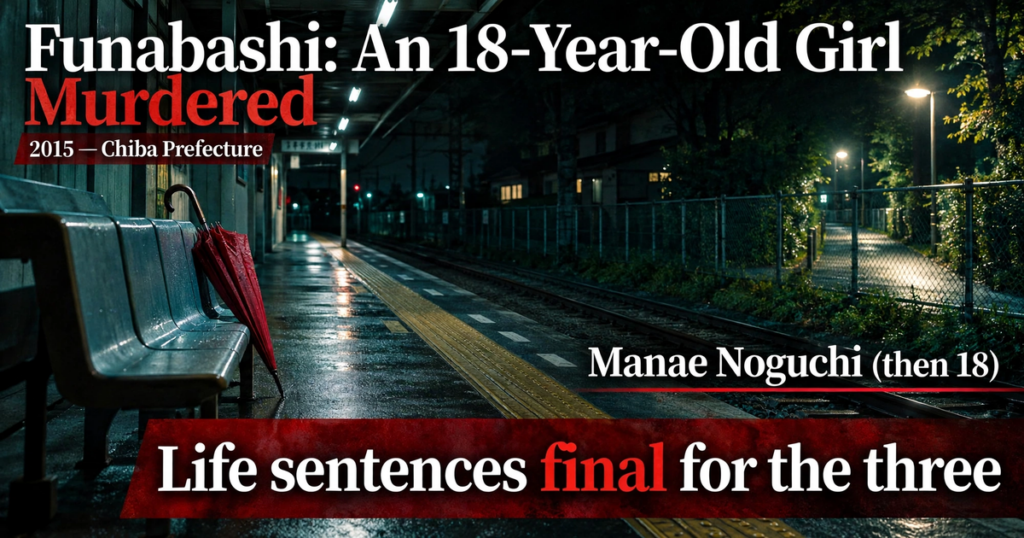
The Murder of 18-Year-Old Manae Noguchi
Manae Noguchi, an 18-year-old woman from Funabashi, was abducted in April 2015 and found buried in a field in Shibayama. Three defendants ultimately received life sentences, but the proceedings distinguished their individual roles and the separate juvenile case.
A missing-person inquiry led investigators to a field in Shibayama
Manae Noguchi, an 18-year-old woman who lived in Funabashi, Chiba Prefecture, disappeared after the evening of 19 April 2015. The investigation later established that she had been taken from a street in Chuo Ward, Chiba City, rather than from Funabashi itself. Witness information and the inquiry into people connected with her led police to arrest four people on suspicion of unlawful confinement. On 24 April, investigators searched a field in Shibayama Town, in what is now Sanbu District, and found Noguchi's body. The discovery changed the case from a missing-person investigation into a homicide inquiry. A post-mortem examination indicated that she had died from asphyxiation. Prosecutors alleged that she had been buried while still alive, and the case was pursued as robbery-murder as well as confinement. The sequence matters: the body was found on 24 April, but the conclusion about the likely cause of death followed forensic examination.
The abduction and burial were treated as parts of a robbery-murder
The account developed in the criminal proceedings was not simply that a young woman had been assaulted and abandoned. The prosecution alleged that the defendants had taken Noguchi, confined her, and buried her in a prepared hole while she was alive. The field was in Shibayama, some distance from the place where she was taken into a vehicle. The court proceedings examined what each participant knew before the group went to the field, what was said about the hole, and whether each defendant shared an intention to commit robbery-murder. In a joint criminal case, being present in a vehicle or at a location does not by itself establish every participant's guilt for the same offence. The prosecution had to prove the required intent and shared plan for each defendant. The court's treatment of the three adults and the juvenile therefore cannot be reduced to the statement that four people carried out an identical act.
The juvenile case followed a different legal route
The four people initially arrested did not all face the same procedure. Hiroki Ide and Shota Nakano were adults and were prosecuted in the ordinary criminal courts. A female former classmate, who was 18 at the time of the offence, was first referred to the family court. The family court decided that criminal proceedings were appropriate and transferred her case to prosecutors, a procedure known in Japan as reverse referral. She was then indicted for robbery-murder and related offences and tried in the adult criminal courts. A male participant who was 16 at the time was treated differently. Prosecutors did not indict him for robbery-murder because they considered the evidence insufficient to establish his agreement to that offence. He was referred to the family court for the juvenile-law matter of unlawful confinement and was sent to a juvenile training school in August 2015. A juvenile training-school disposition is a protective measure under juvenile law, not a criminal sentence of imprisonment. The distinction is essential when describing the number of people charged and convicted.
Nakano's life sentence became final in October 2017
Shota Nakano's trial proceeded first among the adult defendants. At the trial, he accepted the central allegations, including the robbery-murder charge. On 30 November 2016, the Chiba District Court sentenced him to life imprisonment, as prosecutors had requested. The Tokyo High Court dismissed his appeal on 8 June 2017. On 10 October 2017, the Supreme Court's First Petty Bench rejected his final appeal, and the life sentence became final. The fact that Nakano's conviction became final first did not automatically decide the later cases against Ide or the former classmate. Japanese criminal procedure requires the court to assess the evidence and criminal intent of each defendant separately. The court could consider the wider circumstances, but it still had to determine what Nakano, Ide and the woman individually did and intended. The distinction is especially important in a case involving multiple participants and different ages at the time of the offence.
The former classmate's intent was examined in two stages
The former classmate admitted parts of the robbery and confinement allegations but disputed that she had agreed to kill Noguchi or possessed an intent to kill. The trial focused on her relationship with Noguchi, the conversations before the group travelled to the field, and what she understood when Ide said that a hole had already been dug. On 3 February 2017, the Chiba District Court imposed life imprisonment. The Tokyo High Court upheld the sentence on 11 December 2018. Its reasoning went further than the first-instance judgment on the question of intent: it treated the woman's earlier words and conduct as showing that she had asked the others to kill Noguchi and therefore possessed a definite intent to kill. The life sentence became final when the Supreme Court rejected her appeal on 3 June 2019. The legal outcome was the same as for the two male defendants, but the reasoning on intent was not identical across the proceedings.
Ide was found to have played a leading and indispensable role
Hiroki Ide also disputed the allegation that he had shared the intention to kill. The defence argued that the burial was an unexpected act by Nakano rather than part of a common plan. The courts examined the preparations, the communications among the participants, the statement that the hole had already been dug, and the conduct before and after the burial. On 10 March 2017, the Chiba District Court sentenced Ide to life imprisonment. The Tokyo High Court dismissed his appeal on 1 March 2018, describing his role as leading and indispensable. The Supreme Court's First Petty Bench rejected his appeal on 25 December 2018, making the sentence final. The three adult defendants therefore received life sentences, but the finality dates differed: Nakano in October 2017, Ide in December 2018, and the former classmate in June 2019. The 16-year-old's juvenile disposition remained legally separate from those criminal judgments.
The case illustrates why group liability must be assessed individually
The central result is that three adult defendants were convicted of robbery-murder and received life imprisonment, while the 16-year-old participant was not indicted for that offence and was instead sent to a juvenile training school for unlawful confinement. The distinction was not a technical detail. It reflected different evidence about the participants' knowledge, intent, and roles. The courts examined direct conduct at the field, earlier planning, the relationship between the defendants and Noguchi, and whether the possibility of death had been accepted or actively requested. The case also shows that reverse referral can lead an 18-year-old defendant into an adult criminal trial, even though the proceedings begin in the family-court system. The public record does not support treating all four participants as equally convicted of murder. The three life sentences became final at different times after separate appeals, and the juvenile matter ended through a protective disposition rather than a criminal conviction.
Original Japanese record: 船橋18歳少女殺害事件|野口愛永さんの監禁・強盗殺人と3人の無期懲役確定
Last updated:
Related articles

Case record
The Nagoya Couple Murders: Two Young Victims, Six Offenders and the Appeal That Replaced a Death Sentence with Life Imprisonment
Case record
The Komatsugawa Case: Two Murders, Ri Chin-u's Death Sentence and the Debate That Continued After His Execution
Case record
The Murder of Le Thi Nhat Linh: A Nine-Year-Old Student, a Community Volunteer and a Life Sentence
Case record