
The Kaita Town Robbery Causing Death Without a Body: Seven Participants and a Life Sentence Upheld on Appeal
In June 2022, 71-year-old Yoshihiro Takeuchi was confined and assaulted at an office in Kaita Town, Hiroshima Prefecture. Approximately 110,000 yen was taken from him. He then disappeared, and his body has never been found. Investigators nevertheless assembled audio recordings, co-defendant statements and other evidence that led the courts to find that he died as a result of the assault. Seven people were involved, but they were not all charged with the same offence. Two were indicted for robbery causing death, while five faced robbery and other charges. Miho Kado received eleven years in prison in July 2024. Shunta Imaizumi received life imprisonment in October 2024, and the Hiroshima High Court dismissed his appeal on July 22, 2025.
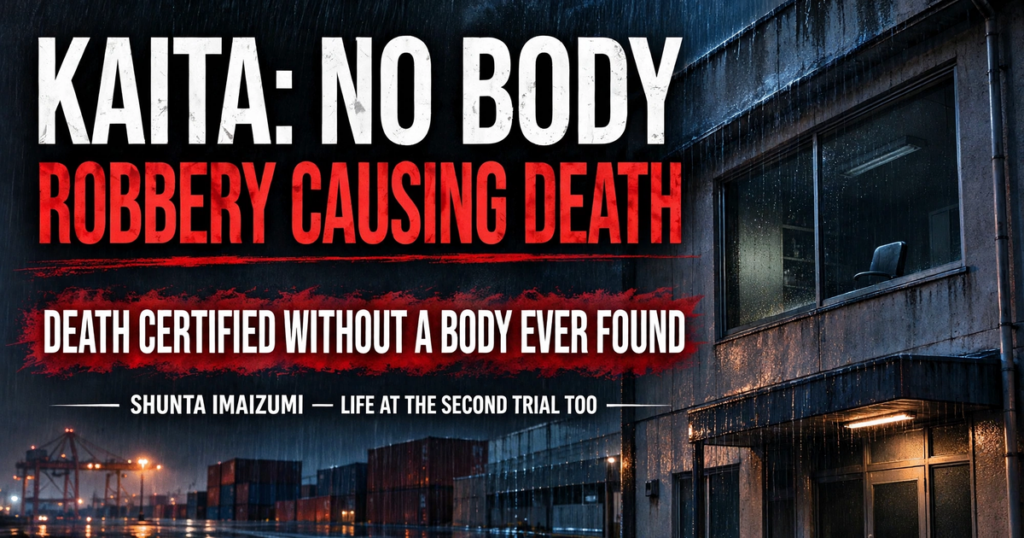
A financial dispute brought Takeuchi to an office in Kaita Town
The incident occurred in June 2022 at an office in Kaita Town, Aki District, Hiroshima Prefecture. Yoshihiro Takeuchi, a 71-year-old self-employed man, had been involved in disputes over investment funds entrusted to him by several people. Miho Kado was among those seeking repayment. She contacted people who were involved in recovering the money, and Shunta Imaizumi and others travelled to Hiroshima. Takeuchi was brought to the office, where the demand for repayment escalated into confinement and violence. The courts also found that Takeuchi had defrauded the defendants of substantial sums, but that background did not justify the assaults or robbery.
Takeuchi was confined and assaulted, and 110,000 yen was taken
At the office, Takeuchi was restrained and repeatedly assaulted while being pressed to return investment money. The prosecution alleged that threats and violence were used to overcome his resistance and obtain cash. Approximately 110,000 yen was taken from him. In Imaizumi's trial, an important issue was whether the violence had been used to take property, as required for robbery, or primarily to force Takeuchi to disclose transaction records. The prosecution argued that the assault was part of the effort to recover money and that the violence continued even after the cash had been taken.
Takeuchi disappeared, and no body was recovered
After the assault at the office, Takeuchi disappeared. His body has never been found. The absence of remains meant that investigators could not rely on an autopsy to establish a medical cause of death. Instead, the investigation and trials considered recordings of the assault, statements from co-defendants, evidence about Takeuchi's condition and evidence concerning what happened after he was moved. The courts concluded that he had died as a result of the violence. The phrase “without a body” describes the physical absence of remains; it does not mean that the courts failed to find that he had died.
Seven people were re-arrested on suspicion of robbery causing death
The investigation proceeded through several allegations, including confinement and disposal of a body. On February 13, 2023, Hiroshima Prefectural Police re-arrested seven people, five men and two women, on suspicion of robbery causing death. On March 6, the Hiroshima District Public Prosecutors Office indicted Imaizumi and Kado for robbery causing death. The other five were indicted for robbery and other offences. The seven defendants were therefore not all prosecuted for the same death-result offence, and it would be inaccurate to say that all seven were charged with robbery causing death.
The proceedings assessed each participant's role separately
The seven cases did not produce one single judgment imposing the same responsibility on everyone. Courts examined each person's involvement in the assault, confinement, taking of money, transportation and disposal of the body. Some defendants were found guilty of offences such as robbery or confinement without being convicted of robbery causing death. A separate debt collector was sentenced to six years in prison in March 2024 after the court found that he continued collecting money while aware that Takeuchi was being assaulted and could not resist. The different outcomes reflected the evidence about each participant's role and knowledge.
Kado's trial centred on whether she shared the plan to use violence to take money
Kado denied that she had conspired with the others to commit robbery and sought acquittal. The prosecution argued that she was seeking repayment and had accepted the use of violence at the office. On July 11, 2024, the Hiroshima District Court found that there had been an implicit agreement to use force and take money. The court considered the assault one-sided and persistent, with a risk of causing death. It sentenced Kado to eleven years in prison, below the prosecution's request for fourteen years.
Imaizumi disputed the robbery-causing-death allegation
In Imaizumi's case, the defence did not contest some of the confinement allegations but disputed the robbery-causing-death and body-disposal charges. It argued that the violence had been used to obtain transaction records rather than to take property. The prosecution maintained that Imaizumi had led the violence as part of the effort to recover investment funds and that Takeuchi died after the assault continued even after the cash had been taken. The lack of a body made the audio recordings and co-defendant testimony particularly important to the court's assessment.
The Hiroshima District Court imposed life imprisonment
On October 10, 2024, the Hiroshima District Court sentenced Imaizumi to life imprisonment, as requested by the prosecution. The court found that repeated blows had been delivered with considerable force, including to Takeuchi's chest. It concluded that the assaults had caused his death and that Imaizumi bore almost full responsibility for the fatal violence. The court did not require the physical recovery of the body before reaching its finding. It considered the totality of the recordings, witness accounts, Takeuchi's condition and the defendants' subsequent conduct.
The Hiroshima High Court dismissed Imaizumi's appeal
Imaizumi appealed on the day of the district-court judgment. At the first hearing before the Hiroshima High Court on June 3, 2025, the defence argued that the first-instance court had made factual errors and that life imprisonment was too severe. The prosecution sought dismissal of the appeal, and the hearing concluded that day. On July 22, 2025, the High Court dismissed the appeal and maintained the life sentence. The archive's published procedural chronology identifies this appellate judgment; it does not add a later Supreme Court outcome.
The case must be described with both the missing body and the judicial finding of death
The legal significance of the case lies in several distinctions. Takeuchi's body remains undiscovered, but the courts found that he died because of the assault. Seven people were involved, but only Imaizumi and Kado were indicted for robbery causing death; the others faced different charges. Kado received eleven years, while Imaizumi received life imprisonment, upheld by the High Court. The translation preserves these differences and does not treat the absence of remains as proof that the death was unproven.
Original Japanese record: 海田町遺体なき強盗致死事件|竹内義博さん死亡認定、今泉俊太に二審も無期懲役
Last updated:
Related articles
Case record
The Hiroshima First-Grader Murder: A Life Sentence After a Complex Appeal and Remand
Case record
The Murder of Le Thi Nhat Linh: A Nine-Year-Old Student, a Community Volunteer and a Life Sentence
Case record
The Luffy Wide-Area Robbery Cases: Four Separate Leadership Trials and Their Different Legal Stages
Case record