
The Sakahogi Family Triple Murder: A First-Instance Death Sentence Finalized by Withdrawal of Appeal
On June 3, 1994, three members of a woman's family—her father, mother and younger sister—were killed at their home in Sakahogi, Gifu Prefecture. The defendant, Hamada, had gone there after a relationship dispute. The Gifu District Court sentenced him to death on May 15, 1998. Although his lawyer filed an appeal, Hamada personally withdrew it on June 3, 1998. The first-instance death sentence therefore became final without a substantive appeal judgment.
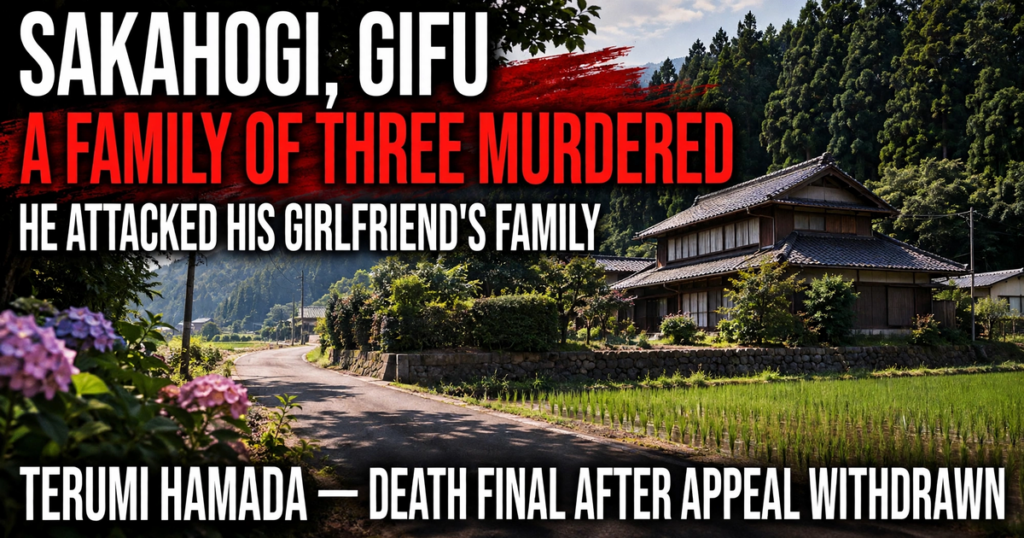
Three members of a family were killed in Sakahogi
In the early hours of June 3, 1994, three members of a family were killed at their home in Sakahogi, Kamo District, Gifu Prefecture. The victims were the father, aged 61, the mother, aged 59, and the younger sister, aged 31, of a woman who had been in a relationship with Hamada. The woman herself was not one of the three people killed. The victim count for this case is three. Hamada was charged with killing the three family members after travelling to their home following a deterioration in his relationship with the woman.
The relationship dispute preceded the journey to the family home
On June 2, 1994, the day before the killings, Hamada and the woman had a dispute about their relationship. After she left him, Hamada came to believe that her family was concealing her whereabouts. He travelled from the Nagano area toward the family's home in Sakahogi in a rental car and entered the house late at night or in the early hours. The relationship dispute forms part of the background to the case, but it should not be used to reduce the events to a private quarrel. The people killed were the woman's parents and younger sister, who were not the parties to the relationship.
The three family members were restrained and killed
Hamada entered the residence, restrained the father, mother and younger sister, and killed all three. The charges included murder, unlawful entry, arrest and confinement, and attempted rape involving the younger sister. The case was therefore not limited to the deaths themselves; the prosecution also addressed the restraint of the family and the attempted sexual offence. The public archive reports the victims by their family relationships and ages. It does not require additional private information about the surviving family members, and this translation does not add such details.
The younger sister's death was a central issue at trial
Hamada admitted responsibility for the deaths of the father and mother but disputed that he had intended to kill the younger sister. The defence argued that the conduct toward her should be treated as causing injury resulting in death rather than murder. The Gifu District Court rejected that position. It considered the younger sister's attempt to escape and Hamada's pursuit and conduct afterward as evidence that he had formed an intent to kill. The finding that all three deaths were murders, rather than two murders and one lesser homicide offence, was important to the first-instance judgment and its sentence.
A previous murder conviction was a separate part of the background
Hamada had previously been imprisoned for killing his then-wife in 1980. That earlier offence was a separate case and must not be added to the three victims in Sakahogi. The prior conviction was relevant to the court's consideration of his criminal history and the prospects of rehabilitation, but the death sentence in this case concerned the June 3, 1994 killings and the associated offences. The distinction is important because an account that adds the prior victim to the Sakahogi total would misstate the number of people killed in this incident.
The Gifu District Court imposed the death penalty on 15 May 1998
On May 15, 1998, the Gifu District Court sentenced Hamada to death. The court's decision followed its finding that he had killed all three family members, including the younger sister, and its consideration of the associated confinement and attempted sexual offence. The judgment was a first-instance decision. At that point, it had not yet become final. In Japan, a defendant or the prosecution may seek review by filing an appeal within the applicable period. The subsequent procedural history in this case is unusual because the appeal was withdrawn by Hamada himself.
The lawyer appealed, but Hamada personally withdrew the appeal
Hamada's defence lawyer filed an appeal against the death sentence. However, on June 3, 1998, Hamada personally withdrew that appeal. The date was exactly four years after the killings and nineteen days after the district court judgment. The withdrawal brought the ordinary appeal process to an end and caused the first-instance death sentence to become final. There was no substantive judgment by the Nagoya High Court and no Supreme Court decision reviewing the merits of the case. It is therefore inaccurate to say that the death sentence was upheld by the high court or confirmed by the Supreme Court.
What appeal withdrawal means under Japanese criminal procedure
An appeal withdrawal is not the same as an appellate court examining a judgment and deciding that it was correct. Once an appeal is withdrawn, the higher court does not issue a substantive decision on the evidence, legal issues or sentence. In this case, the findings about the younger sister's intent and the death sentence remained those made by the Gifu District Court. The legal result was a final death sentence, but the route to finality was the defendant's own withdrawal, not a judicial review by the Nagoya High Court or Supreme Court. This distinction is particularly important when comparing cases that reached the Supreme Court.
Hamada was executed in September 2002
Hamada's death sentence was carried out at Nagoya Detention House on September 18, 2002, approximately four years and three months after it became final. Execution is a separate event from the finalization of a sentence. The sequence was the district-court death sentence on May 15, 1998, the defendant's appeal withdrawal and finality on June 3, 1998, and execution on September 18, 2002. No high-court or Supreme Court merits judgment intervened. The case is a clear example of why a database must record not only the punishment imposed, but also the precise procedural route by which it became final.
Original Japanese record: 岐阜県坂祝町一家3人殺害事件|妹への殺意を認定、一審死刑は控訴取下げで確定
Last updated:
Related articles
Case record
The Gunma Two-Women Murders: Two Killings Committed While on Parole
Case record
The Ogo Town High-School Girl Abduction-Murder: A Life Sentence Replaced by Death on Appeal
Case record
The Katsuta Kiyotaka Serial Murders: The Reported 22-Victim Confession, Eight Judicially Established Deaths and the Nationwide No. 113 Investigation

Case record