
The Ogo Town High-School Girl Abduction-Murder: A Life Sentence Replaced by Death on Appeal
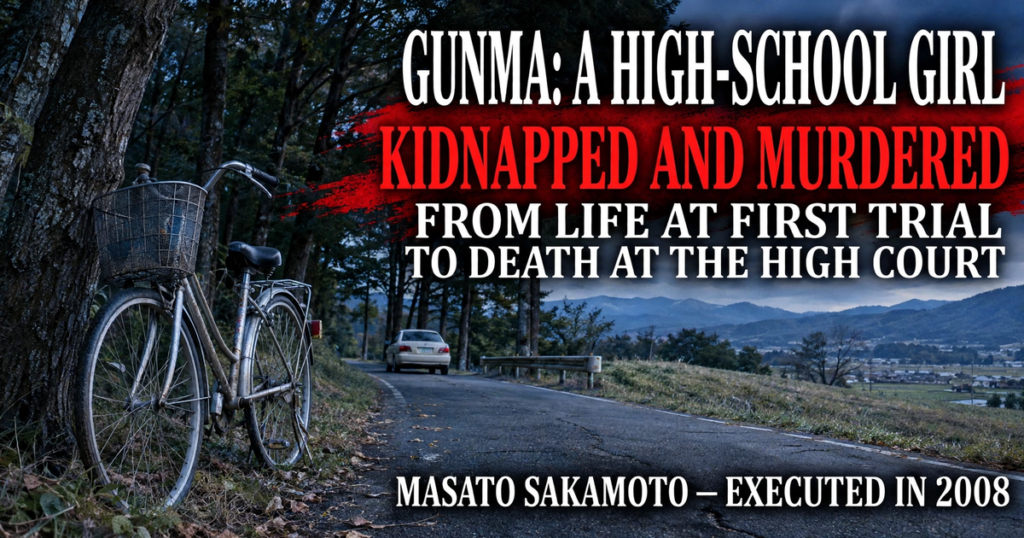
On July 19, 2002, 16-year-old first-year high-school student Ai Yasuda was abducted while returning home in Ogo Town, Gunma Prefecture, now part of Maebashi. She was sexually assaulted and murdered. After her death, the offender, Masato Sakamoto, used her mobile phone and other communications to make her family believe that she was alive and to demand money. He was identified through the attempted ransom collection and taken into custody the following day. The district court imposed life imprisonment, but the Tokyo High Court replaced it with death in 2004. Sakamoto did not appeal to the Supreme Court and was executed in 2008.
A 16-year-old student disappeared on the final day of the school term
The incident occurred on July 19, 2002, the day of a school closing ceremony. Ai Yasuda, a 16-year-old first-year high-school student, was travelling home in Ogo Town, Seta District, Gunma Prefecture, an area now incorporated into Maebashi. Masato Sakamoto approached her on the street, put her in a vehicle and abducted her. The crime involved more than an abduction: the judicial proceedings covered sexual offences, murder and the later demand for money from her family. Yasuda was the sole homicide victim, but the sequence of offences extended over the period after she had been taken.
The offender continued to demand money after killing Yasuda
After murdering Yasuda, Sakamoto used her mobile phone and other communications to make her family believe that she was still alive. He demanded money from the family as ransom. The family therefore had to respond to communications while believing that there might still be a chance to secure her return. The Japanese article does not state a reliable ransom total that should be inserted into the English account, so no specific amount is added here. The important fact is that the demand continued after Yasuda had already been killed.
The attempted ransom collection led investigators to Sakamoto
The investigation focused on the communications and the circumstances of the attempted ransom handover. Sakamoto came to police attention when he appeared to receive money. He was taken into custody on July 20, the day after Yasuda disappeared. His later statements led investigators to the location where Yasuda's body was found in a wooded area. The source notes that reports differed about some of his explanations during the investigation, so the English record does not reproduce uncertain details of those statements. The established sequence is the disappearance, ransom communications, the attempted collection and the discovery of the body.
The prosecution included several offences in addition to murder
The criminal case did not concern murder alone. The charges included murder, indecent abduction, rape and obtaining ransom by an abductor, among other offences. The courts considered the full course of conduct: Yasuda was taken from the street, subjected to sexual violence, killed, and then used as the apparent subject of further ransom demands. Treating the incident only as a single-victim murder would leave out the acts that preceded and followed the killing and would make it difficult to understand why the appellate court later considered the first-instance sentence insufficient.
The Maebashi District Court imposed life imprisonment in 2003
On October 9, 2003, the Maebashi District Court sentenced Sakamoto to life imprisonment. The prosecution had sought the death penalty. The district court recognised the gravity of the crimes but concluded that life imprisonment was the appropriate punishment. The Japanese article explains that the first-instance court also considered the extent to which the crimes had been planned in advance. The disagreement that followed was primarily about sentencing, rather than a complete reversal of the central facts that Yasuda had been abducted and killed and that money had been demanded after her death.
Both the prosecution and the defence appealed
After the district court judgment, the prosecution appealed on the ground that the sentence was too lenient. Sakamoto also appealed. It is therefore incomplete to say that the prosecution alone brought the case to the Tokyo High Court. Both sides challenged the first-instance outcome, and the appellate court considered the case with the full sequence of abduction, sexual violence, murder and post-murder ransom demands in view.
The Tokyo High Court replaced life imprisonment with death
On October 29, 2004, the Tokyo High Court set aside the Maebashi District Court's sentence and imposed the death penalty. The appellate court did not simply turn the case into a different factual incident. It took a more severe view of the seriousness of the crimes already established, including the connected course of conduct and Sakamoto's actions after Yasuda's death. The fact that there was one homicide victim did not prevent the court from selecting death after evaluating the entire criminal course, the motive, the manner of the offences and the impact on the victim's family.
The death sentence became final without a Supreme Court judgment
Sakamoto did not appeal the Tokyo High Court's death sentence to the Supreme Court. As a result, there was no Supreme Court judgment affirming the death sentence. The Tokyo High Court decision became final after the period for a further appeal passed. This procedural distinction is important because death sentences do not all become final through the same procedural route. In this case, the first-instance court imposed life imprisonment, both parties appealed, the high court imposed death, and Sakamoto did not take the case to the Supreme Court.
Sakamoto was executed in April 2008
Sakamoto was executed at Tokyo Detention House on April 10, 2008, aged 41. The Ministry of Justice announced that four prisoners were executed that day. The execution ended the sentence against Sakamoto. The correct legal history is not that the Supreme Court upheld the death sentence, but that the Tokyo High Court imposed it in October 2004, Sakamoto did not appeal further and the sentence became final through the expiry of the appeal period before the execution in April 2008.
Original Japanese record: 群馬県大胡町女子高生誘拐殺人事件|安田愛さん誘拐・殺害と一審無期から高裁死刑、執行まで
Last updated:
Related articles

Case record
The Gunma Two-Women Murders: Two Killings Committed While on Parole
Case record
The Osaka Sisters Murder: A Planned Robbery, Two Deaths and a Death Sentence Final by Appeal Withdrawal

Case record
The Gunma Pachinko-Parlor Robbery-Murders: Two Employees Killed for Store Keys and Cash
Case record