
The Renaissance Sasebo Shooting: Two Killed, Six Injured and a Nationwide Firearms Review
A gunman opened fire at the Renaissance Sasebo sports club on 14 December 2007, killing two people and injuring six. Police investigated licensed gun owner Masayoshi Magome, who was found dead the next morning. No criminal trial was held, leaving the motive and target selection unresolved.
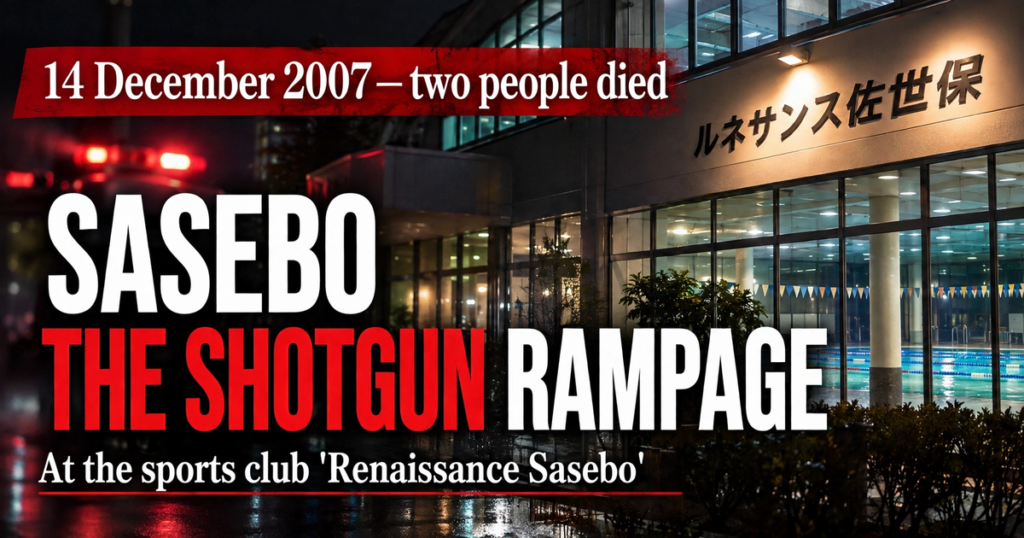
A shooting at a sports club killed two people on 14 December 2007
On the evening of 14 December 2007, a man entered the Renaissance Sasebo sports club in Nagasaki Prefecture and opened fire with a shotgun. The facility was operating normally and contained both staff and customers. Swimming instructor Mai Kuramoto, aged 26, and visitor Yuji Fujimoto, aged 36, were killed. Six other people, including children, were injured. The shooting took place in a public recreational facility, not in a private dispute witnessed only by the people involved. The number of victims and the fact that the firearm had been legally held made the incident a major national issue.
Police investigated licensed gun owner Masayoshi Magome
Police identified Masayoshi Magome, 37, a member of the club, as the principal suspect. He held a firearms licence and was reported to possess three shotguns and one air rifle. The weapons were not unlicensed firearms obtained through an underground market. This detail shaped the policy response: the case raised questions about how authorities assess and monitor people who have received permission to possess firearms. Investigators examined the suspect's vehicle, registered weapons and movements after the shooting. The police treated Magome as the suspected shooter, but the case did not proceed to a criminal trial.
The suspect was found dead the following morning
Magome's body was found on the morning of 15 December 2007 on the grounds of a church in Sasebo. A firearm was found nearby, and police believed that he had died by suicide. Because the suspected offender was dead, prosecutors could not bring him before a court and no criminal judgment was issued. This is a crucial legal distinction. The police investigation identified Magome as the suspect, and several circumstances supported that theory, but there was no trial in which evidence was tested and a court made final findings of guilt. The event should therefore be described as a shooting investigated as Magome's suspected attack, not as a conviction.
The relationship between Magome and Fujimoto was examined
Fujimoto and Magome had known each other for years and had attended school in the same area. Reports indicated that Magome contacted Fujimoto on the day of the shooting and invited him to the club. He also contacted other acquaintances and referred to free trial tickets. These details led investigators to examine whether the shooting was entirely indiscriminate or whether particular people had been selected. Reports also discussed possible personal and financial motives. However, Magome died before he could be questioned in court, and no judgment established why he chose the victims or whether he had planned to target specific individuals. Speculation about motive should not be presented as a proven fact.
The attack exposed a gap in the oversight of legally held firearms
The shooting was especially consequential because the weapons had been legally licensed. Before the incident, firearms policy discussions often emphasized illegal guns, smuggling and organized crime. The Sasebo case showed that a person who had received permission could still present a serious risk if the licensing and monitoring system failed to identify warning signs. The issue was not simply whether a gun had been registered. Authorities had to consider the continuing suitability of the licence holder, the condition of the weapons and whether information about a person's circumstances was reaching the police.
Police carried out a nationwide inspection of licensed firearms
Beginning on 15 December 2007, police across Japan conducted a nationwide inspection of licensed hunting guns and other firearms and their owners. The National Police Agency described the effort as a review covering approximately 170,000 people and 300,000 guns. The inspection continued through 16 March 2008 and reached a reported implementation rate of 99.7 percent. Authorities checked compliance with the Firearms and Swords Control Law and the Explosives Control Law, and took action where licence holders were no longer considered suitable. The response extended beyond the investigation of one shooting to a review of the national licensing system.
A review of firearms administration led to tighter regulation
The National Police Agency also reviewed firearms administration across all prefectures. The review examined licensing practices, actual conditions and the views of relevant organizations. In December 2008, amendments to the Firearms and Swords Control Law were enacted, strengthening requirements and supervision for firearm owners. Some provisions concerning supervision took effect on 1 June 2009, while stricter licence requirements took effect on 4 December 2009. The changes reflected a shift toward continuing oversight after a licence had been granted, rather than treating the initial approval as sufficient for the life of the permit.
The policy response was clear, but the motive remained unresolved
The two deaths and six injuries, Magome's licensed possession of firearms, his death the next morning and the nationwide inspection are supported by public records. The reasons he fired at the people in the club are less certain. Reports proposed different explanations, but no court evaluated those theories and no defendant gave evidence at a trial. The case therefore has an unusual legacy: it prompted significant changes to firearms administration while leaving important questions about the shooting itself unanswered. Respect for the victims requires that those uncertainties be stated plainly rather than filled with a confident but unproved motive.
Original Japanese record: ルネサンス佐世保散弾銃乱射事件|倉本舞衣さん・藤本勇司さん死亡、合法所持銃が規制見直しへ
Last updated:
Related articles
Case record
The Tokushima–Awaji Father-and-Son Murders: Eleven Years of Flight, No Trial
Case record
The Shimane University Student Murder: Miyako Hiraoka's Disappearance, a Deceased Suspect and 57 Images
Case record
The Kawasaki Noborito Stabbing: Two Killed, Eighteen Injured and a Motive That Died with the Suspect
Case record