The Onikuma Incident: Three Deaths, a 42-Day Manhunt, and a Fugitive Made into a Newspaper Legend
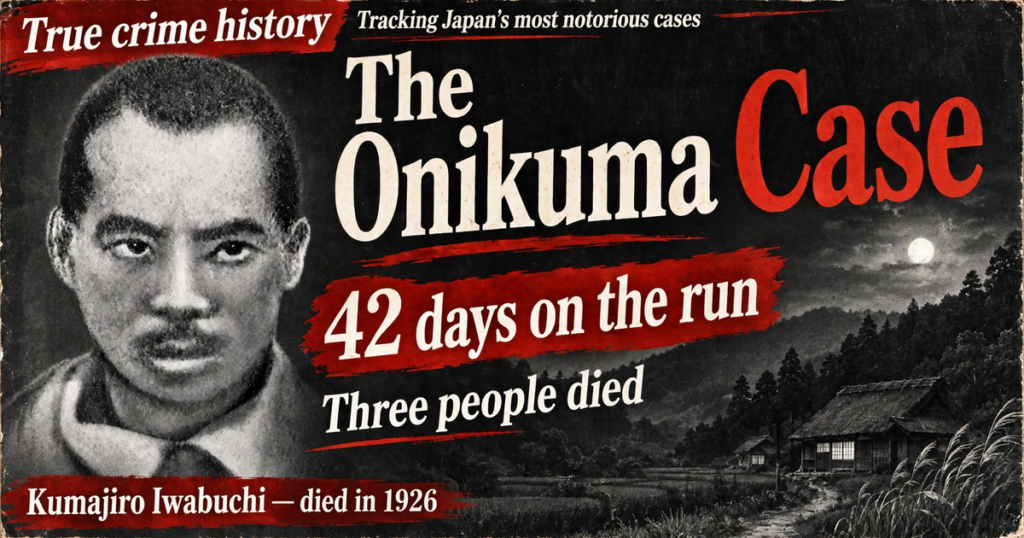
In August 1926, Iwabuchi Kumajiro attacked people in rural Chiba Prefecture, killing two residents and later a police officer during the search. He evaded capture for 42 days and died on 30 September before he could be arrested or tried for the killings. Newspapers transformed the fugitive into the sensational figure known as 'Onikuma', a legend that sometimes obscured the victims and the absence of a criminal trial.
A series of attacks began in a Chiba village in August 1926
Before dawn on 20 August 1926, violence broke out around Takatsuhara in Kuga Village, Katori District, Chiba Prefecture. The central figure was Iwabuchi Kumajiro, a 35-year-old horse-cart driver. Within a short period, two people were killed, homes and other property were attacked or set on fire, and several people were injured. The incident soon became known as the Onikuma case, after the nickname used for Iwabuchi in newspaper coverage. The name can make the episode sound like a folk tale, but the underlying event was a series of killings and assaults in a rural community.
A prior threat had led to a short suspended sentence
The violence did not arise without a known history of conflict. In July 1926, Iwabuchi had been arrested after threatening Kei Yoshizawa with a knife. A court imposed a three-month prison sentence, suspended for three years. He was released on 18 August, only two days before the attacks. Historical accounts describe a worsening personal dispute involving Yoshizawa and another man. The precise emotions attributed to Iwabuchi in later narratives should be treated cautiously, because much of the story comes from police records and newspaper accounts written during a sensational manhunt. The prior conviction is a documented part of the chronology; it does not by itself explain every later act.
Two residents were killed and a police officer was injured
The first fatal attacks occurred in the village. Yoshizawa, aged 27, was killed, and Iwabuchi then attacked Iwai, aged 49, with a military sword taken from a police post. A constable who encountered him was also attacked and injured. Other residents, including Yoshizawa's grandmother, and members of the local fire brigade were hurt during the episode. The details show that the incident was not a single homicide followed by an uncomplicated escape. It involved several separate attacks, property damage and attempts by local officials and residents to respond while the assailant moved through the area.
A police officer was killed during the later search
The manhunt continued into September. On the night of 11 September, Constable Kōno, aged 24, encountered Iwabuchi near a farmhouse and pursued him. Iwabuchi attacked him with a large sickle, inflicting a fatal wound to the neck. Kōno became the third confirmed death associated with the incident. His death changed the character of the search: police and local groups were not only trying to arrest a fugitive but were also dealing with a case in which a member of the police force had been killed during the pursuit. The confirmed death toll was three, with additional people injured.
The 42-day flight became a national newspaper spectacle
From 20 August until 30 September, Iwabuchi repeatedly evaded police searches. Large groups of officers and local volunteers searched the countryside, hills and farm buildings. Newspapers reported alleged sightings and movements, sometimes using dramatic descriptions that portrayed him as almost superhuman or able to appear anywhere. Reports were distributed rapidly, and the story became a national media event. The 42-day figure counts both 20 August and 30 September as calendar dates. Some historical summaries use a shorter elapsed-day count, so the counting convention should remain explicit. The attention given to the fugitive often eclipsed the people who had been killed or injured.
Iwabuchi died before police could arrest him
On 30 September, the 42nd day of the search, Iwabuchi was found in a gravely injured condition near the family graves. He was taken to his brother's home and died before noon. Historical accounts describe a severe neck wound and the presence of poison, and later reporting has discussed assistance from relatives in obtaining strychnine. The exact final circumstances are reconstructed from historical records rather than from a criminal trial. The important procedural fact is that Iwabuchi died before he could be arrested and prosecuted for the August attacks or the death of the constable.
There was no criminal judgment on the killings
Because Iwabuchi died before arrest and indictment, no criminal court tried him for the murders, arson or attacks committed during the 42-day period. The case should therefore not be described as one in which a court convicted him of three murders. The earlier July threat case had been dealt with separately, but the later series of attacks never reached a criminal judgment. The account of what happened is based on police records, newspaper reports and later historical research. This distinction does not erase the deaths; it identifies the limits of what the judicial record can establish.
The nickname 'Onikuma' shaped how the public remembered the case
The media coverage helped turn Iwabuchi into a larger-than-life figure. Songs, films and later retellings added to the image of a mysterious fugitive who could not be caught. The National Diet Library's historical resources preserve contemporary and later materials about the incident, including a 1933 compilation that lists the Onikuma case among major crimes. The Library's reference service also identifies newspaper collections and books that document the story. These sources are valuable, but their existence does not mean every sensational detail printed at the time was accurate. A modern account must separate confirmed events from rumour and folklore.
Remembering the victims requires more than repeating the legend
The name Onikuma remains memorable, but it should not become a substitute for the event's human consequences. Three people died: Yoshizawa, Iwai and Constable Kōno. Several others were injured, and the village endured weeks of fear and an extensive search. The fugitive's death prevented a trial that might have tested the competing accounts and clarified individual acts. The most responsible historical treatment therefore states the confirmed chronology, acknowledges the limits of the evidence and resists turning the fugitive into an entertaining character. The incident is part of Japanese crime history as much for its media treatment as for the violence itself.
Original Japanese record: 鬼熊事件|3人死亡、42日間の逃走と新聞が作った「鬼熊」像
Last updated: