
The Tokushima–Awaji Father-and-Son Murders: Eleven Years of Flight, No Trial
A father was found dead after a fire in Tokushima on 20 April 2001, and his adult son was found dead on Awaji Island the following day. Police sought Koike, an acquaintance of the family, for more than eleven years. Koike died in Okayama in October 2012 before he could be arrested and tried. His posthumous referral to prosecutors did not produce a criminal trial or a conviction.
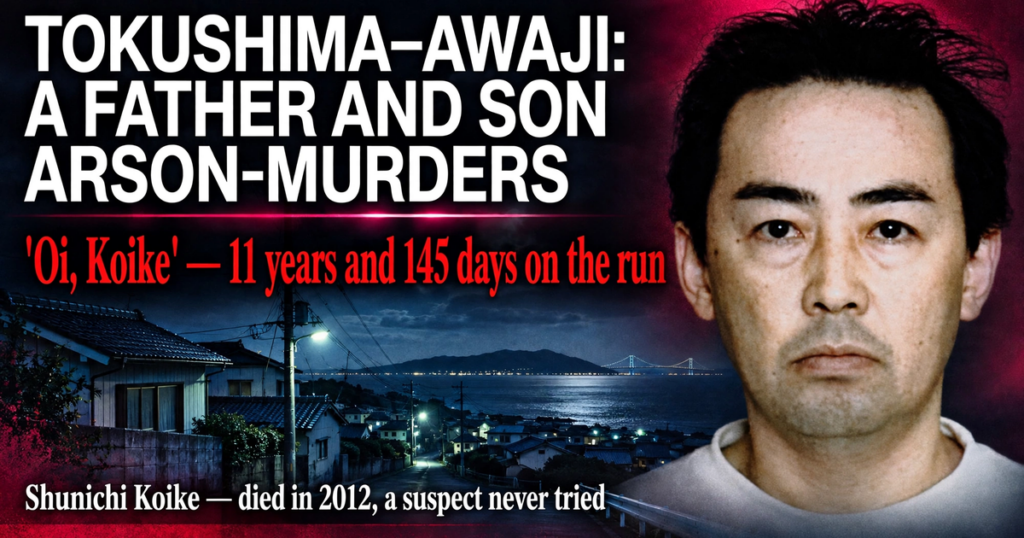
A fire in Tokushima revealed the death of a father
On the afternoon of 20 April 2001, a fire broke out in an apartment in a five-storey prefectural housing complex in Tokushima City. After firefighters brought the blaze under control, a man's body was found near bedding inside the room. The victim was a 66-year-old resident. A forensic examination indicated that he had died from suffocation caused by strangulation; injuries to his head also suggested that he had been struck with a blunt object. The fire was therefore investigated not simply as an accidental blaze but as a possible attempt to conceal a killing.
The missing son was found dead on Awaji Island the next night
The victim's adult son had been living with him and could not be contacted after the fire. Police searched for him and, on the night of 21 April, found a burned body in grass at a development site for holiday homes in Goshiki, on Awaji Island in Hyōgo Prefecture. The body was identified as the son. Investigators found evidence of blunt-force injuries and strangulation. Because the two bodies had been discovered in different prefectures within a day of each other, the Tokushima and Hyōgo police forces investigated the possibility that the same person had killed both men and moved or burned the bodies to obstruct identification.
Police suspicion focused on an acquaintance of the family
Investigators examined the father's financial affairs and his relationships with people he knew through pachinko and other social contacts. Koike was identified as a person who had been acquainted with the father and son. Police believed that money and property were relevant to the crimes, but the suspected offences against the two victims were not identical in their legal formulation. The investigation developed over time: the initial nationwide wanted notice concerned the son's murder and disposal of his body, while suspicion of robbery-murder and arson involving the father was added later. It is important not to collapse those separate investigative steps into a single charge made on the first day.
The poster bearing the words 'Oi! Koike' became widely recognized
Koike was placed on a nationwide wanted list in September 2001. Police circulated his photograph and identifying information across Japan. The poster's large phrase, 'Oi! Koike'—roughly, 'Hey, Koike!'—became familiar to the public and was repeatedly shown in news reports. The slogan was a police appeal, not a nickname chosen by Koike or a judicial finding. National police officials later acknowledged that the authorities had been unable to locate him despite an extensive search. The case became an example of the difficulty of tracking a wanted person over many years, particularly when the person may use an assumed identity and live outside the area where the crime occurred.
Koike lived under another name and died in Okayama
Koike was found in Okayama City in October 2012 after becoming ill and being taken to hospital by ambulance. He died on 19 October. His identity was not immediately established during the initial examination. Subsequent inquiries connected the deceased man to the wanted suspect. Reports described Koike as having lived under the name Junichi Ogasawara and having shared an apartment with a woman who said she did not know that he was wanted. The official police account confirms that he died before the authorities could bring him to justice. His death ended the possibility of an ordinary arrest and trial, but it did not answer every question about the crimes.
The police recorded an escape of eleven years and 145 days
National Public Safety Commission and police records describe Koike's period at large as eleven years and 145 days. The figure reflects the time between the start of the wanted period and his death. On 25 October 2012, the National Police Agency chief told the National Public Safety Commission that Koike had been wanted nationwide since September 2001 and that police regretted being unable to subject him to the law. The chief said that Tokushima and Okayama police would examine his movements and living circumstances to identify lessons for future investigations. That official statement is important because it records the police's own assessment rather than a later popular retelling.
A posthumous referral did not lead to a criminal trial
On 5 December 2012, Tokushima police sent case papers to the prosecutor with Koike listed as a suspect who had died. In Japan, a police referral of a suspect to prosecutors is not the same as an indictment, a trial or a guilty verdict. Because Koike was dead, he could not be prosecuted as a living defendant. Reports state that prosecutors declined to indict him on the ground that the suspect had died, and the investigation was closed. No court heard the evidence against him, and no judgment established his criminal guilt. The distinction matters particularly in this case because the public wanted an explanation after years of pursuit.
The case remains different from a solved murder with a conviction
The police investigation identified Koike as the suspect and referred the case after his death, but the legal process stopped before a trial. The father and son were victims of homicide, and the investigation treated the two deaths as connected. Nevertheless, a posthumous non-prosecution is not an acquittal: an acquittal follows a trial in which a court decides that the prosecution has not proved guilt. Nor can Koike be called a death-row prisoner or a convicted offender. The careful description is that he was a wanted suspect, died before arrest and trial, and was not indicted because of his death.
The unanswered questions are part of the record
The long pursuit and the striking wanted poster can overshadow the family at the centre of the case. The father and son were killed in separate locations, and the fire and burning of the son's body complicated the investigation. Police later reviewed how Koike had travelled and maintained an identity that did not immediately expose him. Yet the absence of a trial means that some allegations were never tested in court and that the public record cannot supply the same level of judicial detail available in a completed prosecution. The case should be remembered both for the two deaths and for the legal limit reached when the only suspect died before proceedings could begin.
Original Japanese record: 徳島・淡路父子放火殺人事件|「おい!小池」11年145日の逃亡と裁判なき被疑者死亡
Last updated:
Related articles
Case record
The Kitashinchi Building Arson: Twenty-Six Victims Killed, No Criminal Trial and the Fire-Safety Reforms That Followed
Case record
The Nagasakiya Amagasaki Store Fire: Fifteen Deaths from Smoke on the Fifth Floor
Case record
The Tatsuno Mother-and-Daughter Murders
Case record