
The Osaki Case and Its Fifth Retrial Request
The Osaki Case concerns the 1979 death of Kunio Nakamura in Kagoshima Prefecture and the 1980 conviction of his sister-in-law, Ayako Haraguchi. Three retrial-start decisions were later overturned. Her fifth retrial request, filed in January 2026, remains pending amid new forensic and statement-analysis evidence.
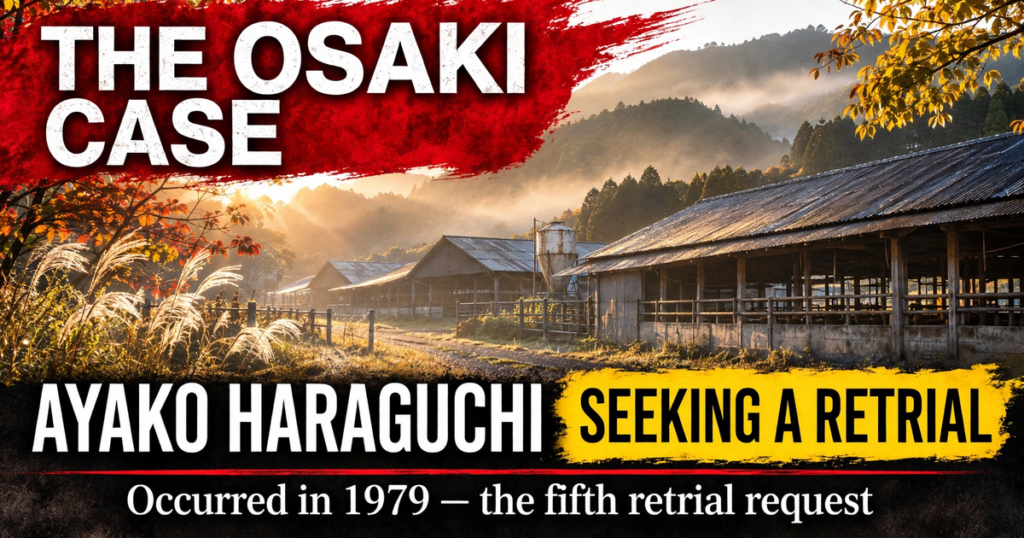
A body was found in a cattle shed in October 1979
On 15 October 1979, the body of 42-year-old Kunio Nakamura was found buried in manure in a cattle shed in Osaki Town, Kagoshima Prefecture. Police investigated the death as a murder and corpse-abandonment case involving members of the family. Nakamura's sister-in-law, Ayako Haraguchi, and three male relatives were arrested and prosecuted. Haraguchi denied involvement from the investigation stage onward. Nevertheless, the Kagoshima District Court convicted her in March 1980 and imposed a ten-year prison sentence. That conviction became final in 1981 and remained in force despite decades of retrial litigation.
The events before the discovery became central to the case
The chronology began three days before the body was found. On 12 October 1979, Nakamura fell or went down beside a rural road and was found lying there in a confused state. Two nearby residents carried him to his home at about 9 p.m. The original judgment found that Haraguchi, her former husband and another relative killed him at about 11 p.m., then involved a fourth person in moving the body to the cattle shed during the early hours of 13 October. The judgment attributed death to strangulation with a towel. Later retrial applications challenged both the medical basis for that conclusion and the time at which Nakamura had died.
The original conviction relied heavily on statements by three relatives
The three male relatives who were treated as accomplices gave statements admitting involvement during the investigation. Their accounts became central to the prosecution and the conviction. Haraguchi herself did not confess. On 31 March 1980, the Kagoshima District Court sentenced her to ten years for murder and corpse abandonment. The evidence included the relatives' statements, testimony from the wife of one relative and a forensic opinion that inferred death by strangulation. The defence argued that there was little direct physical evidence tying Haraguchi to the killing and that the relatives' statements were unreliable. Her appeals were rejected, and she served the sentence, leaving prison on 17 July 1990.
The first retrial request briefly succeeded in 2002
Haraguchi filed her first retrial request on 19 April 1995. On 26 March 2002, the Kagoshima District Court ordered a retrial, creating the first real prospect of reopening the conviction. The prosecution immediately challenged that decision. In December 2004, the Fukuoka High Court's Miyazaki Branch overturned the district court's order and dismissed the request. The Supreme Court rejected a further special appeal in January 2006. The retrial never proceeded to a new trial. The first episode established a pattern that would recur: a court at one level found the new material sufficient to reopen the case, but a higher court later reversed that conclusion.
The second request challenged the relatives' statements
Haraguchi filed a second retrial request in August 2010. The defence submitted new forensic opinions and expert analysis of the relatives' statements, including questions about their intellectual abilities and the circumstances of their interrogations. The argument was that the three statements might have been shaped by investigators and could not safely support the conviction. The Kagoshima District Court rejected the request in March 2013. The Fukuoka High Court's Miyazaki Branch dismissed the immediate appeal in July 2014, and the Supreme Court rejected a special appeal in February 2015. The request failed, but the reliability and formation of the statements remained central to later applications.
The third request produced two retrial-start decisions before reversal
The third request began in July 2015. On 28 June 2017, the Kagoshima District Court ordered a retrial. The prosecution appealed, but on 12 March 2018 the Fukuoka High Court's Miyazaki Branch upheld the decision. On 25 June 2019, however, the Supreme Court's First Petty Bench overturned both lower-court rulings and dismissed the request. The majority considered that the defence's forensic evidence raised questions about the cause of death but did not establish when Nakamura had died in relation to the time he was carried home. The new evidence was therefore insufficient, in the majority's view, to overturn the final conviction.
The fourth request focused on whether Nakamura was already dead
The fourth retrial request was filed on 30 March 2020. A new emergency-medicine opinion considered the possibility that Nakamura had already died when the neighbours carried him home. The defence also submitted analysis of the neighbours' accounts and the relatives' statements. The Kagoshima District Court rejected the request in June 2022, and the Fukuoka High Court's Miyazaki Branch dismissed the appeal in June 2023. On 25 February 2025, the Supreme Court's Third Petty Bench rejected the special appeal by a majority of four judges. Justice Katsuya Uga dissented, arguing that the new medical evidence and the statements should be assessed together and that a retrial should begin.
The fifth request was filed in January 2026
On 8 January 2026, Haraguchi's defence team filed a fifth retrial request at the Kagoshima District Court. The new submission included expert work on the credibility of the relatives' statements and experiments intended to test the method of strangulation described in the original judgment. By the third progress conference on 14 July 2026, the defence had submitted eleven new items of evidence. A psychological expert analysed the relatives' statements and identified concerns about possible investigative influence. The defence also presented a reconstruction experiment involving the towel-strangulation method accepted in the original judgment.
Further forensic evidence was presented in October 2026
The proceedings continued after the July submissions. Ahead of a three-party conference on 15 October 2026, the defence disclosed that it had submitted two further forensic opinions by 10 October. The opinions challenged the reliability of the conclusion that Nakamura had been strangled. At the conference, held privately at the Kagoshima District Court, the defence explained the new medical and forensic material to the court and prosecutors. These were defence submissions in a pending retrial proceeding, not findings already accepted by a court. The fifth request remained under examination, and the original conviction had not been vacated.
Three retrial-start decisions have never led to a retrial trial
Across the first and third requests, lower courts issued three decisions ordering a retrial: one in 2002 and two in 2017 and 2018. All were later overturned, and no retrial trial has ever been held. As of October 2026, Haraguchi's ten-year conviction from 1980 remained legally effective while the fifth request was pending. The central issues continued to be whether Nakamura's time of death and cause of death were correctly established and whether the relatives' statements could be trusted. The case remains an example of how a long-running retrial process can involve repeated new evidence without yet producing a new criminal trial.
Original Japanese record: 大崎事件|3度の再審開始が覆り、第5次再審で自白と死亡時期を争う原口アヤ子さん
Last updated:
Related articles

Case record
The Shibushi Case: A Failed Vote-Buying Allegation, Twelve Acquittals and an Unlawful Investigation
Case record
The North Kanto Child Disappearances and Murders: Five Cases, a Wrongful Conviction and a Possible Connection

Case record
The Nagaokakyo Murders: Two Women Killed While Gathering Wild Plants
Case record