
The Nagaokakyo Murders: Two Women Killed While Gathering Wild Plants
Two women disappeared while gathering edible wild plants in Nagaokakyo in 1979. Their bodies were found two days later; no offender was convicted.
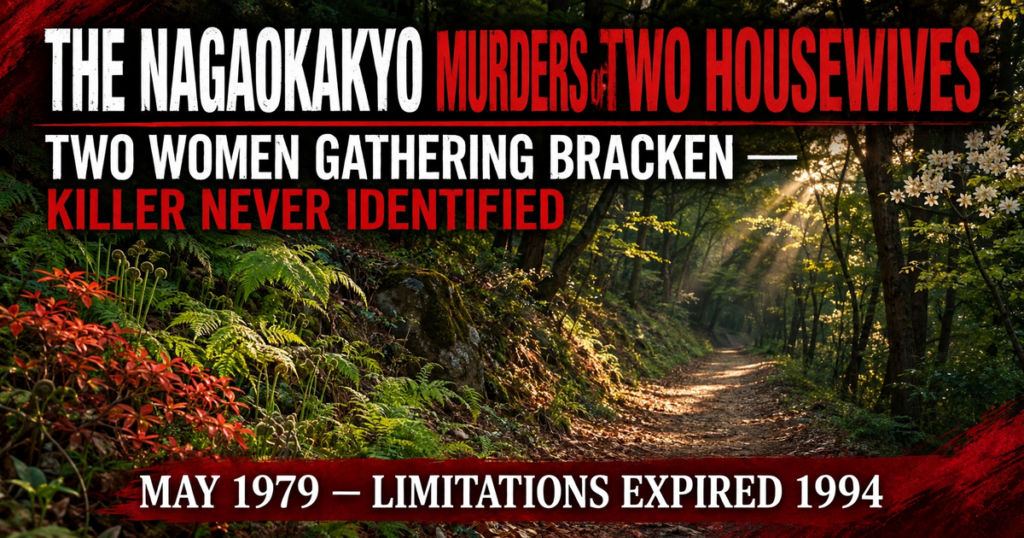
Two women went to gather bracken and did not return
On May 23, 1979, two housewives entered a wooded area in Nagaokakyo, Kyoto Prefecture, to gather bracken, an edible wild fern. They did not return home. A search began, and on May 25 their bodies were found in the hills. The investigation quickly focused on objects and observations from the area: a knife believed to have been used in the attack, a short handwritten note found among a victim's belongings and reports of people seen on paths near the hills. The case became widely known as the Nagaokakyo Bracken-Picking Murders, but no person was ultimately convicted.
A note reading 'Please help' became the best-known clue
On May 28, the Kyoto Shimbun reported that a note had been found in a victim's pocket. The reported wording included a plea for help and a description of a man as dangerous. Its existence, however, did not identify the writer's attacker. The publicly available record does not establish how many offenders were involved, who they were or what their motive was. A newspaper headline suggesting that a single offender might be responsible reflected a line of investigation at the time, not a judicial finding.
Investigators traced the knife and its sales route
The Kyoto Shimbun's reports from May 26 through May 30 described efforts to identify the knife, its manufacturer and the route through which it had been sold. Investigators examined where the weapon might have been produced and distributed, hoping to identify a purchaser or user. The note also led police to examine the pencil or writing instrument that might have been used. Tracing a manufacturer's product and identifying the person who bought or used it are different steps. The public record does not show that the knife's sales route led to a person who could be charged.
Witnesses described a man leaving the hills, but his role was never proved
A newspaper report on May 29 described a witness who had seen a man walking quickly down from the hill. The observation was one of several investigative leads. Police examined the time, direction and appearance of people who had been in the area, while also trying to determine whether they had any connection to the two deaths. The available record does not establish that the man described in the newspaper was an offender. His presence remained a reported sighting, not proof of participation.
Two young men were reported as persons of interest
On May 31, the Kyoto Shimbun reported that two young men had become important persons of interest and might be questioned voluntarily. No public court record establishes that the two men were prosecuted for the murders. It would therefore be inaccurate to identify them as the killers or to imply that the investigation had settled on two offenders. The report records a stage of police inquiry, not a final conclusion.
The number of offenders and the motive remained unknown
Contemporary headlines and later retellings have discussed both a single-offender theory and the possibility of multiple offenders. Those were hypotheses considered in the course of the investigation. No suspect was indicted, and no court made findings about the number of people involved, their motive or any relationship with the victims. The note, knife, pencil and witness reports were separate investigative lines. The fact that they were examined does not mean that they formed a complete chain of evidence pointing to a particular person. In a case without a trial, newspaper reports about police suspicions must be kept distinct from established facts.
The fifteen-year prosecution period expired in May 1994
At the time of the murders, the prosecution limitation period for an offence punishable by death was fifteen years. The killings occurred in May 1979, and the period expired in May 1994 without a person being charged. The expiry did not mean that investigators had discovered the truth or that a court had determined the cause of every injury. It meant that the state could no longer bring a murder prosecution under the law then applicable. The families were left without a criminal judgment identifying the perpetrator or explaining the motive.
Later abolition of the murder limitation period did not revive the case
Japan changed its limitation rules in stages. A 2005 reform extended some periods for serious crimes, and the 2010 reform abolished the limitation period for certain fatal offences, including murder. The later reform did not apply to crimes for which the limitation period had already expired before it took effect. Because the Nagaokakyo murders became time-barred in May 1994, the 2010 change did not restore the possibility of prosecution. This legal position is different from a modern unsolved murder that remains prosecutable. The case is unresolved in the historical sense, but the criminal prosecution period has ended.
The surviving newspaper record shows how the investigation moved
The National Diet Library's reference records preserve details of the Kyoto Shimbun coverage from May 24 to May 31, 1979. The headlines trace the investigation from the women's disappearance and the discovery of their bodies, to the knife, the note, the pencil, a man seen descending the hill and the questioning of two young men. It does not show that one lead became decisive. The public record contains fragments of an investigation that did not produce an indictment. Treating each headline as proof of a final suspect would turn the history of the search into a fictional solution.
The case remains a record of unresolved deaths, not a confirmed offender profile
The two women were killed, but the perpetrator or perpetrators were never identified in court. The note, the knife and the witness accounts remain part of the historical record, while the number of offenders and the motive are unknown. The prosecution limitation period expired in 1994 and was not revived by later amendments. The Nagaokakyo case is often remembered through the short plea for help, but the message should not be used to invent a confirmed offender profile. The most accurate account preserves both the human significance of the victims' attempt to seek help and the limits of what the available evidence can establish.
Original Japanese record: 長岡京主婦2人殺害事件|「たすけて」メモと包丁・目撃情報を追った15年、時効成立
Last updated:
Related articles
Case record
The Kyotanabe Police Officer Murder: A 16-Year-Old Daughter and the Family Court's Decision Not to Transfer
Case record
The Uji Cram-School Murder: Eighteen Years Reduced to Fifteen After a Diminished-Responsibility Finding

Case record
The Cosmo Research Case: Two Abductions, One Hundred Million Yen and Litigation After the Executions
Case record