
The Kyotanabe Police Officer Murder: A 16-Year-Old Daughter and the Family Court's Decision Not to Transfer
At about 4:00 a.m. on September 18, 2007, a 45-year-old police sergeant was attacked while asleep in his home in Kyotanabe, Kyoto Prefecture. The attacker was his 16-year-old second daughter, who used a hand axe with a blade about 11 centimetres long. She admitted her involvement when police arrived. The prosecution sent her to the Kyoto Family Court on October 5 with an opinion that criminal disposition was appropriate. Although the law then generally required transfer to prosecutors when a person aged 16 or older intentionally killed someone, the family court ordered a medium-term juvenile training school disposition on January 23, 2008. The protective disposition became final the following month; there was no adult criminal trial.
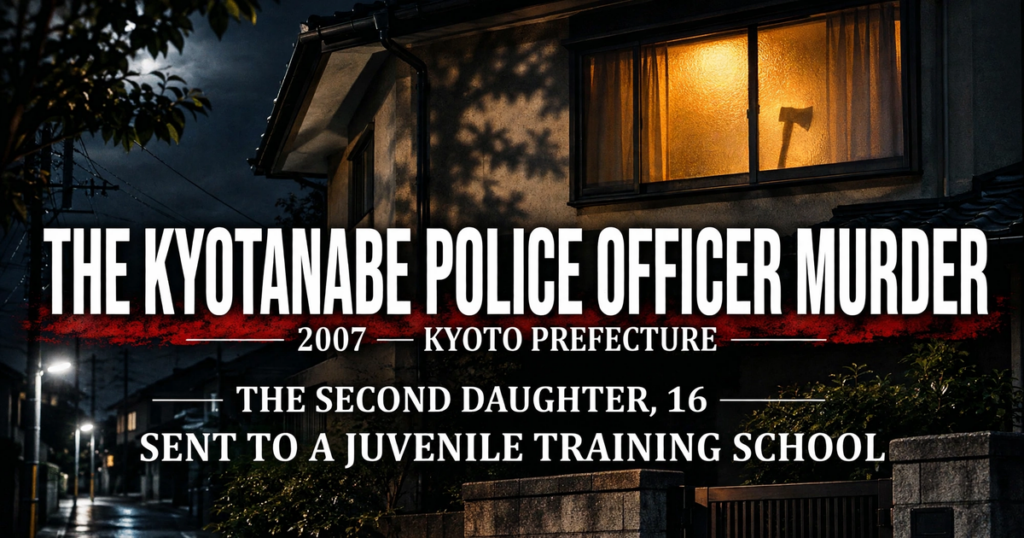
A police sergeant was attacked in his own bedroom
At about 4:00 a.m. on September 18, 2007, a 45-year-old man who served as a sergeant in the Traffic Division of the Kyoto Prefectural Police's Minami Police Station was attacked while asleep in a second-floor bedroom of his home in Kyotanabe City. The attacker was his 16-year-old second daughter. She struck him repeatedly with a hand axe, cutting his neck and other areas. He died from blood loss. At about 4:40 a.m., a family member called for help, and police officers arrived at the house.
The daughter admitted her involvement at the scene
When officers arrived, the girl was still at the home and had blood on her clothing. She acknowledged that she had attacked her father, and police secured her on suspicion of murder. This was not a case in which an unknown intruder had entered the house. The victim and the girl lived together as members of the same family. The investigation therefore examined their relationship, the events leading up to the attack and the preparation of the weapon, as well as the girl's mental state and the proper legal process for a 16-year-old.
The hand axe had been purchased several days before the attack
The weapon had a blade approximately 11 centimetres long and a handle about 30 centimetres long. The girl was reported to have bought it herself at a home-improvement store near the house roughly five days to one week before the incident. The purchase was significant because it indicated preparation before the attack. The assault also took place while her father was asleep. The family court later considered the planning involved and the seriousness of the outcome, rather than treating the weapon as an object picked up spontaneously during an argument.
The family relationship and the girl's psychological condition were examined
After her arrest, the girl spoke about dissatisfaction with her father's relationships with women and the strict discipline he had imposed. She also resented needing his approval for her educational plans. The family court considered those circumstances as part of the background to the offence. It also examined her psychological state, including reported depressive symptoms and the effect of family relationships on her thinking. The existence of family conflict did not by itself determine the legal disposition, and the translation does not present it as an excuse for the killing.
Claims about manga and anime were not the family court's conclusion
In the immediate aftermath, media attention focused on the girl's clothing and interest in horror fiction. Some reports and broadcast decisions drew connections to anime and games featuring axes or similar imagery. The family-court account, however, placed greater weight on her relationship with her father and her psychological state. Reports also said that the choice of an axe was associated with her interest in a guillotine. There was no judicial finding that a particular anime or game caused the offence. Post-incident broadcasting decisions and a proven cause of the crime are separate matters.
The prosecutor referred the case to the Kyoto Family Court
On October 5, 2007, the Kyoto District Public Prosecutors Office sent the girl to the Kyoto Family Court on the delinquent fact of murder. The referral was accompanied by an opinion that criminal disposition was appropriate, based on the planning and the seriousness of the result. Under Article 20(2) of the Juvenile Act as it then stood, a juvenile aged 16 or older who intentionally caused another person's death was generally to be transferred to prosecutors. The family court nevertheless retained authority to consider whether exceptional circumstances justified a protective disposition.
A psychological assessment was ordered during the first juvenile hearing
At a hearing on October 18, 2007, the Kyoto Family Court decided that an assessment of the girl's psychological condition was necessary. The assessment was intended to examine her mental state at the time of the offence, personality characteristics, relationships with her parents, how the intention to kill had developed and what kind of education might prevent further offending. Juvenile hearings are generally closed, unlike adult criminal trials. As a result, the public record of the court's detailed reasoning is limited, and reported explanations must be distinguished from the court's formal decision.
The family court chose a medium-term juvenile training school disposition
On January 23, 2008, the Kyoto Family Court ordered the girl to a medium-term juvenile training school. The court recognised that the offence was planned and had resulted in the death of her father. It nevertheless found special circumstances supporting a protective disposition, taking account of her age, psychological condition, family environment and prospects for rehabilitation through correctional education. The decision was not a prison sentence. A juvenile training school disposition involves institutional education and guidance, and it does not set a fixed term of imprisonment in the way an adult criminal judgment does.
The protective disposition became final in February 2008
The family-court disposition became final in February 2008. The girl was not transferred to an adult criminal court and did not receive a public conviction or a prison term. The period she spent in the institution and her later life are not established in reliable public records and are not necessary to explain the legal outcome. The source also notes that the case later appeared in a court investigation into the preservation and destruction of important juvenile records. That later records issue is distinct from the merits of the family court's 2008 disposition.
The case demonstrates the difference between a general transfer rule and an individual juvenile disposition
The case is notable because the victim was a police officer and the attacker was his 16-year-old daughter, yet the proceedings did not result in an adult criminal trial. The court considered the serious and planned nature of the offence but chose a protective measure after psychological assessment. The final legal outcome was a medium-term juvenile training school disposition, not a conviction for murder followed by a prison term. The translation does not disclose the girl's identity or speculate about her current life.
Original Japanese record: 京田辺警察官殺害事件|16歳の次女を「原則逆送」せず中等少年院送致とした家裁判断
Last updated:
Related articles
Case record
The Oita Family-of-Six Attack: A 15-Year-Old, the Juvenile Justice System and Destroyed Court Records

Case record
The Nagasaki Abduction and Killing of a Four-Year-Old Boy: A Twelve-Year-Old Child, Juvenile Protection, and Destroyed Court Records

Case record
The Murder of Kyoto Seika University Student Daisaku Chiba
Case record