The Cosmo Research Case: Two Abductions, One Hundred Million Yen and Litigation After the Executions
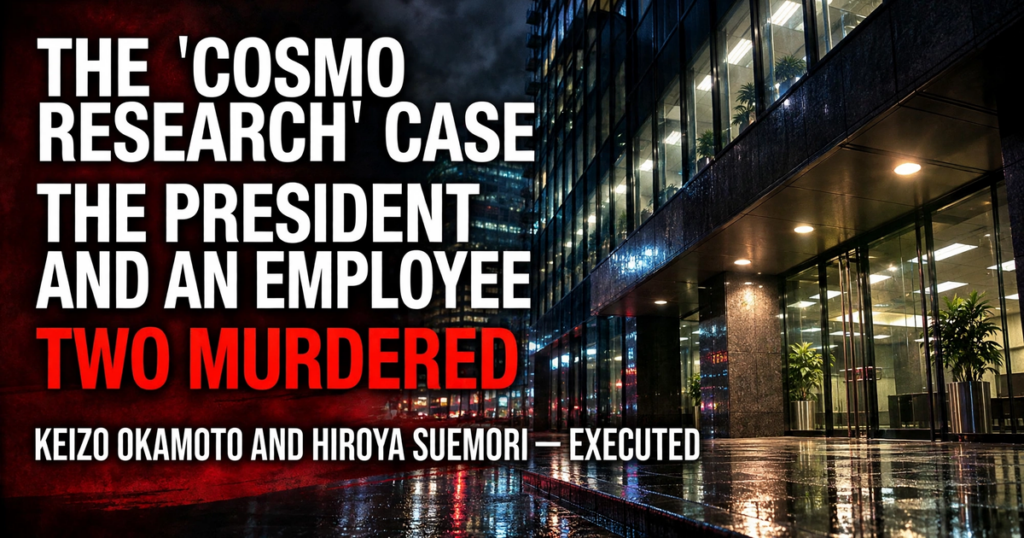
On January 29, 1988, three men abducted an employee and the president of the investment advisory company Cosmo Research in Osaka in order to obtain a large amount of money. The victims were employee Hiroyuki Watanabe, aged 23, and president Kazuo Kengaku, aged 43. The offenders took 400,000 yen from Mikami and forced him to arrange a further 100 million yen. Both men were killed and their bodies were encased in concrete and buried in a mountain area of Kyoto Prefecture. Two defendants received final death sentences and were executed in 2018; a later civil lawsuit over one execution was dismissed in 2026.
The employee was taken first so that the company president could be found
The incident began on January 29, 1988. Okamoto Keizo, Suemori Hiroya and another accomplice first took Cosmo Research employee Hiroyuki Watanabe, aged 23, to an apartment in Osaka. They questioned him about the whereabouts of the company's president, Kazuo Kengaku, aged 43. The plan was not simply to rob an office or seize cash from a person encountered by chance. The employee was used as a route to the president, whose access to substantial funds made him the principal target. When Mikami returned home, he too was abducted and brought to the apartment.
The two men were restrained and the president was forced to obtain money
Watanabe and Mikami were placed under restraint and could not freely leave or seek help. The offenders took 400,000 yen in cash that Mikami had with him. They then forced him to arrange an additional 100 million yen. The sum was far beyond the cash immediately available at the scene, and the offenders sought to use Mikami's position and financial connections to obtain it. The Supreme Court treated the abduction, confinement and taking of money as part of a planned robbery rather than as a dispute that unexpectedly became violent.
The killings were intended to conceal the robbery
After the money had been obtained, the three men killed Mikami and Watanabe. The Supreme Court's final findings treated the deaths as acts intended to conceal the robbery and prevent the victims from identifying the offenders. The Japanese article deliberately does not reproduce graphic details of the killings. What matters to the legal account is that the two men were not released after the money was taken: the offenders killed both and then undertook substantial measures to hide the bodies. The killings were connected to the original financial plan and its concealment.
The bodies were encased in concrete and buried in Kyoto
The bodies of Mikami and Watanabe were encased in concrete and buried in a mountainous area of Minamiyamashiro Village, Kyoto Prefecture. This was not a casual disposal of the bodies. The preparation and burial were part of the attempt to prevent discovery of the crimes and delay identification of the victims. The location in Kyoto was separate from the Osaka apartment where the abductions and confinement had occurred. The combination of kidnapping, a large financial demand, two deaths and the concrete burial became central to the case's public identity.
Two defendants received death and a third received life imprisonment
The case involved three perpetrators. The third accomplice was also prosecuted and received a life sentence, which became final. The Osaka District Court sentenced Okamoto and Suemori to death on March 23, 1995. Their appeals were dismissed by the Osaka High Court on March 5, 1999. The Supreme Court dismissed their final appeals on September 13, 2004, making the two death sentences final. The Supreme Court assessed Okamoto and Suemori as active participants who each played important roles. It did not reduce one man's responsibility to that of a merely subordinate participant.
The final criminal case included offences beyond the two murders
The case is sometimes reduced to the robbery of 100 million yen and the killing of two people. The confirmed criminal record was broader. The 2018 Justice Minister's statement described a securities fraud in which approximately 140 million yen worth of share certificates was obtained from an employee of a securities company. The convictions also included possession of a firearm and ammunition, as well as violations of firearms and explosives laws. The legal record therefore included robbery-murder and body disposal, fraud and weapons-related offences. The two deaths were the central events, but they were not the only offences considered in sentencing.
Both death sentences were carried out on 27 December 2018
Okamoto and Suemori were executed at Osaka Detention House on December 27, 2018. Okamoto had been using the surname Kawamura in some earlier reports; official materials at the time of execution described him as Okamoto Keizo, formerly Kawamura. The different surnames refer to the same person. At the time of execution, Okamoto was pursuing a fourth retrial request. The fact that a retrial request had been filed did not itself suspend the execution. Under Article 442 of the Code of Criminal Procedure, a retrial request does not automatically suspend the execution of a sentence.
The former defence lawyers sued the state over the execution during a retrial request
In 2020, three former defence lawyers for Okamoto sued the state, seeking approximately 16.5 million yen in damages. They argued that carrying out the execution while a retrial request was pending infringed their ability to continue defence work. The civil case did not ask a court to retry the murders or overturn the criminal conviction. Its subject was the relationship between execution during an extraordinary retrial procedure, the rights of former counsel and the state's official duties. The government argued that the law did not make a retrial request an automatic stay of execution.
The civil claim was dismissed at both court levels
The Osaka District Court dismissed the former lawyers' claim on May 14, 2025. The plaintiffs appealed, but on May 13, 2026, the Osaka High Court upheld the first-instance result and dismissed the appeal. The later civil litigation must be kept separate from the criminal judgments: it did not reverse the convictions, did not grant a retrial and did not alter the fact that Okamoto and Suemori had been executed in 2018. The final legal record therefore contains both the completed criminal proceedings and a separate civil dispute over the timing of one execution.
Original Japanese record: コスモ・リサーチ事件|見学和雄さんら2人殺害、死刑執行後も続いた再審請求をめぐる訴訟
Last updated: