
The Maizuru High School Girl Murder: An Acquittal Based on Reasonable Doubt
A 15-year-old high school student was killed in Maizuru, Kyoto Prefecture, in May 2008. A man was convicted at first instance and sentenced to life imprisonment, but the Osaka High Court found serious weaknesses in the eyewitness identification and statements about the victim's belongings. It overturned the conviction and acquitted him. On July 8, 2014, the Supreme Court dismissed the prosecution's final appeal. The acquittal became final, while the identity of the actual perpetrator remained unresolved.
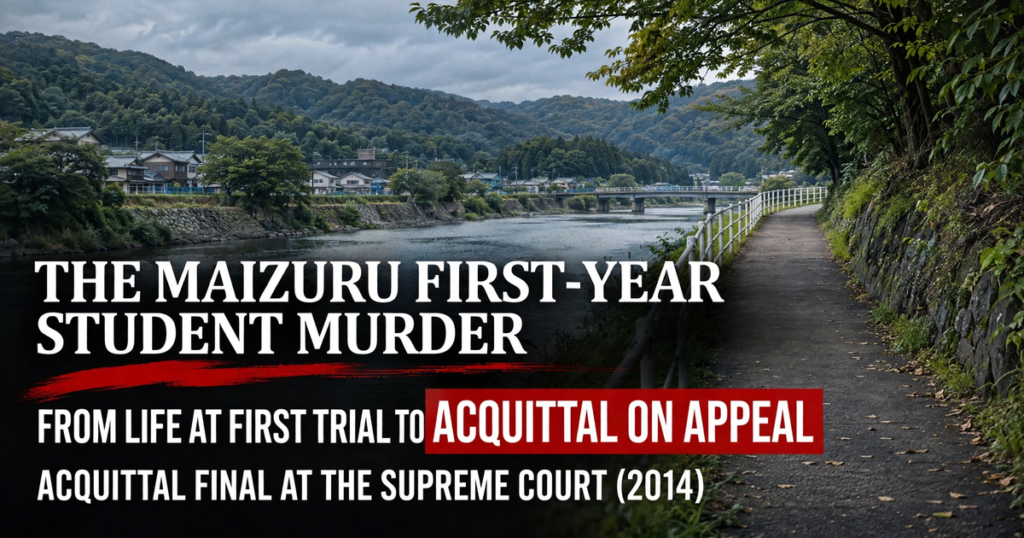
A fifteen-year-old student disappeared after leaving home
The victim was Miho Kosugi, a 15-year-old first-year high school student living in Maizuru, Kyoto Prefecture. She left home on the evening of May 6, 2008. Her body was discovered on May 8 in a wooded area beside the Asaki River. The prosecution alleged that she had been sexually assaulted and killed in the early hours of May 7. The case became a major local investigation and later a significant appellate decision because the evidence used to identify the defendant was largely circumstantial and depended on the reliability of an eyewitness and statements about items belonging to the victim.
The prosecution alleged a sexual assault and fatal beating
The indictment alleged that the defendant, Katsumi Naka, encountered the student near the riverbank, removed some of her clothing and struck her repeatedly on the head and face with a blunt object after she resisted. The injuries included multiple lacerations and facial fractures. The prosecution said that bleeding from those injuries caused shock and death. This is the prosecution's account of the offence, not a fact that survived the final appeal. The ultimate acquittal means that the courts did not find the evidence sufficient to establish that Naka was the killer.
The first-instance court relied on an eyewitness account
On May 18, 2011, the Kyoto District Court found Naka guilty and sentenced him to life imprisonment. The prosecution had sought the death penalty. The district court relied in part on a witness who said that, at about 3:15 a.m. on May 7, he had seen a man walking with the victim near an intersection roughly 305 metres from where her body was found. The court considered the witness's description consistent with Naka and treated the sighting as evidence that placed him with the victim shortly before the killing.
Statements about the victim's belongings were treated as incriminating
The first-instance court also placed weight on statements Naka made during the investigation about the colour and features of items belonging to the victim, including a cosmetic pouch and underwear. The prosecution argued that he could have known those details only because he was the perpetrator. The district court viewed the statements as strongly supporting guilt, particularly when combined with the alleged sighting. Naka consistently denied committing the crime. The appeal therefore examined not only what he had said, but how the information had been elicited and whether the statements could safely be treated as independent knowledge.
The Osaka High Court questioned the eyewitness identification
On December 12, 2012, the Osaka High Court overturned the conviction and acquitted Naka. It found that the witness's opportunity to see the man was not sufficiently good to support a reliable identification. The witness had later been shown a photograph of Naka by himself during the investigation, a procedure capable of changing or reinforcing memory. The witness's early descriptions also differed in important respects from Naka's appearance. The appellate court considered the later convergence of the descriptions with Naka's features difficult to explain and concluded that the identification carried substantial doubt.
The High Court also questioned the statements about the belongings
The appellate court examined the investigation interviews in detail. It concluded that the statements about the cosmetic pouch and underwear could have been influenced by suggestions or leading questions from investigators, whether intentional or unintentional. If the information had been supplied during questioning, it could not safely be treated as knowledge that only the killer possessed. The High Court therefore rejected the inference that the statements independently established Naka's guilt. The weakness of both the identification and the supposed secret knowledge meant that the combined evidence did not prove that he was the perpetrator.
Reasonable doubt required the conviction to be set aside
The High Court held that the district court's conclusion was unreasonable when tested against logic and ordinary experience. It was possible that the man seen with the victim at the intersection was someone other than Naka, and the statements about the belongings did not exclude that possibility. The prosecution had not eliminated reasonable doubt about the identity of the killer. The court therefore quashed the first-instance judgment and entered an acquittal. This was not a finding that the killing had not occurred; it was a finding that the evidence did not prove that this defendant had committed it.
The Supreme Court upheld the acquittal on July 8, 2014
The prosecution appealed to the Supreme Court. On July 8, 2014, the Supreme Court's First Petty Bench dismissed the appeal. The Court said that the High Court had specifically demonstrated why the first-instance fact-finding was unreasonable under logic and experience. The prosecution's arguments largely amounted to disagreement with the assessment of facts and evidence, which did not establish a valid ground for a further appeal under the Code of Criminal Procedure. The acquittal therefore became final. The Supreme Court did not order a new trial or restore the life sentence.
An acquittal does not identify the actual killer
The final legal result is that Naka was acquitted and the prosecution's appeal was rejected. That result must be stated clearly, without implying that the victim was not murdered or that the actual perpetrator was identified. The public record does not establish who killed the student. The case remains unresolved in that sense. It also demonstrates why a conviction based on circumstantial evidence requires careful scrutiny of the reliability of each inference, especially when eyewitness memory may have been influenced by investigative procedures.
The case is a lesson in evaluating circumstantial evidence
Japanese criminal courts may convict on circumstantial evidence; a confession or direct eyewitness account is not legally indispensable. But the evidence must establish guilt beyond a reasonable doubt. A witness's opportunity to observe, the consistency of descriptions over time and the possibility of memory contamination are all relevant. Statements about undisclosed details must also be examined in light of the interview process. The Maizuru case is not a general rule that eyewitness evidence is unreliable. It is a concrete example of an appellate court finding that the particular identification and statements in one case could not support a safe conviction.
Original Japanese record: 舞鶴高1女子殺害事件|一審無期を覆した「目撃証言」と遺留品供述の合理的疑い
Last updated:
Related articles

Case record
The Koto Memorial Hospital Case: A Twelve-Year Sentence Overturned by Retrial, and a Death Not Proven to Be Homicide

Case record
The Tokushima Radio Shop Murder: A Wrongful Conviction Overturned in a Posthumous Retrial

Case record
The Matsukawa Railway Incident: Twenty Convictions Overturned and Three Deaths Still Unresolved
Case record