
The Murder of Natsumi Kikuchi
Eighteen-year-old university student Natsumi Kikuchi travelled from Tokyo to Ibaraki on 20 November 2018 to meet Koichi Hirose, whom she had contacted online. Her body was found buried in Kamisu on 31 January 2019. The Tokyo District Court found eventual intent to kill and sentenced Hirose to 14 years in prison in October 2020.
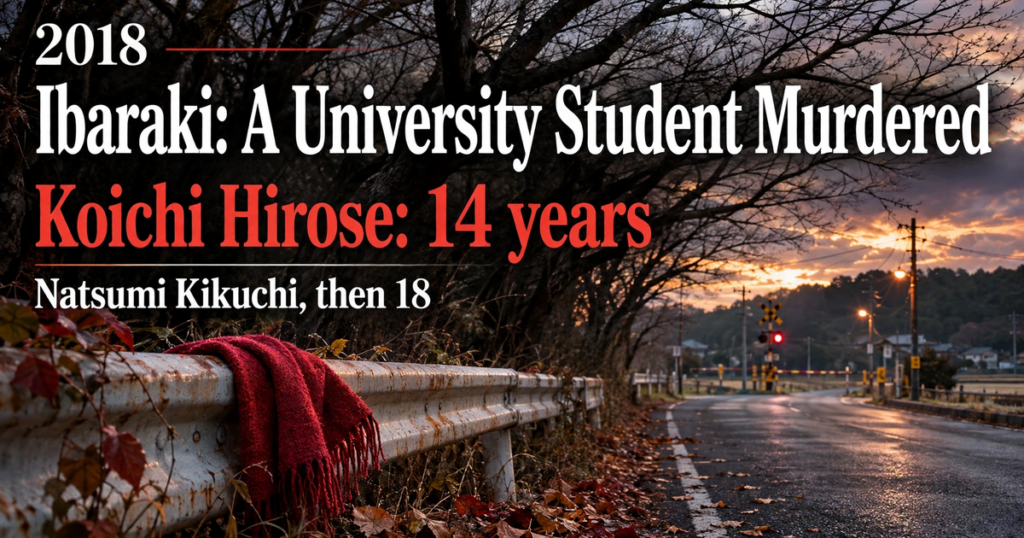
An 18-year-old university student travelled to meet someone she knew online
Natsumi Kikuchi was an 18-year-old first-year student at the Nihon Pharmaceutical University. She lived in Katsushika Ward, Tokyo. On 20 November 2018, she travelled to Ibaraki Prefecture to meet Koichi Hirose, a man she had contacted over the internet. It was the first time the two had met in person. Kikuchi travelled toward Kashima-Jingu Station and then used a taxi to reach an area near a convenience store in Kamisu. The court later considered the financial arrangement between the two and found that a dispute over payment preceded the fatal incident.
The meeting ended with Kikuchi's death in a vehicle
The Tokyo District Court found that Hirose obstructed Kikuchi's nose and mouth with his hands while they were in a vehicle in the Kamisu and Kashima area. He was physically larger than Kikuchi and continued applying pressure for at least five to six minutes. The defence argued that the act occurred during a struggle over a mobile phone and that Hirose had not intended to kill her. Prosecutors argued that he understood the danger of preventing a person from breathing and continued regardless. The court did not find a premeditated, definite intention to kill from the outset, but it did find that he accepted the possibility of death.
The court found eventual intent rather than a definite prior plan to kill
Under Japanese criminal law, murder intent does not require proof that the defendant began with a settled plan to kill. Eventual intent may be found where a person recognizes that death may result and continues the conduct while accepting that possibility. The district court considered the length of time that Hirose covered Kikuchi's nose and mouth, the force applied and the difference in their physical strength. It concluded that he understood the danger and continued the act. The court therefore convicted him of murder rather than only injury resulting in death. The distinction between definite intent and eventual intent also influenced the sentence.
Hirose buried the body in Kamisu after the killing
After Kikuchi died, Hirose did not contact emergency services or report the death. He transported her body to a secluded location in Kamisu and buried it in the ground. The concealment left her family without information about her whereabouts for approximately two months. The prosecution charged Hirose with both murder and abandonment of a corpse. The two offences concerned different conduct: the murder was the act that caused Kikuchi's death, while the corpse-abandonment offence concerned his subsequent handling and concealment of the body. Both were considered in the criminal proceedings.
Police traced her final movements through transport and digital evidence
When Kikuchi failed to return home or respond to messages, the investigation began as a missing-person inquiry. Police examined her movements from Tokyo to Ibaraki, including railway travel, taxi use and available security-camera footage. Her mobile-phone communications and the people she had contacted online helped investigators identify Hirose as the last person known to have met her. On 31 January 2019, police found a woman's body buried in Kamisu. It was identified as Kikuchi. Hirose, then 35, was arrested that day on suspicion of abandoning a corpse. The investigation subsequently developed into a murder case.
The initial arrest was for corpse abandonment, followed by a murder charge
The first arrest on 31 January 2019 concerned the act of burying and concealing the body. Investigators then examined the circumstances of death, forensic findings, Hirose's statements and the movements of the two people on the day of the meeting. The police later treated the case as murder, alleging that Hirose had suffocated Kikuchi by covering her nose and mouth. He was ultimately prosecuted for murder and corpse abandonment. The order of the arrests matters: it is not accurate to say that he was first arrested for murder on the day the body was found.
The trial focused on whether Hirose had intended to cause death
Hirose's lay-judge trial took place at the Tokyo District Court in October 2020. The defence argued that the act amounted to injury resulting in death rather than murder. Prosecutors sought a 20-year prison term and argued that Hirose understood the risk of suffocation. The court examined the duration and force of the obstruction, the relative size of the two people and the circumstances of the dispute. It found eventual intent to kill. The court also treated the effort to hide Kikuchi's body as an aggravating circumstance, because it delayed discovery and concealed what had happened from her family and investigators.
The Tokyo District Court imposed a 14-year prison term
On 19 October 2020, the Tokyo District Court sentenced Hirose to 14 years in prison. Prosecutors had sought 20 years. The court criticized his selfish motive: he had sought to avoid paying money that was part of the arrangement between the two. It also considered his decision to bury the body. At the same time, the court did not find that he had carefully summoned Kikuchi with a settled plan to kill her. It found eventual intent rather than definite intent. Those distinctions were relevant to the sentence selected. The source article reports the first-instance judgment and does not establish that the sentence became final after an appeal.
The legal status should not be described beyond the reported judgment
The established outcome in the Japanese source is the Tokyo District Court's 14-year sentence for murder and corpse abandonment on 19 October 2020. The article describes the prosecution's 20-year request, the defence's argument for a lesser offence and the court's finding of eventual intent. It does not provide a verified later appellate disposition. This translation therefore records the first-instance sentence and does not call it a final, unappealable judgment. The case should remain centred on Kikuchi as a young student whose first in-person meeting with an online contact ended in her death, rather than on unsupported speculation about her private life.
Original Japanese record: 茨城女子大生殺人事件|菊池捺未さん殺害、東京地裁が廣瀬晃一に懲役14年
Last updated:
Related articles
Case record
The Sakaimachi Family Attack: Two Parents Killed, Two Children Injured, Trial Still Pending
Case record
The Onikuma Incident: Three Deaths, a 42-Day Manhunt, and a Fugitive Made into a Newspaper Legend

Case record
The Goka High School Girl Murder: The Disappearance of Mai Sato After a Summer Festival
Case record