
The Sakaimachi Family Attack: Two Parents Killed, Two Children Injured, Trial Still Pending
In the early hours of September 23, 2019, an intruder attacked a family in Sakaimachi, Ibaraki Prefecture. The parents, Mitsunori and Miwa Kobayashi, were killed, while their son and daughter were injured. Yoshiyuki Okaniwa was arrested in May 2021 and indicted in September of that year for murder and related offences. As of the latest published update in November 2026, no first hearing had begun; the case remained in pretrial proceedings. The indictment is not a conviction.
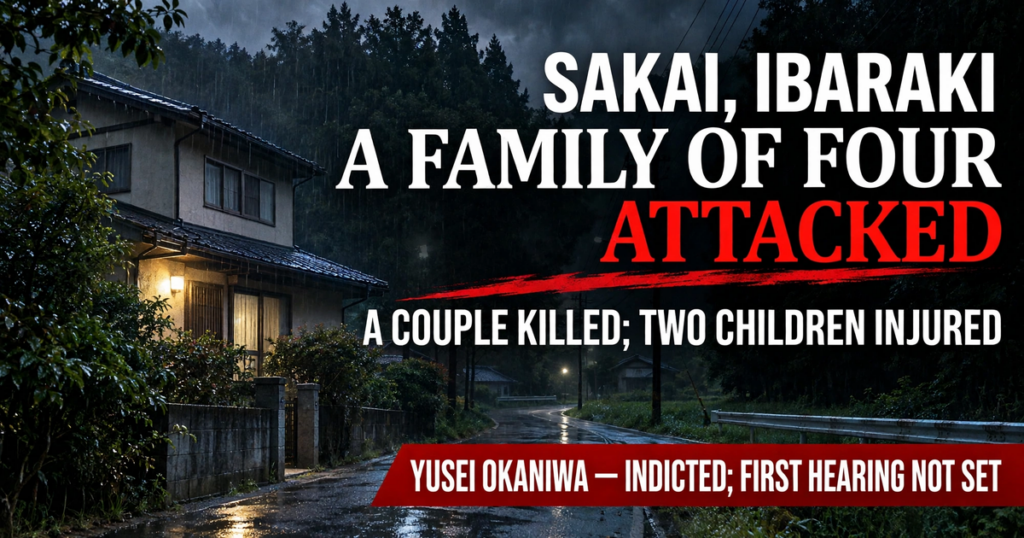
A distress call came from a home in Sakaimachi
At about 12:40 a.m. on September 23, 2019, Miwa Kobayashi called emergency services from the family's home in Wakabayashi, Sakaimachi, Ibaraki Prefecture, saying that someone should help. The call ended while sounds of a struggle could be heard. Police officers arrived roughly ten minutes later. In an upstairs bedroom they found Mitsunori Kobayashi, 48, and his wife Miwa, 50, dead. Their son had been stabbed in the arms and legs and seriously injured; their daughter had been sprayed with a tear-gas-like substance and suffered minor injuries. The incident involved four attacked family members but two deaths.
The attack occurred while the family was at home
The family lived in a detached house in an area surrounded by fields and woodland. The attack took place at night, when the surrounding area was dark and nearby homes were not close. The parents were killed inside the residence, while the children were attacked in an upstairs room. The son sustained serious knife injuries; the daughter was injured by a spray-like substance. The family members' accounts and the physical evidence became important to the later investigation, but public reporting has not established a personal relationship between the family and the accused.
The investigation continued for more than a year and a half
The Ibaraki Prefectural Police received information from the public and examined a wide range of material, including surveillance images, communications, physical traces and statements from people connected with the family. The lack of an immediately identified suspect and the absence of a recovered weapon made the investigation lengthy. The police also considered how an unknown person could have approached and left the property without being noticed. The passage of time did not mean that the investigation had stopped; investigators continued to compare separate pieces of evidence until they identified a suspect.
Yoshiyuki Okaniwa was arrested in May 2021
On May 7, 2021, police arrested Yoshiyuki Okaniwa, then 26, on suspicion of murdering Mitsunori and Miwa Kobayashi. Reporting at the time said that a smartphone associated with him contained an image of the area around the Kobayashi home that appeared to have been taken before the attack. Such a reported image was part of the investigative picture, but it should not be treated as a complete proof of guilt on its own. The arrest was an accusation made during an investigation, not a judicial finding.
Additional charges concerned the two children
On May 29, 2021, police re-arrested Okaniwa on suspicion of attempted murder involving the son and injury involving the daughter. The legal allegations were therefore separated according to the conduct and harm attributed to each child. The son had sustained serious knife wounds, while the daughter had been injured by a spray-like substance. The indictment later included murder, attempted murder and related offences. A careful account should not merge the children's injuries into the parents' murders or imply that the children died.
A psychiatric assessment preceded the indictment
The Mito District Public Prosecutors Office ordered a psychiatric examination during a period of detention for assessment, known in Japan as a forensic psychiatric evaluation or evaluation detention. The examination continued for approximately three months and ended on September 6, 2021. Prosecutors said that they had concluded that Okaniwa could be held criminally responsible. The purpose of this procedure was to assess responsibility at the time of the alleged conduct; it was not a trial and did not decide whether the prosecution's factual allegations were true.
The prosecution was filed on September 17, 2021
On September 17, 2021, the Mito District Public Prosecutors Office indicted Okaniwa for murder, attempted murder and related offences. The prosecution did not publicly disclose his position on the charges at the time. The indictment transferred the case from the investigation stage to the court process. Under Japanese procedure, an indictment is a formal accusation that allows a criminal trial to proceed; it does not establish guilt. The prosecution must present evidence, the defence may challenge it, and the court must decide the facts and criminal responsibility.
Pretrial proceedings continued for years without a first hearing
The case was expected to be heard by a lay-judge panel because the charges included serious offences carrying severe penalties. Before the first public hearing, the court conducts pretrial arrangement proceedings to identify disputed issues, organise evidence and determine which witnesses or exhibits will be used. As reported in the archive's latest update on November 14, 2026, the first hearing had still not begun; the procedural status cited was that no trial date had been set as of August 27, 2026. The long interval is unusual, but it does not itself establish why any particular party caused the delay.
The length of pretrial proceedings should be explained carefully
Pretrial arrangement can take time in a complex case involving multiple victims, forensic evidence, psychiatric assessment and a large volume of disclosure material. Lawyers interviewed by Bengo4 have explained that the time before trial may include several distinct stages, such as the initial investigation, evaluation detention, disclosure of evidence and scheduling. The Sakaimachi case had remained in the pretrial phase for nearly five years after indictment. It is appropriate to call that an unusually long interval, while avoiding speculation that the delay proves the strength or weakness of the prosecution.
Past juvenile history is not proof of the present charges
News reports have discussed Okaniwa's juvenile history, including earlier violent incidents and his placement in a medical juvenile training school. That background may explain why the arrest attracted attention, but it is not a substitute for evidence concerning the Sakaimachi attack. The criminal court must assess the charges in this case on the evidence linking the accused to the house, the victims and the alleged acts. Prior treatment or juvenile proceedings cannot, by themselves, prove that he committed the offences charged in 2021.
The case remains pending and no verdict should be implied
The established procedural sequence is that the attack occurred on September 23, 2019; Okaniwa was arrested on May 7, 2021, re-arrested on May 29, and indicted on September 17, 2021. The archive's latest November 2026 update reports that no first hearing had started and that pretrial proceedings remained ongoing. There has been no trial verdict in the public record reviewed for this translation. Accordingly, the correct status is a pending prosecution, not a conviction, and the accused must be described as a defendant rather than as the perpetrator.
Original Japanese record: 茨城県境町一家4人殺傷事件|小林夫妻殺害から7年、岡庭由征被告の初公判は未定
Last updated:
Related articles

Case record
The Murder of Natsumi Kikuchi
Case record
The Hitachi Junior-High-School Girl Abduction-Murder: A Family Acquaintance, a Ransom Demand and Death in Custody
Case record
The Ibaraki University Student Murder: DNA Evidence, Two Life Sentences and a Third Suspect Still Sought

Case record