
The Matsusaka Murder of Two Filipino Women: A Deceptive Invitation and a Final Death Sentence
On December 25, 1998, two Filipino women living in an apartment in Matsusaka, Mie Prefecture, were strangled and robbed. Nobuyuki Morimoto, who was using the surname Sawamoto at the time, knew the victims and used that connection to gain entry with two accomplices. The group prepared neckties, rope and gloves and used a false story about introducing a marriage partner. They took approximately 13,000 yen and jewellery worth about 250,000 yen. Morimoto's death sentence became final on December 14, 2004 after a separate earlier robbery causing injury was also considered.
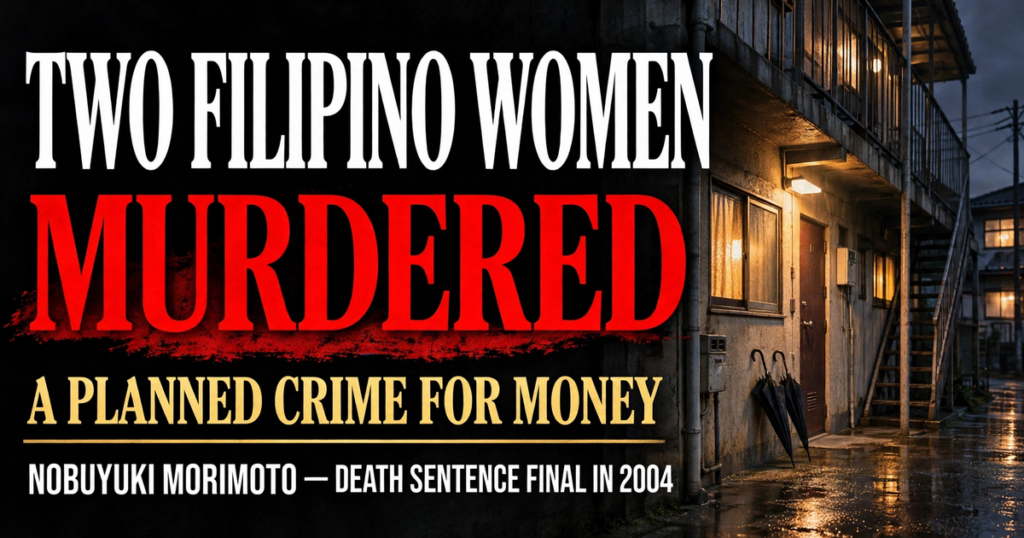
The victims were targeted through an existing acquaintance
On December 25, 1998, two Filipino women who lived in an apartment in Matsusaka, Mie Prefecture, were strangled and robbed. Morimoto Nobuyuki, who used the surname Sawamoto at the time, knew the victims through a Filipino woman with whom he was living. He learned that the two women might keep a substantial amount of cash. Rather than entering a random apartment, he used his personal connection to identify the victims, learn where they lived and make it possible for the group to approach them without immediately raising suspicion. The case involved two deaths.
The group prepared restraints and a plan before going to the apartment
Morimoto and two accomplices prepared neckties, rope and gloves in advance. The items were intended to restrain and strangle the victims. The preparation showed that the attack was not an unexpected escalation after an ordinary visit. The group believed the women possessed a large amount of money and planned to kill them in order to take cash and valuables. Morimoto's role was more than that of a person who merely supplied an address: he was the person who knew the victims and could make the planned entry possible.
A false marriage introduction was used to gain entry
The accomplices did not know the victims well enough to be welcomed into the apartment. Morimoto therefore used a story that he would introduce a person for a sham or arranged marriage. His presence helped reassure the women and reduce their suspicion. On December 25, the three men visited the apartment. Morimoto brought out forms and asked the women to write their names and other details. While the victims were looking at the papers, the accomplices moved behind them and wrapped neckties around their necks. A rope was also used against one of the women.
Morimoto was found to have joined in the strangling
The victims were attacked from behind while their attention was directed toward the forms. The archive states that Morimoto himself also took part in the killing. The women had been deceived about the reason for the visit and were attacked inside their own home, with little opportunity to escape or call for help. Both died. The court treated the event as a planned robbery-murder rather than as an accidental death during a theft. The victims' lack of preparedness and the deliberate use of their trust were important features in the sentencing analysis.
The amount stolen was smaller than the offenders had expected
After the killings, the three men searched the apartment. They did not find the large amount of cash they had expected. They took approximately 13,000 yen in cash and four pieces of jewellery, including necklaces, with an estimated total value of about 250,000 yen. The relatively small amount recovered did not reduce the seriousness of the crime. The Supreme Court focused on the plan to kill two people in order to obtain property, the preparation of restraints and the deception used to gain entry. The intended financial reward did not determine the gravity of the loss of life.
Morimoto had also participated in an earlier robbery causing injury
The proceedings also included an earlier robbery causing injury at a pachinko parlour. Morimoto and an accomplice entered the premises after closing, threatened an employee with a knife and struck the employee with a wooden sword before taking approximately 19.2 million yen from a safe. The employee suffered serious injuries, including a skull fracture, brain contusion and a fracture of the left upper arm, requiring prolonged treatment. Morimoto was found to have participated in planning and carrying out that robbery and to have received part of the stolen money. The earlier offence was separate from the two deaths in Matsusaka but was considered in sentencing.
The district court sentenced all three defendants to death
On March 1, 2000, the Tsu District Court sentenced all three defendants to death. Their later procedural paths differed. One co-defendant died during the appeal process, while another received a reduced sentence of life imprisonment from the Nagoya High Court, and that sentence became final. Morimoto argued that the difference between the co-defendants' sentences, his lack of prior convictions and his expressions of remorse should prevent a death sentence. The courts instead examined each defendant's actual role in the planning and execution of the crime.
Morimoto was found to be a central participant, not merely a guide
Morimoto was the only member of the group who knew the victims and knew the location of the apartment. He created the false reason for the visit, maintained the conversation and directed the victims' attention toward the forms so the others could attack. The Supreme Court also found that he personally assisted in the strangling. His contribution therefore extended from the planning stage through the execution of the murders. The fact that another co-defendant later received life imprisonment did not automatically require the same sentence for Morimoto, because the courts assessed each participant's role individually.
The high court and Supreme Court maintained the death sentence
The Nagoya High Court dismissed Morimoto's appeal on May 14, 2001. On December 14, 2004, the Supreme Court's Third Petty Bench dismissed his final appeal. The Court emphasized the financial motive, careful preparation, deception of unguarded victims and Morimoto's central role in making the crime possible. It also considered the earlier robbery causing injury, which had inflicted serious harm and involved the theft of approximately 19.2 million yen. The Court considered favourable circumstances, including the absence of prior convictions and some indication of remorse, but concluded that they did not justify avoiding the death penalty.
The final status is a death sentence, not an assumed execution
The Supreme Court's dismissal made Morimoto's death sentence final on December 14, 2004. The archive's update of August 27, 2026 stated that the Ministry of Justice had not announced an execution of Morimoto by that date. This translation records the final death sentence and does not infer an execution after the archive's stated verification date. The legal record remains two women killed in Matsusaka, a planned robbery, a separate earlier robbery causing serious injury, different outcomes for the three co-defendants and a death sentence final for Morimoto.
Original Japanese record: フィリピン人女性2人殺害事件|松阪市で2人を絞殺、森本信之の死刑が2004年確定
Last updated:
Related articles
Case record
The Katsuta Kiyotaka Serial Murders: The Reported 22-Victim Confession, Eight Judicially Established Deaths and the Nationwide No. 113 Investigation

Case record
The Sakai Couple Murder: A Planned Robbery, Two Deaths and a Final Death Sentence
Case record
The Ikebukuro Street Attack: Two Women Killed, Six Injured and the Death Sentence for Hiroshi Zoda

Case record