The Ikebukuro Street Attack: Two Women Killed, Six Injured and the Death Sentence for Hiroshi Zoda
On 8 September 1999, 23-year-old Hiroshi Zoda attacked pedestrians in Ikebukuro, Tokyo, with a kitchen knife and a hammer. Two women, Kazuko Sumiyoshi and Maya Takahashi, were killed and six other people were injured. The courts found that Zoda had planned an indiscriminate attack and retained full criminal responsibility. The Supreme Court dismissed his appeal on 19 April 2007, leaving the death sentence in place.
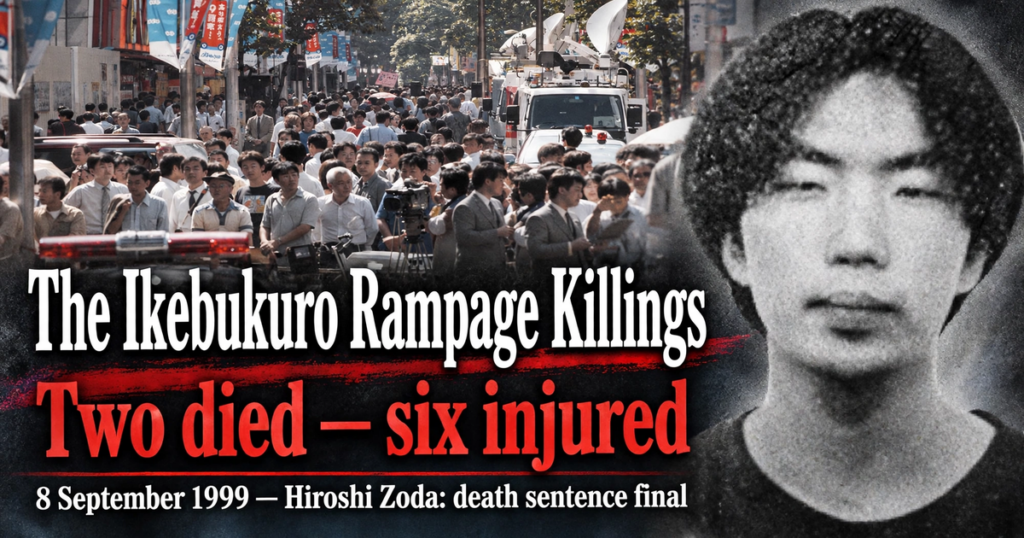
A lunchtime attack began in a crowded shopping district
Shortly before noon on 8 September 1999, 23-year-old Hiroshi Zoda attacked pedestrians in the busy streets of Ikebukuro, in Tokyo’s Toshima Ward. He carried a kitchen knife and a hammer and struck people who happened to be nearby. The first attacks took place near the former Tokyu Hands Ikebukuro store, and the violence continued in the direction of Ikebukuro Station. Zoda had no established personal relationship with the people he attacked. Two women, Kazuko Sumiyoshi, aged 66, and Maya Takahashi, aged 29, died. Six other people suffered injuries, making eight victims in total.
The two people who died were both women
The victims who died were Sumiyoshi and Takahashi. Sumiyoshi’s husband was also attacked, including being struck with the hammer and cut with the knife, but he survived. The distinction matters because some secondary accounts have incorrectly described the two people killed as a woman and a man. The correct total is two women killed and six people injured. The victims were not selected because of a personal dispute with Zoda. They were pedestrians going about ordinary activities in a busy public area.
The weapons had been obtained before the attack
The attack was not an impulsive use of an object picked up in the street. Zoda had obtained a kitchen knife and a hammer in advance and went to a crowded part of Tokyo intending to attack people indiscriminately. The court considered the way he purchased the weapons, including his purchase of unrelated items intended to avoid attracting attention. He had not chosen individual victims by name, but the absence of a named target did not mean that there had been no plan. His intention was to attack unknown people in a place where many pedestrians would be present.
The courts examined his stated grievances and the immediate trigger
The Supreme Court’s account described Zoda as deeply dissatisfied with Japanese society and convinced that his efforts were not being recognised or rewarded. The judgment also referred to a silent call to his mobile phone shortly before the attack, which became the immediate trigger in his decision to carry out indiscriminate violence. These findings concern the reasoning attributed to Zoda in the criminal proceedings. They do not suggest that the victims had any connection to the call or responsibility for his grievances. The courts regarded the decision to direct his anger at random members of the public as having little or no mitigating justification.
Mental-health questions were considered separately from legal responsibility
The defence argued that Zoda’s mental condition meant he lacked criminal responsibility or that his responsibility was substantially diminished. Psychiatric assessments considered personality problems and the possibility of an illness within the schizophrenia spectrum. The existence of a suspected or possible psychiatric condition, however, is not identical to a legal finding that a defendant could not understand the nature of his conduct or control it. The Tokyo District Court examined the assessments together with Zoda’s conduct before, during and after the attack. It placed weight on his advance preparation, his efforts to avoid suspicion when buying the weapons and his decisions during the attack. It concluded that he retained full criminal responsibility.
The Tokyo District Court imposed the death sentence in 2002
On 18 January 2002, the Tokyo District Court sentenced Zoda to death. The court did not base its decision on the number of deaths alone. It considered the indiscriminate nature of the attack, the prior preparation, the continuation of violence against unrelated pedestrians, the two deaths and six injuries, the absence of any fault on the part of the victims, and the seriousness of the social impact. Zoda appealed. The defence again argued that his mental state had affected his responsibility and sought further consideration of the psychiatric evidence.
The Tokyo High Court and Supreme Court maintained the sentence
On 29 September 2003, the Tokyo High Court dismissed Zoda’s appeal and maintained both the finding of full criminal responsibility and the death sentence. The defence then appealed to the Supreme Court. On 19 April 2007, the Supreme Court’s First Petty Bench dismissed the appeal. It described the attack as a planned indiscriminate assault in a public shopping district and upheld the assessment that the motive offered no meaningful mitigation and the consequences were grave. The Supreme Court also rejected the constitutional challenge to the death penalty under Articles 31 and 36 of the Constitution. The decision was an appellate ruling dismissing the appeal, not a sentence made final by withdrawal.
The case involved several offences, not a separate crime called street attack
The familiar label “street attack” is a description of the event, not the name of a specific offence under Japanese criminal law. The Supreme Court case concerned murder, attempted murder, violations of the Swords and Firearms Control Law, injury and assault. Those charges reflected the different forms of violence directed at the eight victims and the possession of the weapons. The distinction is useful for readers outside Japan: a single incident may involve several statutory offences, each addressing a different act or victim, even when the event is commonly referred to by one short name.
The death sentence is final; execution must be treated as a separate event
The Supreme Court’s dismissal brought the ordinary appeal process to an end and left the death sentence final. A final death sentence is not the same thing as an execution. The Japanese article’s latest stated check, dated 27 August 2026, reported that no Ministry of Justice announcement of Zoda’s execution had been confirmed by that date. Execution dates are not announced in advance, and no future date should be inferred from the sentence itself. The case is therefore accurately described as one in which the death sentence was final, while the execution status must be tied to the date of the latest verified public information.
Original Japanese record: 池袋通り魔殺人事件|女性2人死亡・6人負傷、完全責任能力を認めた造田博の死刑確定
Last updated: