
The Kakogawa Seven Murders
On 2 August 2004, Yasutaka Fujishiro attacked two neighbouring homes in Kakogawa, Hyogo Prefecture, killing seven people and seriously injuring one woman. The courts examined competing psychiatric assessments but found that he retained criminal responsibility. His death sentence became final in June 2015 and was carried out in December 2021.
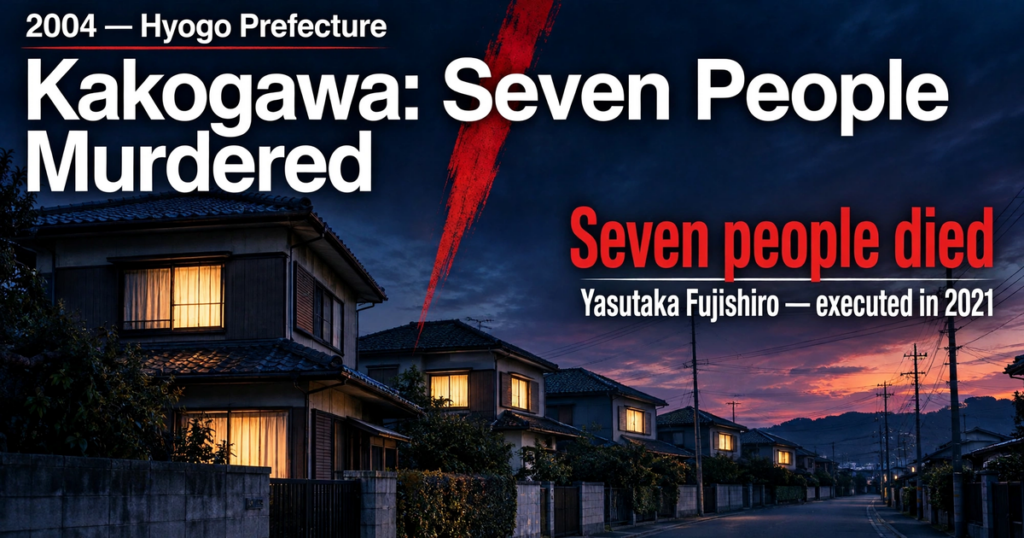
Seven people were killed in two neighbouring homes
In the early hours of 2 August 2004, Yasutaka Fujishiro, then 47, attacked two homes in Nishikichō, Kakogawa City, Hyogo Prefecture. Seven people were killed and one woman was seriously injured. The victims were relatives and neighbours living in two nearby houses. After the attacks, Fujishiro set fire to the home where his mother lived, using gasoline and kerosene. The building was completely destroyed. The offences included seven murders, one attempted murder and arson of an inhabited building. The central issue in the later trials was whether Fujishiro had been legally responsible for his actions.
The first attack was directed at relatives living next door
At about 3 a.m., Fujishiro entered the home of relatives next door. He struck a 46-year-old man with a hammer-like tool and stabbed him with a boning knife, killing him. He then attacked an 80-year-old woman. Fujishiro initially believed that she had died and left, but she survived and escaped outside. He pursued her and stabbed her again, causing her death. The judgment described this sequence as part of a wider plan to kill several people and set fire to his own home. The first household was occupied by people with whom Fujishiro had longstanding personal conflicts.
A second household and a neighbour who came to help were attacked
Fujishiro then went to another nearby house. He killed a 64-year-old man, the man's 64-year-old wife, their 27-year-old eldest son and their 26-year-old daughter. A 55-year-old man who heard of the trouble at the first home came to the scene and was also killed. The man's 50-year-old wife was stabbed in the chest, back and neck. She suffered serious injuries to her lungs and blood vessels but survived. The final toll was seven deaths and one seriously injured survivor. The attacks moved between two homes within a short period.
Fujishiro's car crashed and burned as he left the scene
After the attacks and the fire, Fujishiro drove away in a small passenger vehicle. The car collided with a bridge support on the Kakogawa Bypass, approximately 700 metres south of the scene, and caught fire. Police officers nearby secured his person. The response had initially involved reports of a residential fire, but the discovery of multiple injured and dead residents transformed the incident into a mass-murder investigation. The district court also considered that Fujishiro had attempted suicide after the offences. That circumstance did not outweigh the number of victims, the preparation for the attacks or the seriousness of the arson.
The arson was a separate and serious part of the offending
Fujishiro spread gasoline and kerosene on tatami mats, bedding and the floor of an attached building at the house where his mother lived, then ignited the materials with a lighter. The building burned down completely. The house was an inhabited structure, and the fire created a danger of spreading to nearby buildings. The courts treated the arson as an additional grave offence, not merely as an attempt to destroy evidence after the killings. The first-instance judgment described Fujishiro as embarrassed by the old appearance of the house and concerned that it might be shown in news coverage after the crimes.
Two psychiatric assessments offered different explanations
The defence argued that Fujishiro suffered from a delusional disorder and should be found insane or diminished in capacity. The district court considered differing psychiatric opinions. One assessment emphasized persecutory beliefs and diagnosed a delusional disorder. Another placed greater weight on personality characteristics, language difficulties and perceptions that were not wholly detached from actual interpersonal conflicts. The legal question was whether any disorder had substantially impaired his ability to understand the wrongfulness of his conduct or to control his actions at the time of the offences. Japanese criminal law distinguishes a medical diagnosis from the legal test for criminal responsibility.
The first-instance court found full responsibility and imposed death
The Kobe District Court sentenced Fujishiro to death on 29 May 2009. It found that he had full criminal responsibility. The court considered his choice of targets, preparation of weapons, movement between homes and the sequence of the attacks. It also considered the long-standing disputes with relatives and neighbours, his background and the absence of prior convictions. Those circumstances did not justify the killings. The source article's summary table contains a conflicting date for the first-instance judgment, but the article's narrative and the court-record chronology identify 29 May 2009 as the date of the death sentence. The translation uses the court-record date.
The High Court and Supreme Court maintained the death sentence
On 26 April 2013, the Osaka High Court dismissed Fujishiro's appeal. It considered psychiatric evidence that accepted the presence of a delusional disorder, but concluded that his ability to understand his actions and control his behaviour had not been substantially impaired to the level of diminished capacity. On 25 May 2015, the Supreme Court's Second Petty Bench dismissed his final appeal. The Supreme Court held that criminal responsibility could not be decided mechanically by accepting a psychiatric diagnosis; the court had to examine the defendant's conduct, motives, planning and behaviour before and after the crime. The application to correct the judgment was dismissed on 10 June 2015, after which the death sentence became final.
The death sentence was carried out in December 2021
Fujishiro was executed at Osaka Detention House on 21 December 2021, aged 65. He was one of three prisoners executed that day. The sequence should remain precise: the attacks and arson occurred on 2 August 2004; the Kobe District Court imposed death on 29 May 2009; the Osaka High Court dismissed the appeal on 26 April 2013; the Supreme Court dismissed the final appeal on 25 May 2015; the correction application was rejected on 10 June 2015; and the execution took place in December 2021.
The case also prompted continuing coordination among local agencies
After the incident, it became clear that residents had previously contacted the Kakogawa Police Station and the prefectural health and welfare office about conflicts and concerning behaviour involving Fujishiro. Following the murders, the health and welfare office, Kakogawa City and the police established a liaison arrangement to share information about cases in which mental-health support might be needed. Reports at the time of the 2021 execution indicated that this coordination continued, including regular meetings among relevant officials. This later administrative response is separate from the criminal trial and should not be used to imply that officials could have predicted the exact crimes.
Original Japanese record: 加古川7人殺害事件|責任能力をめぐる3審の判断と2021年の死刑執行
Last updated:
Related articles
Case record
The 2008 Akihabara Attack: Seven Deaths and the Supreme Court's Sentencing Decision
Case record
The Ikeda Elementary School Attack: Eight Children Killed, a Death Sentence and Lasting Changes to School Safety
Case record
The Fujisawa Murders of Five People, Including a Mother and Her Daughters

Case record