
The Kurume Nurses' Insurance Murders: Fabricated Threats, Two Deaths and a Ringleader
A scheme built around fictitious powerful figures drew former classmates into insurance fraud and two murders. Junko Yoshida was found to have devised and led the killings of two husbands and an attempted robbery-murder of an 82-year-old woman; her death sentence became final in 2010 and was carried out in 2016.
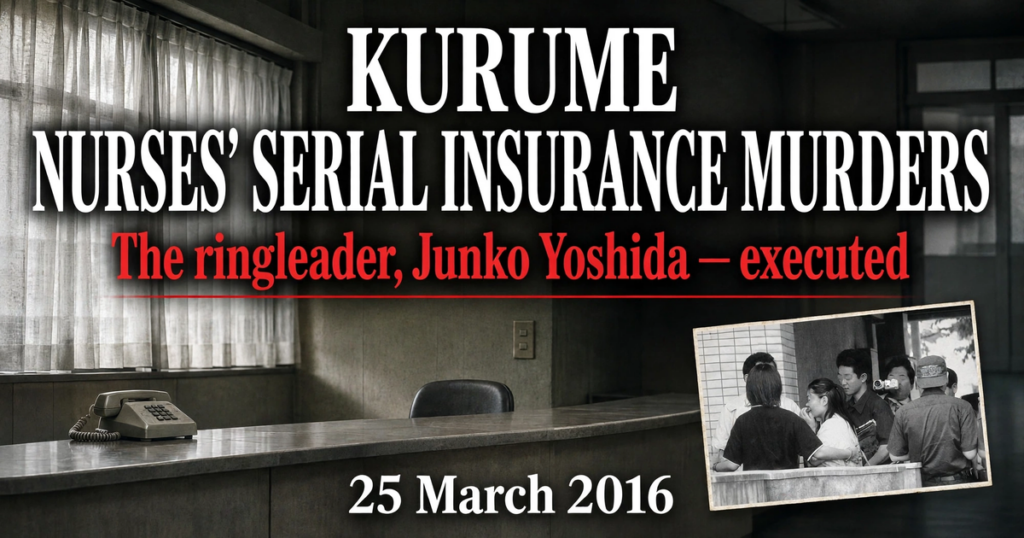
A confession by one participant exposed deaths that had been treated as natural
The Kurume Nurses' Insurance Murders came to light not because investigators initially suspected a homicide scene, but because one of the women involved went to the police. In August 2001, Hitomi Ishii reported the killing of her husband. His death, like that of another man, had originally been treated as a natural death. The report caused investigators to revisit two deaths that had led to substantial life-insurance payments. The case involved four women: Junko Yoshida, Miyuki Tsutsumi, Kazuko Ikegami and Hitomi Ishii. Their relationships were rooted in school friendships and nursing work. The prosecution and courts did not treat them as four interchangeable participants. Yoshida was ultimately identified as the planner and central instigator, while each co-defendant's role and procedural outcome differed.
Yoshida used invented figures to create fear and dependency
The first major part of the scheme was psychological and financial control. From at least the early 1990s, Yoshida told acquaintances about a powerful, supposedly real figure called “the Teacher” and people around him. She used fabricated letters, telephone calls and other devices to make the story appear credible. Different women were told about different fictitious people, including names such as Yukiko Yamashita, Ida, Sakamoto and Tamae Kobayashi. The invented figures supposedly demanded compensation, repayment or obedience. Yoshida presented herself as the trusted friend who could negotiate with them. The trial court found that the deception exploited the women's trust and vulnerabilities, generated large financial demands and helped create the emotional pressure under which the later crimes were planned.
The first husband died in January 1998 after a staged medical emergency
The first murder concerned Ikegami's husband, who was 39. A life-insurance policy of approximately 35 million yen was in place. The judgment described a plan to make his death appear to be a natural cardiac event. The first attempt began on the night of 21 January 1998 and continued into the following morning. The man became unconscious after being given drugs, and the participants attempted to cause death by medical means. He regained consciousness, and the attempt was interrupted. The plan was not abandoned. The group resumed the killing on the night of 23 January and into 24 January. His death was then treated as natural, and insurance money was paid. The court found that most of the proceeds went to Yoshida, who spent the money.
A second husband was killed in March 1999 and his death was also disguised
The second murder involved Ishii's husband, aged 44. Yoshida persuaded Ishii that fictitious people, including a person called Kobayashi Tamae, wanted him dead. The judgment found that Yoshida helped turn this false story into a murder plan and discussed how the death could be made to look like an illness. On 27 March 1999, the man was rendered unconscious. Alcohol was then administered through a medical tube. He died at hospital the following day. The court identified respiratory failure associated with aspiration pneumonia as the cause of death. The insurance claim was presented as a claim arising from illness, and approximately 32.57 million yen was paid. The two deaths were separated by more than a year, but shared the use of medical knowledge and post-death explanations to avoid suspicion.
An 82-year-old woman survived a separate robbery-murder attempt
The criminal case was not limited to the two completed murders. On 29 May 2000, an 82-year-old woman, who was the mother of one participant, was targeted because the group believed she had substantial savings. The plan was to obtain her bankbook and seal and to make her death appear natural. A woman entered the home pretending to be a visitor and administered insulin. The victim called for help and managed to escape outside. She received medical treatment and survived. The incident was prosecuted as trespass and attempted robbery-murder. It must not be counted as a third death. The court considered it alongside the two completed insurance murders when assessing Yoshida's planning, leadership and responsibility.
Ishii's departure and police report broke the scheme open
After her husband's death, Ishii continued to face demands from Yoshida. The judgment described payments exceeding 60 million yen, as well as domestic work and care duties imposed on her. When she was pressed to place her children in an institution, she left Yoshida's control around 1 August 2001. Yoshida feared that the murders would be exposed and attempted to deter her, including through a threatening letter prepared with another participant. Ishii nevertheless went to the police in August and disclosed the killing. That report caused investigators to examine the two deaths that had been treated as illnesses. The discovery demonstrates how the insurance claims, fabricated figures and apparent medical explanations had delayed the recognition of homicide.
The courts distinguished Yoshida's leadership from the responsibility of the other women
The Fukuoka District Court found that Yoshida had conceived and led the two murders and the attempted robbery-murder. It did not excuse the other women: each had crossed a serious criminal line and bore individual responsibility. But the court concluded that Yoshida's fabricated stories and pressure had created the motives, that she coordinated the plans and that she received most of the insurance proceeds. On 24 September 2004, the court sentenced Yoshida to death. The Fukuoka High Court upheld the sentence on 16 May 2006. On 18 March 2010, the Supreme Court's First Petty Bench rejected her final appeal, making the death sentence final. The other women's outcomes were different: Tsutsumi received life imprisonment, Ishii received 17 years, and Ikegami died in September 2004 before her first-instance judgment, so the prosecution against her was dismissed.
Yoshida's sentence was carried out in 2016
The trial court also considered Yoshida's conduct after arrest. It found that she continued to influence co-defendants through letters, attempting to shape statements and create distrust among them. Those actions were relevant to the court's assessment of remorse and the reliability of her expressions of regret. On 25 March 2016, approximately six years after the Supreme Court decision, Yoshida's death sentence was carried out at Fukuoka Detention House. She was 56. The legal history therefore consists of two completed insurance murders, one attempted robbery-murder of an elderly woman who survived, a death sentence upheld on appeal and made final by the Supreme Court, and execution in 2016. The different sentences and procedural outcomes of the other participants remain essential to an accurate account.
Original Japanese record: 久留米看護師連続保険金殺人事件|架空人物で共犯者を動かした吉田純子と死刑判決の理由
Last updated:
Related articles

Case record
The Fukuoka Serial Robbery Murders: Two Victims, a Handgun Network and a Final Death Sentence

Case record
The Maruyo Wireless Robbery-Murder-Arson: A Death Sentence Final Since 1970 and a Seventh Retrial Appeal

Case record
The Oita Insurance-Fraud Substitute-Body Murders
Case record