
The Omuta Four Murders: A Family's Robbery and Killing of Four Victims, and Four Death Sentences
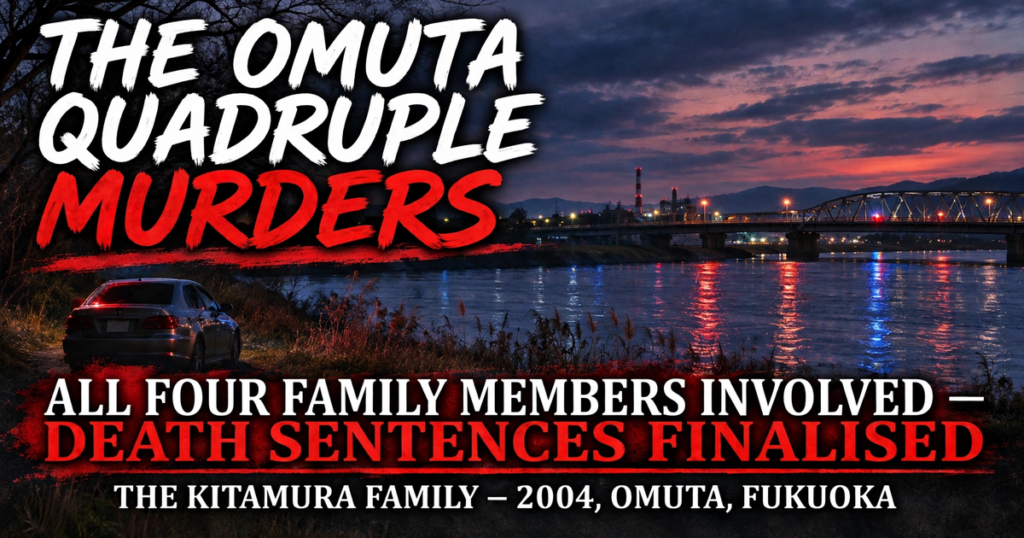
Four people were killed in Omuta, Fukuoka Prefecture, on September 16 and 18, 2004. Four members of the Kitamura family received final death sentences, although their roles in the two stages of the crimes differed.
Four people were killed in two stages in September 2004
The Omuta Four Murders took place in Omuta, Fukuoka Prefecture, on September 16 and 18, 2004. The victims were Sayoko Takami, aged fifty-eight; her younger son, Joji Takami, aged fifteen; her older son, Tatsuyuki Takami, aged eighteen; and Tatsuyuki's friend, Junichi Hara, aged seventeen. The four deaths did not occur in one single attack. Joji was killed first, in a robbery carried out by the two sons of the Kitamura family. Two days later, Sayoko, Tatsuyuki and Hara were killed in a separate series of acts involving all four members of the family. The Supreme Court's judgments carefully distinguished the roles played by each defendant.
The first killing was carried out by the two sons
The first victim was Joji, the fifteen-year-old younger son of Sayoko Takami. The Supreme Court found that the eldest son of the Kitamura family, Takashi Kitamura, and his younger brother, Takahiro Inoue, who then used the surname Kitamura, conspired to rob the Takami home. On September 16, they attacked Joji while he was alone at the residence, took a safe containing jewellery and other valuables and killed him. The property was valued at approximately 3.98 million yen. This first robbery and murder occurred before the parents' plan to kill Sayoko was carried out. The distinction matters because the father and mother were not found to have participated in Joji's killing.
Sayoko was killed two days later
On September 18, all four members of the Kitamura family acted together against Sayoko. The judgment found that she was given food containing sleeping medication and became drowsy. Takahiro strangled her, and approximately 260,000 yen was taken from her handbag. The family had been seeking money and valuables from her. The killing was not an isolated act by one son: the court found that the father, Jitsuo Kitamura, the mother, Mami Kitamura, and both sons were involved in the plan and its execution. Their individual contributions differed, but the court found that the four had acted together in the murder and robbery.
Her older son and his friend were then killed to conceal the earlier crimes
Tatsuyuki knew that his mother had been acting with Mami and could expose what had happened. The family therefore decided to kill him as well. Hara happened to be with Tatsuyuki and was also killed. The court found that Takahiro used a firearm to shoot the two young men. The three bodies were then placed in a vehicle, which was sunk in a river. Hara was not a member of the Takami family and had no role in the dispute over money. He was killed because he was present with Tatsuyuki and could identify what had happened. The later murders were therefore linked to the effort to conceal the first crimes and the killing of Sayoko.
The four defendants did not have identical roles
The phrase 'the entire family committed four murders' is too broad unless the individual roles are explained. Jitsuo was found to have participated in the murders of Sayoko, Tatsuyuki and Hara, but not in Joji's murder. Mami was involved in the September 18 crimes, but did not personally carry out the killings. Takashi was a central participant in Joji's robbery-murder and also helped plan and facilitate the later crimes. Takahiro was involved in all four deaths and carried out the strangulation of Sayoko and the shootings of Tatsuyuki and Hara. The Supreme Court assessed planning, instructions, preparation and assistance, not only who physically inflicted the fatal injuries.
The bodies were discovered and the investigation widened
Joji's body was found in the Suwa River on September 21, 2004. His mother, brother and Hara had also disappeared, and the search expanded. On September 23, the bodies of Sayoko, Tatsuyuki and Hara were recovered from a vehicle submerged in another part of the river system. The discoveries led police to investigate the Kitamura family for murder and body disposal. During the investigation, Jitsuo attempted suicide with a firearm at a police station on September 22. That incident also became part of the criminal proceedings because he possessed the firearm and ammunition. Takashi later escaped from custody on November 13, 2004; the escape was separately prosecuted.
The cases were tried in two groups and all four received death sentences
The four defendants were not tried together in one single proceeding. Mami and Takahiro, who admitted substantial parts of the charges, were tried in one case. Jitsuo and Takashi, who disputed important aspects of their involvement, were tried separately. The Fukuoka District Court's Kurume Branch sentenced Mami and Takahiro to death on October 17, 2006, and sentenced Jitsuo and Takashi to death on February 27, 2007. The Fukuoka High Court upheld the sentences. The Supreme Court dismissed the appeals of Mami and Takahiro on October 3, 2011, and those of Jitsuo and Takashi on October 17, 2011. All four death sentences became final.
Jitsuo died in custody, while three final death sentences remain
Jitsuo died on March 6, 2025, aged eighty-one, before his death sentence was carried out. Reports based on the Ministry of Justice announcement said he had been transferred for treatment after symptoms of aspiration pneumonia and died of pneumonia. His death did not change the final judgments against the other three defendants. Mami, Takashi and Takahiro remained under final death sentences in the latest located public information. Takahiro later used the surname Inoue after an adoption; older records may refer to him as Kitamura Takahiro. The legal record therefore consists of four final death sentences, one of which ended with the defendant's death in custody, and three that remain in force.
Original Japanese record: 大牟田4人殺害事件|兄弟の最初の強盗殺人から一家4人の死刑確定まで
Last updated:
Related articles
Case record
The Fukuoka Family of Four Murders: Three Defendants Tried in Japan and China, and the Evidence Behind Wei Wei's Death Sentence
Case record
The Konohana Pachinko Parlor Arson Murders

Case record
The Utsunomiya Jewelry Store Arson-Robbery Murders: Six Employees Bound and Killed for High-Value Stock
Case record