
The Maruyo Wireless Robbery-Murder-Arson: A Death Sentence Final Since 1970 and a Seventh Retrial Appeal
In the early hours of December 5, 1966, two employees on night duty at the Maruyo Wireless electrical shop in Fukuoka were attacked. Approximately 220,000 yen was stolen, one employee died and the other was seriously injured. The offenders were former employee Nobuo Oda and an accomplice who was a juvenile at the time. The final judgment found that Oda knocked over a kerosene stove to set the shop on fire. His death sentence became final on November 12, 1970. A seventh retrial request was rejected in March 2026, but Oda's lawyers immediately appealed; the original death sentence remains in force.
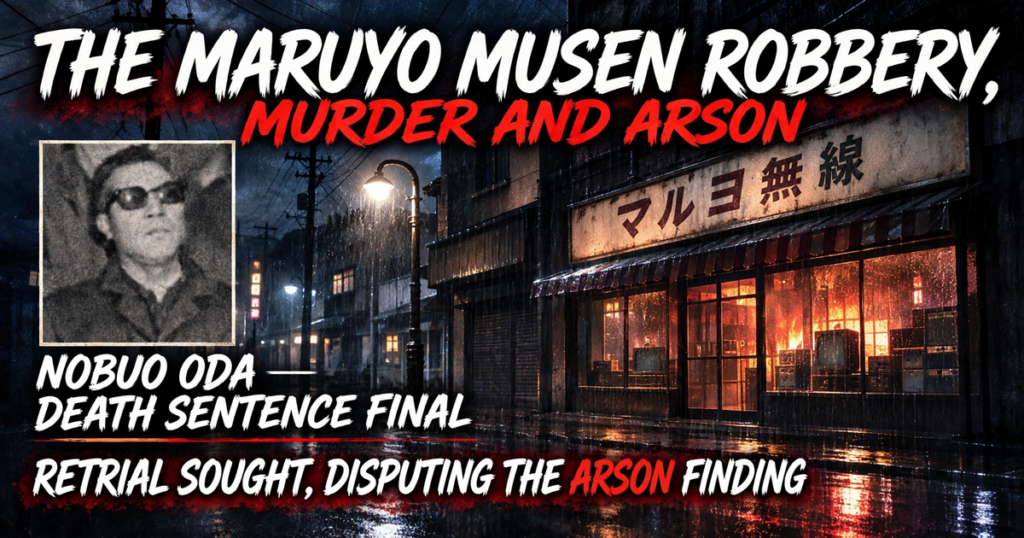
Two night-duty employees were attacked at a former workplace
In the early hours of December 5, 1966, two employees working overnight at the Maruyo Wireless electrical shop in Fukuoka City were attacked. One of the offenders was Nobuo Oda, who had previously worked at the store. The other was a co-defendant who was a juvenile at the time. The offenders took approximately 220,000 yen in cash. One employee died and the other suffered serious injuries. The case was prosecuted as robbery-murder, attempted robbery-murder and arson of an inhabited building.
The fire became central to the death sentence
The final judgment found that Oda and the juvenile accomplice entered the store and attacked the two employees, using a hammer. The court also found that Oda kicked over a kerosene stove and caused the fire in order to destroy evidence. The fire and the death of one employee were central to the legal assessment. Oda's role in the robbery was not the only issue: the intentional arson finding formed a significant part of the final judgment and later became the principal focus of his retrial requests.
The first-instance court imposed death in December 1968
On December 24, 1968, the Fukuoka District Court sentenced Oda to death. The juvenile co-defendant was prosecuted separately under the procedures applicable to a juvenile and later received a prison sentence. The Fukuoka High Court dismissed Oda's appeal on March 20, 1970. On November 12, 1970, the Supreme Court's First Petty Bench dismissed his final appeal. The Supreme Court case number was 1970 (A) No. 721, and the death sentence became final on that date.
Oda later withdrew his admission that he had deliberately set the fire
The issue Oda would challenge for decades was not simply whether he had participated in the robbery. During the investigation, he had made a statement that he knocked over the kerosene stove and caused the fire. During the appellate proceedings he withdrew that account and argued that the fire had not been intentionally started. The distinction is important: acknowledging participation in a robbery is not the same as admitting intentional arson. The retrial litigation focused on whether the final judgment's finding of deliberate fire-setting could still be sustained.
The retrial dispute centred on the kerosene stove and the origin of the fire
The final judgment's account was that Oda kicked over the stove, allowing kerosene to spill and ignite. Oda's lawyers challenged that mechanism. They submitted expert assessments and experimental material suggesting that abnormal combustion could cause a fire even if the stove had not been deliberately knocked over. The retrial issue was not simply whether a stove could burn or whether a fire occurred. It was whether the new material created a reasonable doubt about the finding that Oda intentionally set the fire to conceal the robbery.
Earlier retrial proceedings examined stove experiments and the total evidence
In earlier retrial proceedings, including the fifth retrial appeal, experiments using a stove of the same type were considered. A question about whether the stove could be knocked over in the way described by the final judgment did not automatically establish that the fire was accidental. The courts examined whether a possible weakness in one part of the explanation undermined the overall finding of intentional arson. This distinction continued into the seventh request: an alternative explanation for the fire had to be assessed against the whole body of evidence, not treated as a conclusive demonstration of innocence.
The seventh retrial request was filed in 2013
Oda's defence team filed the seventh retrial request in 2013. The request focused on the arson finding and presented new arguments about the stove and the possible cause of the fire. The original death sentence remained final while the request was examined. A retrial request does not itself cancel a conviction, and the death sentence does not become provisional merely because the defendant continues to challenge one part of the factual findings. The case therefore involved a final death sentence and a separate extraordinary procedure seeking permission to retry the case.
The Fukuoka District Court rejected the seventh request on 24 March 2026
On March 24, 2026, the Fukuoka District Court rejected the seventh retrial request. The court described the evidence underlying the final judgment as fundamentally sound and not shaken by the new material. It concluded that the defence's proposed explanation of the fire did not create the level of reasonable doubt required to begin a retrial. The decision did not amount to a new trial or a fresh conviction; it was a ruling that the requirements for reopening the case had not been met.
The defence filed an immediate appeal three days later
Oda's lawyers filed an immediate appeal to the Fukuoka High Court on March 27, 2026. The appeal meant that the seventh retrial request had been rejected at first instance but the review process was not over. It would therefore be inaccurate to say that the seventh retrial request had been finally rejected. The original death sentence, however, remained in force. The retrial appeal and the final criminal judgment are separate procedural matters.
The death sentence had not been carried out by the 2026 source update
Oda's death sentence had been final since November 12, 1970. The Japanese article's October 31, 2026 update recorded no execution and described the immediate appeal against the seventh retrial rejection as ongoing. Contemporary reporting in March 2026 described Oda as the longest-serving prisoner among those then held under final death sentences without execution. That length of detention does not itself mean a retrial has been granted. The correct status is a final death sentence, no execution recorded in the source update and a pending immediate appeal in the seventh retrial process.
Original Japanese record: マルヨ無線強盗殺人放火事件|死刑確定55年、放火認定を争う第7次再審と即時抗告
Last updated:
Related articles

Case record
The Oita Insurance-Fraud Substitute-Body Murders
Case record
The Kanagawa Two Robbery Murders: An Acquittal Reversed and a Death Sentence Later Upheld

Case record
The Fukuoka Serial Robbery Murders: Two Victims, a Handgun Network and a Final Death Sentence
Case record