
The Komatsugawa Case: Two Murders, Ri Chin-u's Death Sentence and the Debate That Continued After His Execution
The Komatsugawa case involved two murders in Tokyo in 1958. A 23-year-old woman was killed in April, and a 16-year-old female student was murdered at Tokyo Metropolitan Komatsugawa High School on August 17. Eighteen-year-old Ri Chin-u was arrested in September and confessed to both killings. The courts convicted him of two murders and imposed the death penalty, which was carried out on November 16, 1962, when he was 22. His prison letters and later publications prompted debate about his confession and the second murder, but those later criticisms must be distinguished from the final judicial findings.
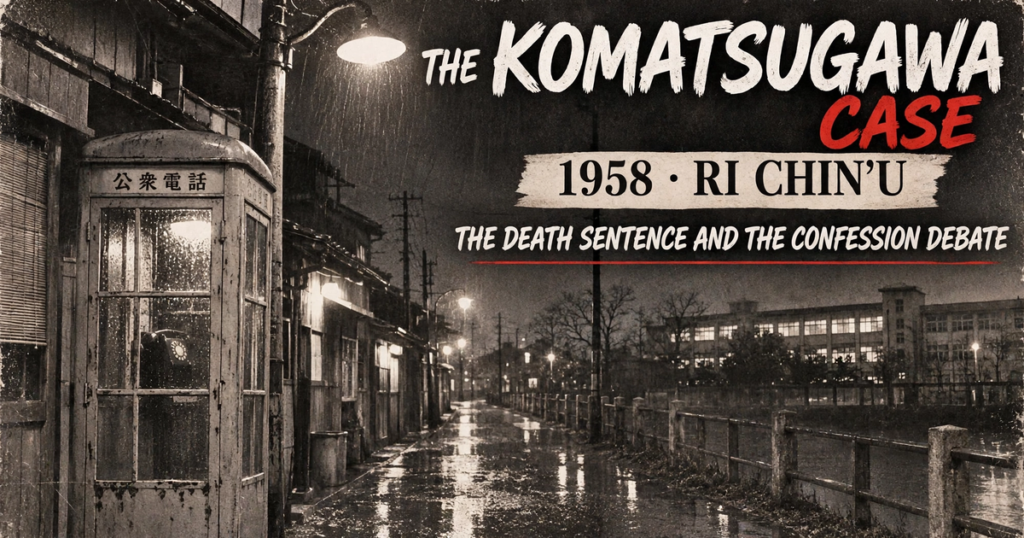
Two murders in 1958 became one criminal case
The Komatsugawa case refers to two murders in Tokyo in 1958. In April, a 23-year-old woman was killed. On August 17, a 16-year-old female student was murdered inside Tokyo Metropolitan Komatsugawa High School. The August killing brought an intensive investigation to the school and its surrounding area. The police later arrested Ri Chin-u, who was 18 at the time. During questioning, he confessed not only to the high-school student's murder but also to the earlier killing. Both incidents became part of the criminal proceedings against him.
The August murder took place inside a school
The second murder occurred at a public high school in Komatsugawa, in Tokyo's Edogawa Ward. The victim was a 16-year-old student. The fact that the crime took place within a school gave the case an immediate impact on students, parents and the surrounding community. Investigators worked to identify the offender and reconstruct how the victim had been attacked. The case should not be reduced to the later controversy about the defendant's statements: the first established fact in the archive is that a young student was killed inside her school in August 1958.
Ri Chin-u was arrested in September 1958
Police arrested Ri Chin-u in September 1958. He was 18 years old, so he fell within the juvenile-justice framework of the time, but he was not under the age threshold that automatically prohibited a death sentence. After his arrest, he admitted responsibility for the Komatsugawa High School murder and also made statements about the April killing of a 23-year-old woman. The second case therefore expanded the scope of the prosecution. The court was required to assess both murders rather than treating the August school killing as the only offence.
The two murder findings depended in part on Ri's statements
The prosecution relied on Ri's statements concerning the April murder as well as the evidence relating to the school killing. Later writers questioned how the statements were obtained and how far the confession about the April incident was supported by independent evidence. These later criticisms became part of the history of the case. They should be described as arguments and reassessments published after the trial, not as a new judicial ruling that overturned the conviction. The final criminal judgment found Ri guilty of two murders.
His age did not prevent the court from imposing a death sentence
Ri was 18 at the time of the offences. Under the juvenile law then in force, the prohibition on imposing the death penalty applied to offenders who were under 18 when they committed the crime. Ri was treated as a juvenile for some purposes, but he was above that age threshold. The distinction explains why the courts could select the death penalty despite his youth. It is important not to apply the current age and sentencing framework retroactively when explaining the legal position in 1958.
The Tokyo District Court imposed the death penalty in 1959
The first trial began in November 1958. On February 27, 1959, the Tokyo District Court sentenced Ri to death. The Tokyo High Court rejected his appeal on December 28, 1959. On August 17, 1961, the Supreme Court rejected the final appeal, and the death sentence became final. The sequence of judgments matters because the sentence was not simply imposed and carried out immediately after arrest. It passed through the ordinary appellate process before the execution took place.
Ri was executed on November 16, 1962, at the age of 22
Ri's death sentence was carried out on November 16, 1962, He was 22 years old. The execution ended the criminal proceedings against him. It also meant that later challenges to the factual basis of the conviction could not lead to a new trial for a living defendant. The case continued to be discussed through his prison writings and through books that examined the investigation, the confession and the social circumstances surrounding the trial.
His letters and later publications kept the case in public debate
Ri wrote many letters while in prison. Some were later published and attracted attention from writers, scholars and activists. His background as a Korean resident of Japan and the discrimination he described became part of the broader discussion. Several later books questioned aspects of the confession and the conviction for the April murder. Other works discussed the case in the context of juvenile justice, capital punishment and post-war social history. Those publications are relevant to the case's later history, but they are not equivalent to a court judgment setting aside the conviction.
The final judgment and the later debate must remain distinct
The established legal record is that Ri was convicted of two murders, his death sentence became final in 1961 and he was executed in 1962. The later debate concerns the reliability of his statements, the evidential basis for the April murder and the way society understood his background. A careful account can describe those criticisms without presenting them as proven facts or as a formal exoneration. The Komatsugawa case therefore has two histories: the criminal proceedings that ended with execution, and the continuing debate in books and scholarship about the investigation and the defendant's life.
Original Japanese record: 小松川事件|李珍宇の2件の殺人認定と死刑、後年も残った供述をめぐる議論
Last updated:
Related articles
Case record
The Ichikawa Family Murders: Four Victims and Capital Punishment for a Nineteen-Year-Old
Case record
The Murder of 18-Year-Old Manae Noguchi

Case record
The BOAC Flight Attendant Murder: The Unsolved Death of Tomoko Takekawa

Case record