
The Kawasaki First-Year Junior-High-School Student Murder: Ryota Uemura, Three Juvenile Defendants and the Failure to Connect Warning Signs
Thirteen-year-old Ryota Uemura was found dead on the Tama River riverbank in Kawasaki on 20 February 2015. Three older boys with whom he had social contact were arrested on 27 February. The principal defendant was charged with murder and injury; the other two were charged with injury resulting in death. They received different indeterminate sentences. The case also led to reviews of how schools and local agencies responded to Uemura's prolonged absence and reports of trouble.
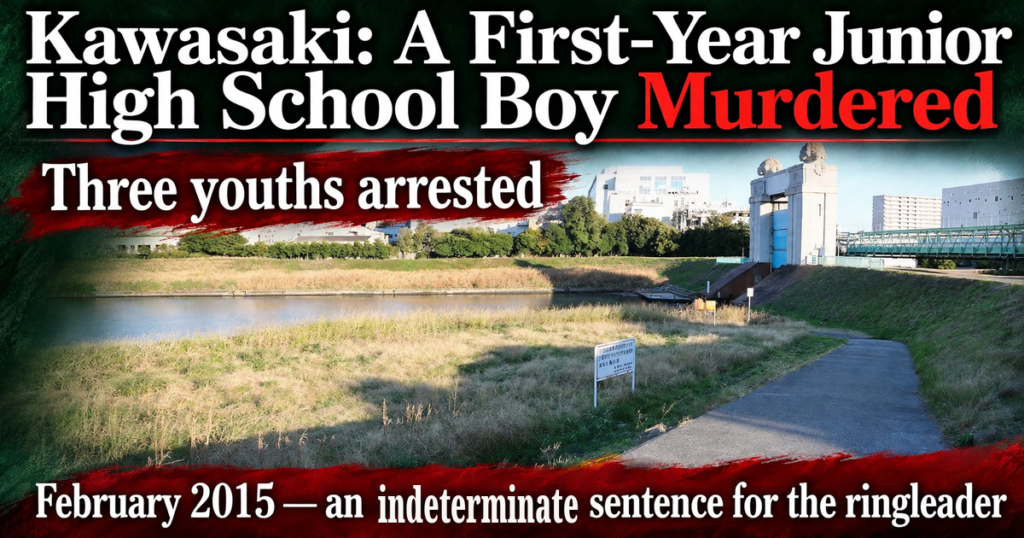
A 13-year-old boy was found on the Tama River bank
On 20 February 2015, the body of Ryota Uemura, a first-year junior-high-school student aged 13, was found on the riverbank of the Tama River in Kawasaki's Kawasaki Ward. The discovery led to an investigation into the boy's movements and the people with whom he had been spending time. Three older boys who had known Uemura were arrested on 27 February. The case drew national attention not only because of the victim's age and the violence involved, but also because questions arose about how his prolonged absence from school and the difficulties he faced in his relationships had been understood by adults around him.
The three juveniles were not charged with the same offence
The prosecution did not treat the three boys as a single group with identical responsibility. The youth described as the principal offender, who was 18 at the time, was charged with murder and injury. The other two were charged with injury resulting in death. That distinction reflects the charges prosecutors brought and the findings made in each proceeding. It is inaccurate to say that all three were convicted of murder. Their cases were heard separately, and the courts imposed different indeterminate sentences based on the conduct and responsibility attributed to each individual.
The principal defendant received an indeterminate sentence of nine to thirteen years
The principal defendant was convicted of murder and injury and received an indeterminate sentence of nine to thirteen years. In Japan, an indeterminate sentence for a juvenile offender is expressed as a minimum and maximum term. It is not the same as a fixed sentence of eleven years, nor does it mean that release automatically occurs at the midpoint. The sentence reflects the juvenile sentencing framework and the court's assessment of the offence and the offender. The exact legal outcome should be reported using the minimum and maximum terms rather than compressing the range into a single number.
The other two defendants received separate sentences
One of the other boys was sentenced by the Yokohama District Court on 14 March 2016 to an indeterminate term of four to six years and six months for injury resulting in death. The judgment was not appealed and became final. The third defendant contested his participation in the assault and claimed that he should be acquitted. On 3 June 2016, the Yokohama District Court found him guilty of injury resulting in death and imposed an indeterminate sentence of six to ten years. He appealed and pursued further review, but the conviction and sentence were ultimately maintained. These different paths are why the three cases should not be merged.
Uemura's school absence became a central institutional question
Before the killing, Uemura had been absent from school for an extended period. There had also been information about conflict in his peer relationships. After the incident, the public asked why the information did not lead to a direct safety check that could establish whether he was safe. The question is not whether school staff could have predicted every act of violence. It is whether the systems for responding to prolonged absence, signs of bullying or intimidation, and changes in a child's circumstances were adequate. The case made school attendance and safeguarding procedures a central part of the public discussion.
The education board and municipal review reports
The Kawasaki City Board of Education published its review on 18 May 2015. Separately, the city established an internal countermeasure meeting on 3 March and published its report on 25 August 2015. The reviews found that the school had shared some information and contacted the family, but it had not met Uemura directly for a prolonged period. They called for direct contact with the child to be prioritised and for staff to assess the background to the absence rather than treating each report in isolation. These administrative reviews were distinct from the criminal trials.
Why the three sentences must be kept separate
Juvenile proceedings are often described in broad terms, but the legal outcome in this case depended on each defendant's age, role and conduct. The principal defendant faced murder and injury charges and received a nine-to-thirteen-year indeterminate sentence. The other two faced injury-resulting-in-death charges and received ranges of four to six years and six months, and six to ten years. The courts did not issue one collective judgment for “three murderers.” The distinction matters both for legal accuracy and for avoiding an exaggerated account of the convictions.
The case's continuing significance
The killing of Uemura remains a case about both individual criminal responsibility and institutional safeguarding. The criminal proceedings resulted in different findings and sentences for three juveniles. Separately, the education and municipal reviews highlighted the need to connect information about absence, peer conflict and a child's safety. The record should avoid claiming that a particular administrative measure would certainly have prevented the death. What can be said is that the case exposed weaknesses in how warning information was shared and assessed. Remembering Uemura requires preserving his name and age, while also reporting the legal outcomes accurately and avoiding the assumption that all three defendants had the same role.
The response was redesigned around earlier intervention
The city later called for pupils showing a tendency toward prolonged absence to receive support before they reached the conventional 30-day absence benchmark. Education officials were to share absence information and check whether schools had taken appropriate steps. The measures also included team-based assessment rather than leaving the case to one teacher, greater use of school social workers, coordination with welfare services and clearer information-sharing arrangements with the police. The aim was not to predict a homicide mechanically, but to ensure that several warning signs led to a direct safety check.
Original Japanese record: 川崎中1男子殺害事件|上村遼太さんの欠席を学校はどう捉え、少年3人はどう裁かれたか
Last updated:
Related articles
Case record
The Sasebo High-School Girl Murder: Aiwa Matsuo, Prior Warnings and a Type 3 Juvenile Training School Disposition
Case record
The Kyotanabe Police Officer Murder: A 16-Year-Old Daughter and the Family Court's Decision Not to Transfer
Case record
The Zushi Stalker Murder: Rie Miyoshi, the Disclosure of Her Address and Gaps in the Law
Case record