
The Kanie Family Three-Person Attack
Two members of a family were killed and a third was attacked in their home in Kanie, Aichi Prefecture, in May 2009. The offender was identified more than three years later through a DNA comparison made after his arrest in an unrelated theft case. The Supreme Court upheld a death sentence after examining when an initial theft became robbery and why the attacks continued against three members of the household.
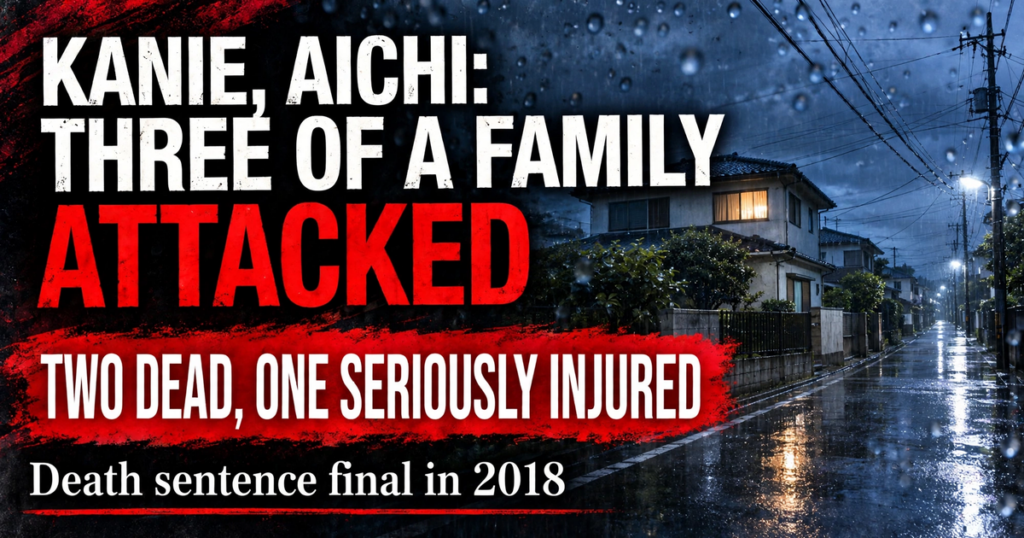
Two family members were killed in May 2009
Between 1 and 2 May 2009, a man entered a residence in Kanie, Aichi Prefecture. Yamada Kihoko, aged 57, and her second son, Masaki, aged 26, were killed. A third son, aged 25, was attacked after returning home but survived. The offender was not identified at the time, and the investigation continued for more than three years. The attacks occurred at different points during the offender's time inside the home, rather than as one uninterrupted encounter.
The intruder was not initially known to the family
The investigation did not begin with an obvious suspect from the victims' personal relationships. The offender had entered to steal property, rather than because of a known dispute with the family. Investigators preserved biological material and other evidence from the residence, but the material did not immediately provide a name. The case shows the difference between obtaining a forensic profile and having a person against whom it can be compared. The lack of a clear personal connection made ordinary inquiries into relatives, friends and acquaintances less productive.
The original purpose was theft, but robbery intent arose later
A central legal issue was when the offender formed the intention to take property by force. The Supreme Court accepted that he entered the residence intending to steal, not intending from the outset to kill the family. While searching the home, he was discovered by Kihoko and then formed an intention to take property by force. Under Japanese law, robbery-murder requires a connection between the taking purpose and the violence. The fact that property is taken after a killing does not by itself establish that the killing was committed as robbery.
A later theft arrest produced the DNA match
The breakthrough came in 2012, when police in Mie Prefecture arrested Lin Zhenhua (林振華) in connection with another theft. A DNA sample obtained in that investigation matched biological material preserved from the Kanie residence. The match connected Lin to the earlier crime, and Aichi police arrested him on suspicion of robbery-murder. DNA was a decisive investigative lead, but the trial still had to determine the purpose of entry, the sequence of attacks and the intent toward each person in the house.
The attacks continued after the first confrontation
After attacking Kihoko, Lin confronted Masaki and killed him. Several hours later, the third son returned and was attacked from behind. The Supreme Court emphasised that Lin had opportunities to stop between these encounters. Instead, he used weapons and continued the violence against another family member. The third son survived, but the court found that Lin had intended to kill him. The legal classification for that attack was attempted robbery-murder, not merely an assault causing injury.
The district court imposed a death sentence in 2015
On 20 February 2015, the Nagoya District Court sentenced Lin to death for two counts of robbery-murder and attempted robbery-murder, together with related offences. The judgment considered the two deaths, the attack on the surviving son, the financial purpose and the fact that violence continued across separate encounters. It also considered favourable circumstances, including that Lin had not entered intending to kill from the outset, his expressed apology and the absence of prior convictions. Those matters did not justify avoiding the death penalty.
The High Court and Supreme Court maintained the sentence
On 14 October 2015, the Nagoya High Court dismissed Lin's appeal. It examined the evidence concerning when the intention to rob arose and maintained the conclusion that the robbery purpose developed after Kihoko discovered him. On 6 September 2018, the Supreme Court's First Petty Bench dismissed the final appeal. Following the judgment-correction procedure, the death sentence became final. The district judgment, the high-court review and the Supreme Court decision are separate procedural stages.
The final outcome is not the same as the DNA breakthrough
The Supreme Court focused on the opportunities Lin had to stop between the attacks, the two deaths, the attempted murder of the surviving son and the financial motive. It also acknowledged that the original entry was for theft rather than a pre-planned killing. The legal outcome was based on the entire sequence of decisions after discovery. As of the Japanese article's August 2026 reference to the death-row list, no execution was recorded. The sentence became final in 2018; it should not be described as executed.
Original Japanese record: 愛知県蟹江町一家3人殺傷事件|3年半後のDNA型照合と林振華の死刑確定
Last updated:
Related articles
Case record
The Nagano Family Robbery-Murders
Case record
The Hekinan Pachinko-Manager Couple Murders: Preserved DNA Evidence and Three Different Outcomes

Case record
The Sendai Yakuza Executives Serial Murders: Two Deaths in One Month and One Death Sentence

Case record